



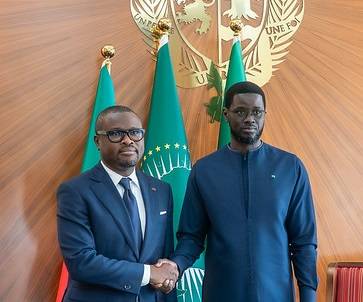
By Dr. Ananou Foly, Economist & Dr. Gloglo Beringer, Economist
The initial paradox
By the end of 2024, Senegal and Benin offer two radically different macroeconomic trajectories. Senegal reveals one of the largest debt concealments in the continent’s history: a real debt-to-GDP ratio of 99.7% compared to the reported 74.4%, an average budget deficit of 11% of GDP over 2019-2023 compared to the stated 4.9%, and approximately $7 billion of hidden debt according to the IMF. On the other hand, Benin shows a growth rate of 7.5%, a deficit reduced to 3% of GDP, an S&P rating of BB- with a positive outlook. The gap between the two signatures is five to six notches. Yet, in the balance sheets of banks in the region, their sovereign debts receive exactly the same prudential treatment: zero weighting.
This asymmetry fuels three lines of thought: what the Senegalese crisis reveals about the mechanisms of controlling public debt in Africa, what the Beninese model reveals about the nature of stability valued by the markets, and what the undifferentiated regulatory treatment of these two sovereign signatures implies for the regional banking system.
The cost of the rupture
For five years, the markets rewarded a fiction. The underestimated figures allowed Senegal to borrow under conditions that a real debt level of 99.7% of GDP would never have obtained – favorable interest rates, preserved IMF program, speculative-grade high rating. The punishment only came at the moment of revelation. What the agencies downgraded – from Ba3 to Caa1 (Moody’s), to CCC+ (S&P) – was not the act of transparency: it was the risk they should have measured from the beginning.
The signal is structurally perverse, especially as the resulting incentive problem is evident. The cost of revelation is immediate and certain; its benefits – restored credibility, future market access – are deferred and uncertain. For a successor government, knowing that an audit will trigger immediate downgrades creates a structural temptation: not to seek, or to manage discreetly. It was the political rupture of March 2024 – the arrival of an opposition to power that had built itself against the previous regime, with an explicit interest in documenting its faults – that made the revelation possible. The alternation is the condition; the rupture is the driving force. And it is this same dynamic that pays the price.
To this initial layer of risk is now added a second one. The political crisis opened in May 2026 – the dismissal of Prime Minister Sonko, unprecedented cohabitation with a National Assembly loyal to his former ally – shifts the problem: it is no longer just about the quality of the figures, but about the governability of the response, at the precise moment when the country is seeking to conclude an agreement with the IMF.
What the markets value
The Beninese case reveals the other side of the phenomenon. Under Patrice Talon, Benin has produced budgetary results that set it apart from comparable countries: fiscal discipline, respected IMF program, successful placement of a $500 million 16-year Eurobond in January 2025. This stability operates in a strong presidentialist regime and is accompanied by a demanding reconfiguration of the democratic political landscape. The presidential transition in April 2026, which brought Romuald Wadagni to power with 94% of the votes, illustrates the logic of continuity at work in Benin: an organized transmission of budgetary discipline, in an electoral framework whose competitiveness has been questioned by some observers. Benin assumes the transmission of discipline from one man to his successor without ever having to prove that it would survive a rupture of power. The markets obtain the continuity and predictability they valued – without the institutional fragility underlying them ever being integrated into prices.
Regional banking risk
The Senegalese crisis finally exposes a vulnerability specific to the region. Sovereign financing goes through the UMOA Securities common market: Senegalese paper is held by banks throughout the Union, including Ivorian and Pan-African banks. However, under the prudential framework of the BCEAO, any debt from a member state is weighted at zero, regardless of the issuer, regardless of the holding bank. No bank, in any country, has set aside capital against this exposure. If Senegal were to restructure its domestic debt, the losses would spread throughout the Union – just like in Ghana in 2022, where the DDEP put 13 out of 23 banks in capital deficit and cost the financial sector 2.6% of GDP.
Two architectural shortcomings
The contrast between the two countries reveals two blind spots in the financial architecture of the continent. On one hand, rating agencies struggle to distinguish stability based on strong institutions from that based on concentration of power: they penalize democratic turbulence without pricing the fragility of concentrated stability. On the other hand, the undifferentiated zero weighting of the UEMOA sovereign does not reflect either the Senegalese or Beninese risk in their specificity – and therefore cannot cushion a cross-border crisis. Europe has been debating this issue since 2015 without resolving it, but has safety nets that Africa does not. It is in this context that the question of an African sovereign rating infrastructure takes on its full meaning – not to replace S&P or Moody’s, but to offer a common framework allowing the continent’s regulators to calibrate prudential weightings differentially.
Predictability anchored to an individual does not have the same value as predictability anchored to an institutional system. This is precisely what neither ratings nor markets yet know how to price.

