



By Aboubakr Kaira Barry, CFA, Managing Director, Results Associates · Bethesda, Maryland, United States.
KEY POINTS
▸ In Nigeria, money is primarily created by commercial banks and, to a lesser extent, by the Central Bank of Nigeria.
▸ Between 2015 and 2024, the money supply grew at a rate of 20% per year while real GDP per capita declined by 0.6%, fueling inflation and eroding living standards.
▸ Reforms by the CBN are necessary, but price stability cannot be achieved without fiscal discipline, stronger public financial management, and stricter institutional safeguards.
▸ Sustainable reform requires constitutional budget rules, improved budget management, enhanced sub-national transparency, and prudent banking regulation.
Monetary creation follows the same fundamental logic in every modern economy, including Nigeria. It is facilitated by two types of institutions: commercial banks and the central bank. Commercial banks create the majority. When a bank grants a loan, it credits the borrower’s account with a deposit that did not previously exist. At that moment, a new loan on the asset side and a new deposit on the liability side appear simultaneously on the bank’s balance sheet.
The central bank acts as the banks’ banker. Each commercial bank holds a deposit account at the central bank, which appears as reserves on its balance sheet. Banks use these reserves to settle their interbank payments within the banking system. Crucially, banks do not need to have reserves in advance to make a loan.
For example, if a customer — let’s call him Shegun — borrows 100,000 nairas from Guaranty Trust Bank (GTBank), it records a loan of 100,000 nairas as an asset and credits Shegun’s deposit account with 100,000 nairas as a liability. If Shegun then writes a 50,000 naira check to Abdul-Lateef, who has an account at Access Bank, and this check is presented for payment, GTBank transfers 50,000 nairas from its reserve account to Access Bank’s reserve account at the central bank. If GTBank does not have sufficient reserves to honor this payment, it can borrow reserves from another bank, sell assets, or refinance with the central bank against collateral. In summary, banks create the loan first and then refinance it.
Suppose that before Shegun’s loan, the total deposits in the banking system were 2,000,000 nairas. The loan granted by GTBank increases the system’s deposits to 2,100,000 nairas.
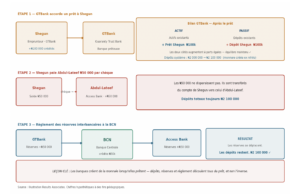
Not all lending activities work this way. If the loan to Shegun was granted by Coronation Merchant Bank Limited (CMB), which does not collect retail deposits, the mechanisms would be different. CMB would debit its own account by 100,000 nairas and transfer this amount in reserves to GTBank’s reserve account at the central bank; GTBank would then credit Shegun’s deposit account with 100,000 nairas. In this case, the total deposits in the banking system remain at 2,000,000 nairas. CMB intermediates existing deposits rather than creating new ones. The distinction is important: deposit-taking commercial banks expand the money supply, while non-deposit-taking institutions only recycle existing money.
The amount of money banks can create is not unlimited. It is constrained by two main factors. First, capital adequacy: the level of capital that the CBN requires banks to have so that, if loans deteriorate, shareholders rather than depositors absorb the losses. Second, banks are limited by their ability to find creditworthy and profitable borrowers.
The other creator of money is the central bank. It creates money through several mechanisms: purchasing foreign currencies, acquiring bonds or other assets from commercial banks, providing secured loans to banks, or directly financing public expenditures when authorized by law (see Figure 2). In each case, the central bank expands its balance sheet and credits a commercial bank’s reserve account, which in turn credits the final beneficiary’s deposit account.
If not managed carefully, monetary creation can significantly contribute to severe economic crises. This raises five questions: who created money in Nigeria between 2015 and 2024, what happened when this money was spent, what lessons can be learned, what is the CBN trying to achieve today, and what broader reforms are needed to achieve sustainable price stability.
Who created money between 2015 and 2024?
As shown in Figure 3, the Central Bank of Nigeria originated between 21 and 34% of the total purchasing power, while commercial banks created between 66 and 79%. Combined, the total money supply grew at a compounded annual rate of 20% over the period.
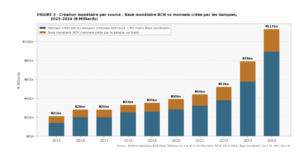
Source: CBN Statistical Bulletin 2024, Tables A1.2 and A2.5. Compound Annual Growth Rate (CAGR), 2015–2024: Monetary Base +21.3%; M3 +20.4%.
What happened when the money was spent?
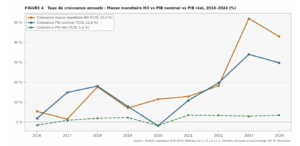
Nominal GDP — the total income generated in the economy before adjusting for inflation — grew at a compounded annual rate of 12.6%. Real GDP, which neutralizes the effect of price increases and reflects actual gains in goods and services produced, only grew by 1.6% per year.
Because the money supply expanded at a rate of 20% per year while the real economy was growing at only 1.6%, the excess purchasing power contributed to fueling inflation. Measured by the GDP deflator, the overall price level increased by 152% over the period. Real GDP per capita — the clearest indicator of living standards — declined by 0.6%, dropping from ₦383,000 in 2015 to ₦362,800 in 2024 (in constant 2010 nairas).
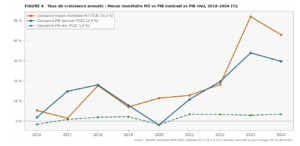
Source: CBN Statistical Bulletin 2024, Tables A1.2, C1.1 and C1.2.
In simple terms, more nairas circulated in the economy, but it did not produce enough additional goods and services to absorb this increase without a significant price hike.
What lessons can be learned ?
Nigeria’s experience demonstrates how excessive monetary creation, both by the central bank and commercial banks, can lead to damaging deterioration of economic conditions when purchasing power far exceeds the real supply of goods and services. The consequences are predictable: high inflation, currency depreciation, rising debt, economic contraction, and a weakening of living standards.
Two lessons emerge. First, monetary creation must be regulated to achieve and maintain price stability. Second, once created, money must be directed towards productive activities that enhance the economy’s capacity to produce sustainable growth.
In the absence of these conditions, the economy not only becomes more expensive. It loses its ability to generate sustainable growth. Curbing inflation therefore requires action on both the demand side — through monetary policy — and the supply side, through fiscal discipline and institutional reform.
What is the CBN trying to achieve today?
The CBN has launched several significant reforms: exchange rate unification, a formal commitment to cease monetizing public debt, and a marked increase in interest rates to contain inflation. Furthermore, it has committed to building the institutional capacity necessary to conduct inflation-targeting monetary policy and achieve price stability over time.
These measures are welcome, but they face a fundamental limit. Central banks can only influence demand. As former Federal Reserve Chairman Ben Bernanke observed, central bankers have a “lending power, not a spending power.” This requires action on three fronts that are beyond the direct control of the CBN.
Fiscal discipline and institutional safeguards. The first step towards price stability is controlling public spending. This requires institutional mechanisms that incentivize all levels of government to live within their means. If this condition is not met, the central bank faces three options, each of which compromises price stability: monetize the deficit through the Treasury’s advances account; lower interest rates to ease the burden of public debt; or compel banks to absorb government securities through financial repression.
Quality of public spending. The second requirement is to improve the quality of expenditure. Federal government personnel costs and interest payments exceeded federal revenues during the period 2021–2023, reflecting both poor expenditure composition and insufficient fiscal capacity.
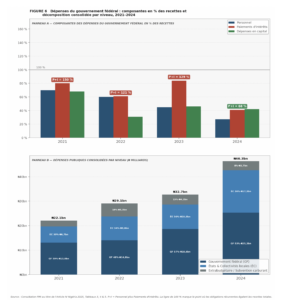
Source: Nigeria 2025 IMF Article IV Consultation, Tables 3, 4 and 5.
Sub-national accountability. A significant portion of expenditure, including off-budget spending, occurs at the state and local levels, where transparency and accountability are particularly weak. Strengthening oversight of these expenditures is essential for any credible budget reform.
What broader reforms are needed?
CBN reforms alone are not sufficient. Because the budgetary pressures overwhelming monetary policy, and expenditures on productive activities that enhance the economy’s capacity to produce sustainable growth, originate mainly in political rather than financial institutions, sustainable price stability requires a broader institutional architecture — one that constrains budgetary behaviors, strengthens public financial management, and ensures that monetary policy is not perpetually overwhelmed by political pressures.
Constitutional amendments. During the next legislative term, the administration should pursue constitutional amendments requiring that current expenditures over a presidential term be financed within available revenues, and borrowing be allowed only for capital investments whose expected returns clearly exceed their costs. These rules should also apply to states.
Public financial management infrastructure. The 2021 PEFA assessment of Nigeria reveals severe systemic deficiencies. D ratings, indicating below baseline level, are recorded in asset and liability management, accounting, auditing, and budget transparency. These issues are addressed in the article Nigeria’s reforms real, but without fixing the plumbing, money will keep leaking, published in The Nation. A dedicated unit for PFM reform should be established within the Presidency, with the Ministry of Finance as the secretariat and strategic oversight by the Presidency.
Independent fiscal responsibility office. Nigeria should establish an independent body equivalent to the UK’s Office for Budget Responsibility — composed of independent and technically competent Nigerians, with adequate resources to exercise rigorous external control of fiscal policy.
Using federal leverage to promote sub-national transparency. The federal government should consistently use its fiscal leverage. The law should require states to adopt international public sector accounting standards, publish certified financial and performance reports, and be subject to withholding of federal transfers for non-compliance. Transparency is not just a governance value. It is a precondition for effective economic management.
Banking regulation and capital account management. Commercial banks create the largest share of purchasing power in every modern economy. Therefore, robust prudential regulation is essential. Nigeria should also consider calibrated measures on the capital account to manage the destabilizing effects of short-term financial flows. The 2022–2023 Ghanaian crisis provides a recent regional example of the dangers of sudden capital reversals in the absence of adequate buffers.
Independent commission to identify self-financing projects. Drawing on the framework developed by renowned Japanese economist Richard Koo in his book The Pursued Economy, Nigeria should create independent commissions at the federal and state levels to depoliticize project selection and focus public investment on initiatives that reduce transaction costs and strengthen the economy’s supply side.
Conclusion
These recommendations form a mutually reinforcing institutional framework. Constitutional budgetary rules address the root of political indiscipline. A stronger PFM system makes public resources visible and directs them towards supply-side investment. An independent budget observer and an effective federal leverage extend transparency standards to the state level. Prudential banking regulation and calibrated capital account management protect the financial system from common sources of crises.
Independent commissions at the federal and state levels, inspired by the type of rigorous investment analysis advocated by Richard Koo, will be essential to improving the quality of capital investment and directing public resources towards projects that can truly grow the economy.
Nigeria possesses what few countries have simultaneously: a vast domestic market, a young and entrepreneurial population, and the human capital to make West Africa a significant source of global growth. Unlocking this potential requires more than a reformed central bank. It takes an institutional ecosystem where budgetary discipline is enshrined in law, public resources are managed transparently, and the financial system is robust enough to support sustainable low-inflation growth.
The current crisis is painful, but it also represents an opportunity not to be missed.

