



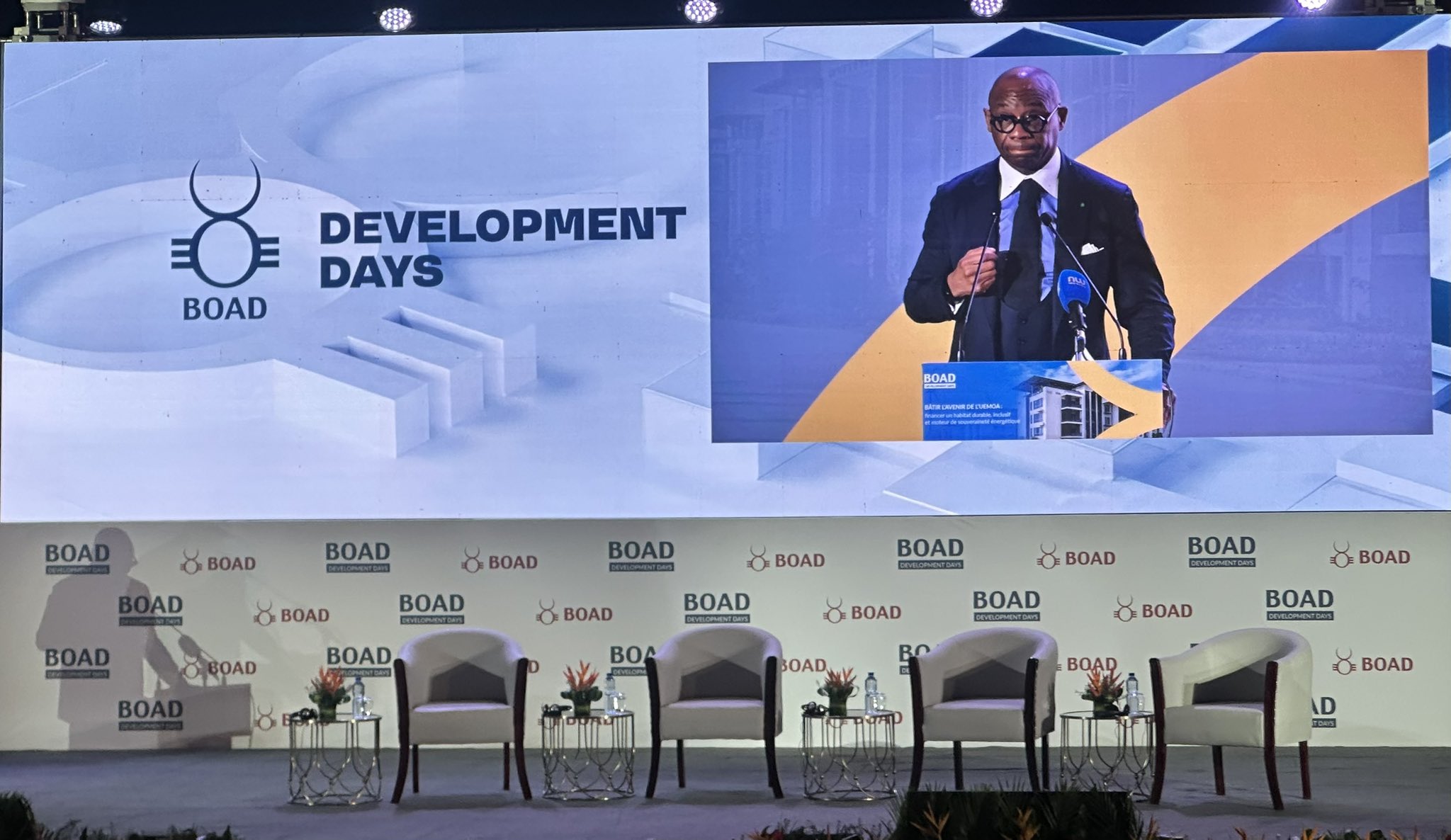
The 2nd edition of the BOAD Development Days, under the theme “Building the future of UEMOA: financing sustainable, inclusive housing that drives energy sovereignty,” opened on Thursday, June 11 in Lomé. At the podium, the President of the West African Development Bank (BOAD), Serge Ekué, the Togolese Minister Kodjo Adedze, and the Ivorian Minister Moussa Sanogo converged on a common urgency: to make housing a strategic lever for regional development.
“The bomb or the asset”
Opening the proceedings, Serge Ekué painted a striking picture: the West African Economic and Monetary Union (UEMOA) will surpass 300 million inhabitants by 2050, with more than half in urban areas. He described this demographic shift as both a “time bomb” and a “formidable asset.”
For Ekué, housing is no longer a social adjustment variable, but “a first-rate economic engine,” inseparable from the energy question. He highlighted ongoing achievements: over 100 billion CFA francs mobilized for the new city of Ouèdo in Benin, 160 billion invested in social housing in Côte d’Ivoire, and the financing of studies for a 20,000 housing program in Kpomé, Togo.
“Rethinking housing as a structuring infrastructure”
Kodjo Adedze, Togolese Minister of Territorial Planning, Urbanism, and Housing, praised an initiative that places housing at the heart of the common agenda. Noting that Togo’s urbanization rate increased from 37% in 2010 to 43% in 2022, he called for a paradigm shift: to consider housing as “a structuring infrastructure for development.”
Three convictions guided his speech: inclusion (tailored financial products, rent-to-own, consideration of irregular incomes), sustainability from conception (land, natural ventilation, local materials), and the strength of regional action. The former Speaker of the National Assembly of his country confirmed that the Kpomé-Dalavé project, whose studies are completed with the support of BOAD, is entering the implementation phase to meet a national demand estimated by the World Bank at 500,000 housing units.
The financial dimension of the challenge
Representing Ivorian Prime Minister Robert Beugré Mambé, Moussa Sanogo, Ivorian Minister of Urbanism, Housing, and Living Environment, presented the key figures of the challenge: Africa faces a deficit of 56 million housing units, including 13.5 million in UEMOA and 600,000 to 800,000 in Côte d’Ivoire. Closing this gap would require 9,000 to 15,000 billion CFA francs, compared to the Ivorian national budget of 17,300 billion. However, in 2024, real estate loans accounted for only 6.8% of the Union’s bank loans, compared to 27% in Morocco.
Praising BOAD’s financing of 4,300 housing units for 159 billion CFA francs, the Minister advocated for the development of regional guarantees, mortgage refinancing, industrialization of local materials, and alignment of technical training with market needs.
A shared conviction
These three interventions converge on a unanimous conviction, summarized by the adage cited by the Togolese and Ivorian ministers: “when construction goes well, everything goes well.” Providing dignified housing for West African populations, it is noted, creates non-relocatable jobs, structures local sectors, and builds the energy sovereignty of the Union; provided that tools are pooled, standards harmonized, and private capital mobilized massively alongside regional finance.

