



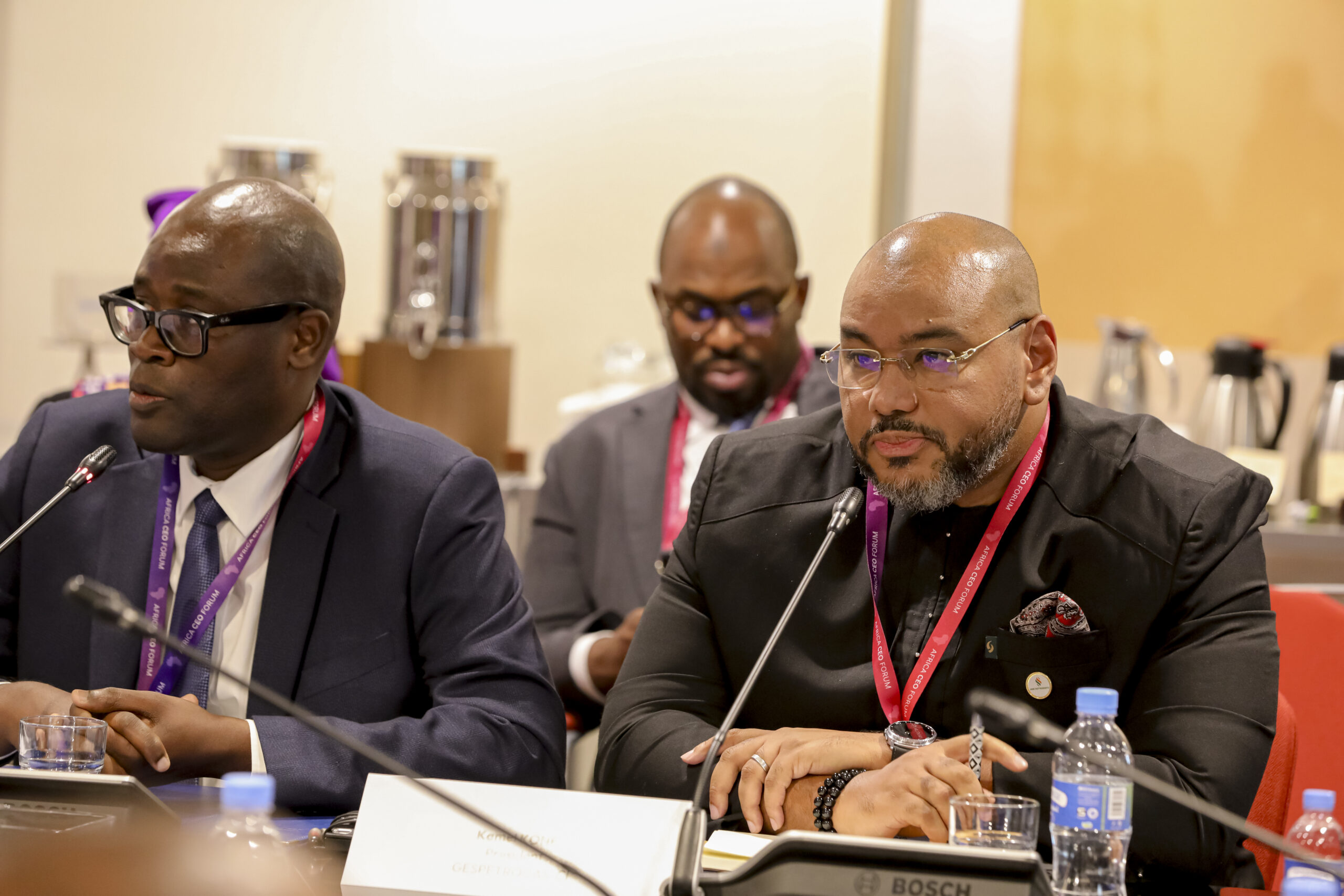
On the occasion of the 2026 edition of the Africa CEO Forum, Kamel Koné, Deputy General Manager of HYDRODRILL SA and President of GESPETROGAZ-CI, shares his analysis of the challenges and opportunities that come with the growth of the African oil sector. Local content, access to financing, skills development of national companies, and cooperation between continent actors: he advocates for greater integration of African companies to better capture the value generated by the continent’s energy resources.
Interview by Daniel DJAGOUE
In a context of revitalization of the oil sector in Côte d’Ivoire, how do you evaluate the positioning of local actors in the value chain today, and what do you see as the main areas for improvement?
It is important to remember that Côte d’Ivoire is currently attracting many investors thanks to significant oil discoveries made in recent years. The country also benefits from a relatively stable economic and political environment, favorable to business.
However, our oil industry is still under construction. Historically, the sector has been dominated by international actors, due to significant needs in capital, technology, and expertise.
Nevertheless, Côte d’Ivoire has taken the lead by adopting an early local content law. This regulation aims to allow Ivorian companies to benefit from the economic spin-offs generated by the exploitation of oil resources.
One of the most interesting aspects of this approach is that it was developed in consultation with private actors. Local companies were able to identify the activities they were capable of executing and thus contribute to the definition of different activity categories.
Today, some activities are exclusively reserved for national companies, while others still require partnerships with international companies. As Ivorian companies gain experience and skills, new activities can gradually be entrusted to them.
It is in this logic that GESPETROGAZ-CI was created, the Grouping of Oil and Gas Service Companies in Côte d’Ivoire, which acts as an interface between local companies and public authorities.
There is still considerable room for improvement, especially since Côte d’Ivoire had the advantage of anticipating these challenges even before the acceleration of major discoveries.
On a continental scale, the development of the oil industry in Africa remains heavily dependent on international actors. How can African countries better capture the value from their oil resources?
The oil sector is inherently very capital-intensive. However, one of the main challenges in Africa remains access to financing.
Some countries have succeeded in developing true national champions, such as Nigeria, Angola, or Algeria. We must draw inspiration from these experiences and promote greater cooperation between African countries.
When we talk about cooperation, it is not only about states. Private actors must also intensify their exchanges to share best practices, technologies, and business opportunities.
In this spirit, we have launched a pan-African platform to interconnect oil service companies on the continent. This initiative facilitates the sharing of information on tenders, innovations, and partnership opportunities.
We have been pleasantly surprised by the level of competence of many African actors we have met, from Mozambique to Algeria. There are already true African champions that need to be further valued.
Another major challenge concerns financing. We have high expectations for the future African Energy Bank, as well as the ability of African financial institutions to develop solutions tailored to the sector’s needs.
In a context where international financing is becoming scarce for hydrocarbon-related projects, African banks must innovate to support an industry that remains essential for the continent’s economic development.
As President of GESPETROGAZ-CI, what are the main obstacles faced by Ivorian companies in the oil sector?
The first challenge is undoubtedly access to capital.
It is not just about access to credit, but also about the cost of financing. African companies are often in competition with international groups that benefit from much more advantageous financing conditions.
When two companies buy the same equipment from the same suppliers, but one borrows at 15% and the other at 4%, the competitiveness gap is considerable from the start.
Local companies also face insufficient startup advances, particularly long payment delays, and tenders that are often too vast to be accessible to national SMEs.
In addition, there is the issue of human capital. Even though Côte d’Ivoire has many talents, the sector still suffers from a shortage of specialized skills. Training needs remain significant to support the industry’s rapid growth.
Finally, the structuring of companies is a crucial issue. GESPETROGAZ-CI supports its members in improving their governance, organization, and contractual practices.
We regularly observe that some companies lose value due to poor negotiation of their contracts. Strengthening managerial and legal capacities is therefore a key factor for competitiveness.
You are committed to local content issues in Côte d’Ivoire. What is your vision for the development of local content in Africa?
Our vision is based primarily on better cooperation among African private actors.
States are already in dialogue with each other, which is positive. But the private sector must also connect more to create concrete synergies.
It is in this perspective that we launched the Rising African Content initiative, which brings together entrepreneurs from several oil-producing countries. This platform allows African companies to share their experiences, business opportunities, and skills.
The goal is simple: when an operator is looking for expertise, their first instinct should be to check if that expertise already exists in Africa before turning to external sources.
We also advocate for the introduction of an “African preference” principle in local content legislation. In practice, when no national company is able to meet a specific need, priority should be given to an African company before considering using a provider outside the continent.
This approach would accelerate African economic integration and strengthen the capacity of continent companies to capture a larger share of the value created by the exploitation of their natural resources.

