



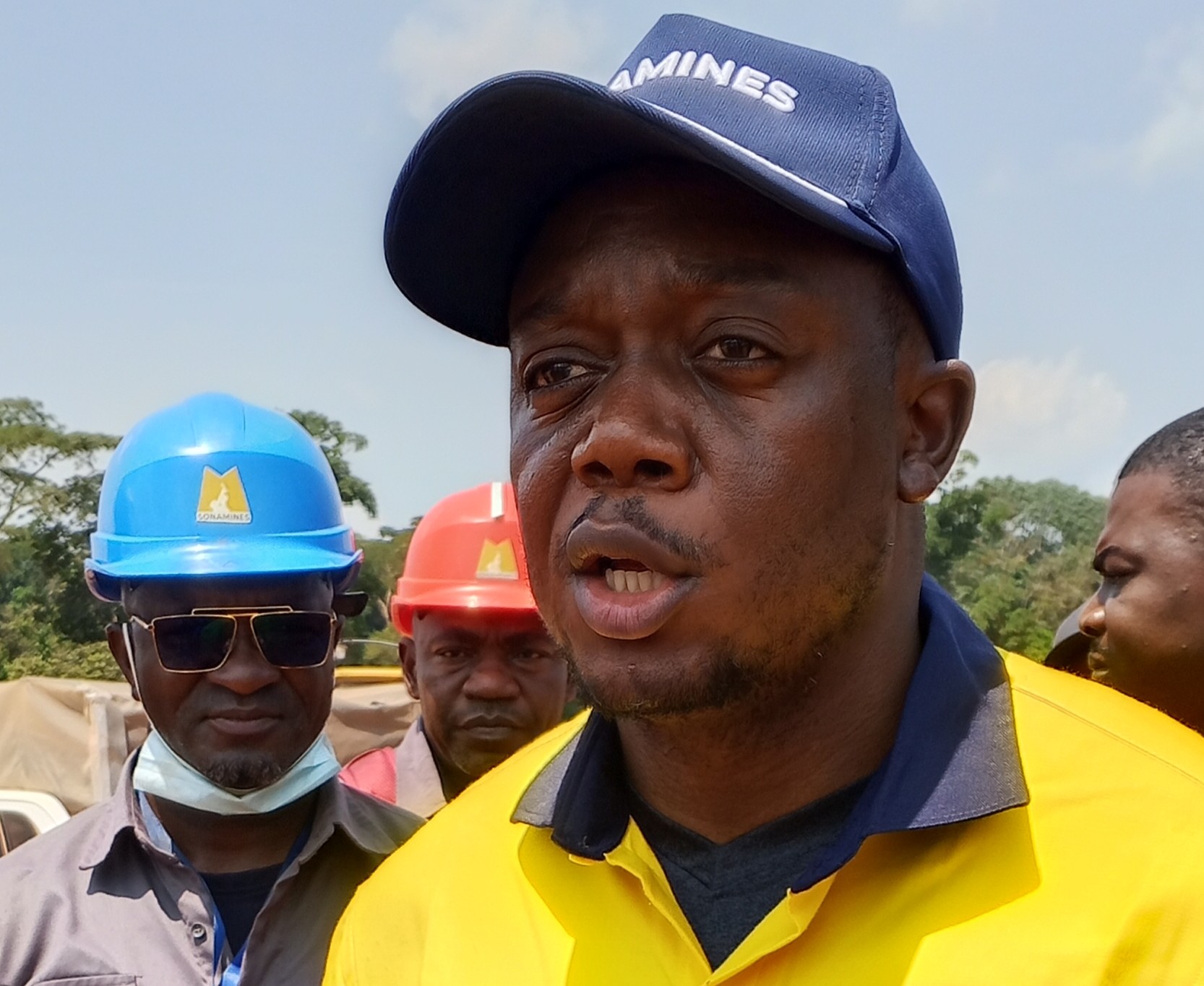
At the end of an inspection mission in the Adamaoua and East regions of Cameroon, the CEO of the National Mining Company (Sonamines), Serge Hervé Boyogueno, provides Financial Afrik with a no-holds-barred analysis of the real state of artisanal and semi-mechanized gold mining. Production thresholds not met, latent insolvency of several operators, environmental deficiencies, persistent opacity in gold marketing, and the ambition to establish a national strategic stock, the head of Sonamines details the financial, regulatory, and sovereign stakes of a mining reform now entering its implementation phase.
Interview by Bernard Bangda
Mr. CEO, today (June 1, 2026), you have just collected 175 grams of gold as the liberating synthetic mining tax for the month of May 2026, at the Garga Mining site. What analysis do you make of this production?
We must start by saying that we have come to implement the instructions of the Minister of Mines, who has set a production threshold based on the number of bowls used by semi-mechanized operators.
Indeed, as you mentioned, at the Garga Mining company site in Batouri, the production records we found on site show that the company is back in operation after a period of shutdown. It has resumed its activities since April 10, 2026. Since then, it has carried out five washes, with a production of 608 grams in May 2026, resulting in a liberating synthetic mining tax and an exit right of 175 grams for the State.
Upon analysis, we note that the operator did not reach the minimum production threshold set at 5 kilograms. By coming here, we expected to collect a liberating synthetic mining tax and an exit right of at least 1,473 grams. By only collecting 175 grams, we consider that Garga Mining still owes the State of Cameroon a little over 1,200 grams, which we will record as debt in the records.
At the end of June, we will ensure to collect these 1,473 grams, as well as the debt recorded to date. When leaving this site, we will report to the Minister of Mines on the state of the collection made today.
What will happen to companies that fail to reach the production threshold set by the Cameroonian government?
As I just said, we will report to the Minister of Mines so that a decision can be made at his level. You know, the role of Sonamines is to monitor production and collect the liberating synthetic mining tax and the exit right. If a company fails to reach the minimum threshold or to fulfill the commitment made to the Minister of Mines, we note this and report it so that measures can be taken.
What initial assessment do you make of this field visit?
In the field, among the mining companies we visited, none were able to reach the minimum threshold set by the Minister of Mines. Furthermore, as of today (June 2), we found two companies at a standstill. Here, we are at the Alpha Mining company site, which has been operating since 2019. It worked for part of May 2026. We have therefore come to implement the Minister of Mines’ instructions to collect the liberating synthetic mining tax (ISML) and the exit right (DS).
Everywhere we went, since the production threshold is set based on the number of bowls used by mining companies, they mention difficulties in reaching it to pay the ISML and DS. They ask us if they are required to pay even if they do not manage to work every day. At this stage, we have no answer to these concerns. What we tell them is that, unless instructed otherwise, even if they only work two days a month, they must organize themselves to produce the minimum of 5 kilograms instructed by the Minister of Mines. Regardless of the duration of their monthly activity, Sonamines will always come to collect 28.75% of their production, based on the number of bowls of each company.
These production capacities contrast with what is observed environmentally, where damages are visible. What do you tell them about this?
You are indeed making the right observation. The production capacities of the visited mining companies truly contrast with the damages you can observe in the environment. Just look at what you see behind me.
What we tell them is that, although they have obtained permits for semi-mechanized artisanal exploitation, they must provide us with the environmental impact study and the environmental compliance certificate, which are documents to be included in their authorization application file. Moreover, they must absolutely present us with the environmental management and rehabilitation plan since, for most of them, they have paid the 63 million CFA francs representing the environmental rehabilitation deposit.
But I can tell you that, since the beginning of our mission, no company has been able to present us with an environmental management and rehabilitation plan. None have presented us with an environmental impact study. None have presented us with an environmental compliance certificate. However, it must be emphasized that the damages they cause to the environment are immeasurable.
Regarding the environment, where is Sonamines in the implementation of rehabilitation projects, especially with Moonlight Mining Restoration (MMR) and the International Bamboo and Rattan Organization?
With MMR, discussions are ongoing with the Cameroonian government. In the framework of this project, we have identified a pilot site in the Bétaré-Oya area. The discussions focus on the possibility of obtaining property rights on this site. Once the conditions are met with the government side, since the funding is already available for this project, we will materialize it on the ground.
As for the second structure, the International Bamboo and Rattan Organization (INBAR), we have worked with the Ministry of External Relations on a memorandum of understanding (MoU) project which, thankfully, has now been validated by the presidency.
We are finalizing the signing modalities of this MoU with the Chinese side. We hope it will be signed in the coming days and that the project can be deployed.
It should be noted that this project with INBAR is based on two strategic axes. The first is to plant bamboo in all areas that have been exploited because bamboo has the particularity of absorbing harmful substances present in the soil. The second axis is to prepare for post-mining, as mining activity can stop at any time. Artisans should be retrained to use bamboo and rattan for a new activity.
For this, we will benefit from training and support from the Chinese side, which has a great deal of experience in the use of bamboo and rattan.
Let’s now talk about the gold marketing, especially the situation of purchasing offices. What is planned for their formalization?
For purchasing offices, it is important to clarify from the outset: the term “purchasing office,” established in the 2016 law to approve legal entities and individuals to conduct gold and diamond purchasing and marketing activities, no longer exists.
Under the 2023 law, the purchasing office no longer concerns gold or diamonds. It has been replaced by the “marketing counter.” We now talk about a “purchasing office” for the purchase of all other substances, except for gold and precious and semi-precious substances.
The issue that arises is that some people believe that Sonamines competes with buyers. They wrongly think that as a result, Sonamines refuses to issue approvals for marketing counters.
In this regard, we say that the legal framework that creates and organizes Sonamines designates it as a unique counter. According to the vision of the Head of State, Sonamines is the only entity authorized and empowered to buy and market gold and diamonds in Cameroon.
This is why, to this day, this entity can benefit from the assistance of subcontractors who are collectors. Thus, we have granted operating permits to over 34 collectors. We work with them, but we do not approve marketing counters for two reasons.
Firstly, we want to have a clear view of the current activity, as there are 105 purchasing offices under the old law. This means that 105 people are authorized to continue gold purchasing and marketing activities. However, we have no visibility on their activities.
For the year 2024, officially zero grams of gold were exported, compared to 8.2 tons of gold recorded in Dubai. We understand that the holders of these purchasing offices use these structures to launder gold purchased in Cameroon to Dubai. For the year 2025, it is no different: 3.8 kg of gold officially exported, compared to 12.2 tons recorded in Dubai.
This is why we have decided not to issue approvals for marketing counters. However, we invite all those who own gold to come and sell it to Sonamines so that it can allow the State to build its strategic gold stock. We are willing to buy all the gold stocks held by individuals, purchasing offices, collectors, artisans, or artisanal mining operators to enable the State to have this strategic stock, which is a fundamental tool to support our economy, support the State’s external borrowings, and perhaps reduce its external debt ratio.
So, once again, Sonamines will not issue approvals for marketing counters, but it is willing to buy all the gold held by individuals, purchasing offices, collectors, artisans, or artisanal mining operators. This is the mechanism adopted.

