



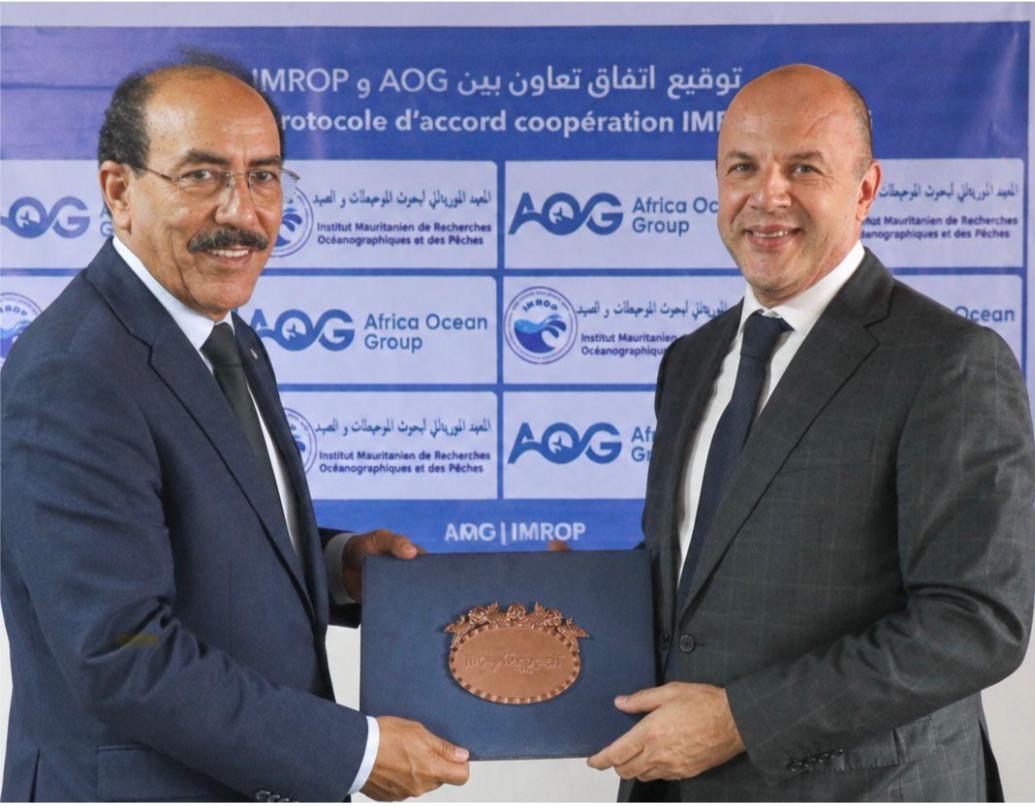
In Nouadhibou, on May 12, 2026, Africa Ocean Group (AOG) and the Mauritanian Institute of Oceanographic Research and Fisheries (IMROP) officially signed a five-year renewable strategic partnership aimed at strengthening cooperation between scientific research, the private sector, and marine resource governance in Mauritania.
This agreement aims to consolidate synergies between the two institutions in the face of growing challenges related to the sustainability of fishery resources, pressure on marine stocks, and the impacts of climate change on oceanic ecosystems.
For Aziz Boughourbal, president of Africa Ocean Group, this alliance reflects a strong belief: “sustainable management of fishery resources can only be built through close collaboration between science and industry.” According to him, this partnership will lay the foundation for a blue economy based on knowledge, transparency, and responsibility, serving Mauritania and the region.
On the other hand, Mohamed El Hafedh Ejiwen, Director General of IMROP, believes that this cooperation represents “a major opportunity to strengthen the link between scientific research and operational actors in the fisheries sector.” He emphasizes that it will help improve the quality of available data, strengthen stock assessments, and support sustainable marine resource management policies.
The agreement includes the provision of vessels and operational data, the development of applied research programs, the strengthening of scientific and technical capacities, training and skills transfer, as well as the promotion of sustainability, traceability, and resilience of fishery resources.
One of the key elements of the partnership is the establishment of a Center of Excellence and Studies for Octopus, aimed at positioning Mauritania as a regional hub for scientific research and fisheries governance.
This initiative is part of the OCTO-RES project, coordinated by the Spanish National Research Council (CSIC) and funded by the Spanish National Research Agency. The program studies the common octopus (Octopus vulgaris) in the northeastern Atlantic to better understand its genetic diversity, resilience, and health status, while analyzing the effects of overexploitation and climate change using genomics and population analysis tools. Deployed in several areas, including Mauritania, the project involves scientific and industrial partners, including Africa Ocean Group.
Through this cooperation, AOG and IMROP reaffirm their joint commitment to a sustainable blue economy based on science, environmental responsibility, and value creation for Mauritanian coastal communities.

