



Open Letter to Kristalina Georgieva, Managing Director, International Monetary Fund
By Aboubakr Kaira Barry, CFA, Managing Director, Results Associates, Bethesda, Maryland • May 8, 2026
“When I attempt to examine my own conduct… I divide, as it were, into two persons… The first is the spectator… The second is the agent, the person I properly call myself.”
Adam Smith, The Theory of Moral Sentiments, 1759
Dear Managing Director,
In 1759, Adam Smith articulated the idea of the impartial spectator – the disciplined act of stepping outside oneself to judge one’s own conduct honestly and without bias. More than two and a half centuries later, this wisdom remains entirely valid.
I write this letter in that spirit: not as an adversary, but as someone deeply convinced that the IMF possesses the knowledge, institutional weight, and mobilization capacity that – combined with the will and commitment of governments – can concretely improve living conditions across our continent.
I. What the Data Reveals: An Honest Assessment Needed
The IMF’s engagement in Africa is not marginal. Since the institution’s creation, 33 African countries have each participated in 10 or more programs. Eight of them have experienced 20 or more. Figure 1 shows each country above this threshold.
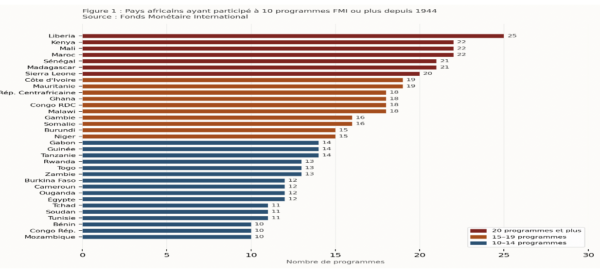
An impartial spectator, faced with this frequency of intervention, would naturally raise questions about their effectiveness. At the recent Spring Meetings, Abebe Aemro Selassie – then Director of the African Department – was asked about ways to break the cycle of recurring programs. He replied that it was up to governments and civil society. He is right – but the IMF has its own capacity to act in designing programs that succeed in light of on-the-ground realities.
II. Four Proposals for More Effective Results
The following four proposals aim to bridge the gap between the institution’s considerable capabilities and the results highlighted by the data.
Proposal 1: A Modern Framework for Debt Service Suspension in the Face of Unforeseen External Shocks
“If a man owes a debt and a storm destroys the grain, the crop fails, or the grain does not grow due to lack of water, then that year he is not obligated to provide grain to the creditor.” – Article 48, Code of Hammurabi, King of Babylon, c. 1750 BC
Hammurabi understood that a debtor cannot be held to the same terms when circumstances beyond his control have destroyed his ability to repay. During COVID-19, African governments demanded exactly that: a temporary suspension of debt service for crises they were not responsible for. The response was emergency loans and allocations of Special Drawing Rights (SDRs) – additional debt instruments. Countries with limited budgetary space were not relieved of their burden; they were given new instruments to manage it.
I propose that the IMF develop – and advocate within the G20 and the Paris Club – a rules-based framework for automatic debt service suspensions triggered by qualifying external shocks: pandemics meeting the World Health Organization’s (WHO) emergency criteria, commodity price collapses exceeding defined thresholds, or climate disasters above a measurable damage/GDP ratio. The criteria must be objective, agreed upon in advance, and independent of any case-by-case negotiation. Suspensions, not additional loans, should be the primary relief instrument when the storm is not the borrower’s doing.
Proposal 2: Moving from Debt/GDP Ratio to Debt Sustainability Assessment Based on Net Worth
The debt/GDP ratio indicates what a country owes relative to what it earns in a year. It says nothing about what the country owns. As Paul Sheard, former vice president of S&P Global, writes in The Power of Money, “it is a very misleading statistic… it divides a stock, measured in dollars, by a flow, measured in dollars per year.”
African governments hold significant sovereign assets that this ratio systematically ignores: mineral and hydrocarbon reserves, urban land, public real estate, infrastructure, and state-owned enterprises. Excluding them produces a distorted picture of net solvency and amplifies the perception of debt risk.
New Zealand understands this. It assesses debt sustainability based on net worth – the difference between its assets and liabilities. This same country gave the world central bank independence through the Reserve Bank of New Zealand Act 1989, a reform that the IMF later adopted as a global standard. The IMF should now lead a similar transition for debt sustainability assessment. It is simply a fairer measure.
However, this proposal depends on Proposal 3: a country cannot produce a credible sovereign balance sheet without first having a functional budget transparency infrastructure.
Proposal 3: Establishing Public Financial Management Infrastructure as a Non-Negotiable Program Condition
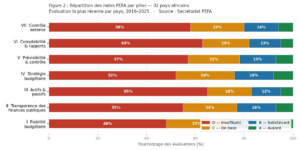
The root cause of recurring programs is the lack of basic budget visibility. The Public Expenditure and Financial Accountability (PEFA) framework – co-sponsored by the IMF – measures this visibility across seven pillars. The pattern observed for 32 African countries is shown in Figure 2.
Insufficient ratings dominate the chart. The poorest performances are concentrated in the most critical pillars: Assets and Liabilities, where governments cannot track or value their public investments; Accounting and Reporting, where financial data integrity cannot be certified; and External Audit, where audit institutions lack the necessary independence to conduct an impartial audit of government performance. Transparency and Execution Control are only marginally better. Budget Reliability – the most fundamental pillar – is the least deficient, but still fails for the majority.
Countries with the most extensive program histories – Liberia (25 programs), Madagascar, and Senegal (21 each) – continue to score Insufficient on most pillars. Programs have not built the systems their own conditionalities presuppose.
I propose that the IMF establish – for new programs only – a minimum standard of Basic level (C grade) on all seven PEFA pillars as a binding condition, supported by: migration to the Government Finance Statistics Manual (GFSM) 2014; deployment of an Integrated Financial Management System (IFMS) based on International Public Sector Accounting Standards (IPSAS); and a country-led PEFA improvement plan with specific milestones per pillar.
Countries would have seven years to reach this standard. No successive program would be approved until the goal is achieved – except in cases of globally significant emergencies, where a limited time waiver would apply. Progress would be published annually in the IMF’s flagship publications. The most successful countries would be publicly recognized by the Managing Director at her annual meeting with African finance ministers – a recognition that gives ministers political leverage to overcome institutional resistance to reform in their countries.
The Basic level is not an ambitious standard. It is the minimum below which public financial management cannot function – and the foundation on which the sovereign balance sheet required by Proposal 2 rests. The IMF has the necessary clout. What remains is the will to use it.
Proposal 4: Subjecting IMF Programs to the Accountability Standards It Demands from Borrowers
The conditionality of IMF programs is based on a founding principle: accountability and transparency are prerequisites for sustainable budget management. It is a principle that deserves to be applied to the institution itself.
For each IMF program, the Fund should publish – in clear language and in the borrower country’s main language – a results framework specifying: the imposed conditions and their justification; the concrete and measurable outcomes expected; and the baseline data against which progress will be evaluated. At the end of the program, an independent evaluation conducted by a firm unaffiliated with the IMF should assess performance, with simultaneous publication of results to the Board and the general public.
This is not a radical proposal. It is what the IMF demands from its borrowers. The effect would be constructive: it would create incentives for country teams to focus on results rather than procedural compliance, and establish the conditions for an honest dialogue between the Fund and the citizens it seeks to help.
Adam Smith’s impartial spectator does not demand perfection, but honesty. An institution willing to examine its own conduct through the lens of this spectator can only emerge stronger.

