



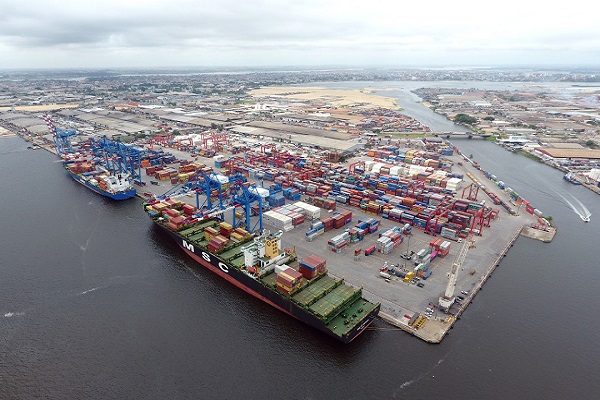
At the heart of the country’s commercial exchanges, the port of Abidjan is the subject of investments aimed at increasing its capacity and improving its competitiveness. This modernization is taking place in a context of growing flows and increased competition between port platforms in West Africa.
The port of Abidjan plays a central role in the Ivorian economy. It is the main transit point for the country’s imports and exports, while also serving a regional function by connecting landlocked states such as Mali, Burkina Faso, and Niger. This position gives it a structuring role in West African trade. However, it is facing a growing constraint: absorbing increasing volumes of goods in an environment where the demands for speed and efficiency are strengthening.
This dynamic is reflected in its recent activity. In 2025, the port of Abidjan handled approximately 46.6 million tons of goods, an increase of more than 16% in a year. In this context, the modernization of the port appears as an essential lever to support the growth of commercial flows.
Expanding capacities to meet the increase in traffic.
To address this evolution, several significant investments have been made. The most significant is the commissioning of the second container terminal, designed to increase the port’s handling capacity.
This terminal has a capacity of 1.5 million TEUs (twenty-foot equivalent units) per year, according to the Autonomous Port of Abidjan. It represents a scale change for port operations, with the aim of improving traffic flow and reducing processing times. In parallel, the strengthening of handling equipment contributes to this increase in capacity. The acquisition of new cranes aims to improve operational productivity.
Competitiveness to be consolidated in a competitive regional environment.
Beyond increasing capacities, these investments reflect a broader strategy. The challenge is to maintain the competitiveness of the port of Abidjan in an environment where several port platforms in the region have also strengthened their infrastructure in recent years. This is notably the case of the port of Tema in Ghana, which, in 2025, inaugurated phases 1 and 2 of its expansion, increasing its annual capacity to around 3 million TEUs. At the same time, the port of Lomé in Togo continues to grow in transshipment and now ranks among the main logistics hubs in the Gulf of Guinea.
In this context, logistical performance becomes crucial. The ability to quickly process goods, reduce waiting times, and offer reliable services is a key factor in attracting and retaining commercial flows.
A dynamic that attracts international players.
The modernization of the port of Abidjan is part of a resolutely progressive trajectory. Indeed, the projects underway illustrate a constant adaptation to the growing needs of trade in a competitive regional environment.
This increase in power also attracts the interest of major players in maritime transport. During his visit to Abidjan on April 23, the CEO of the CMA CGM group, Rodolphe Saadé, reiterated his ambition to invest in the city’s port infrastructure, while remaining open “to all kinds of developments in Ivory Coast.” This perspective reflects the growing attractiveness of the port, in a context where large companies seek to secure their logistical footholds on the continent.
However, the continuation of this dynamic will depend on the country’s ability to maintain a high level of performance and support the evolution of flows in the long term. Between investments, competition, and operational requirements, the port of Abidjan must further consolidate its position as a key player in exchanges in West Africa.

