



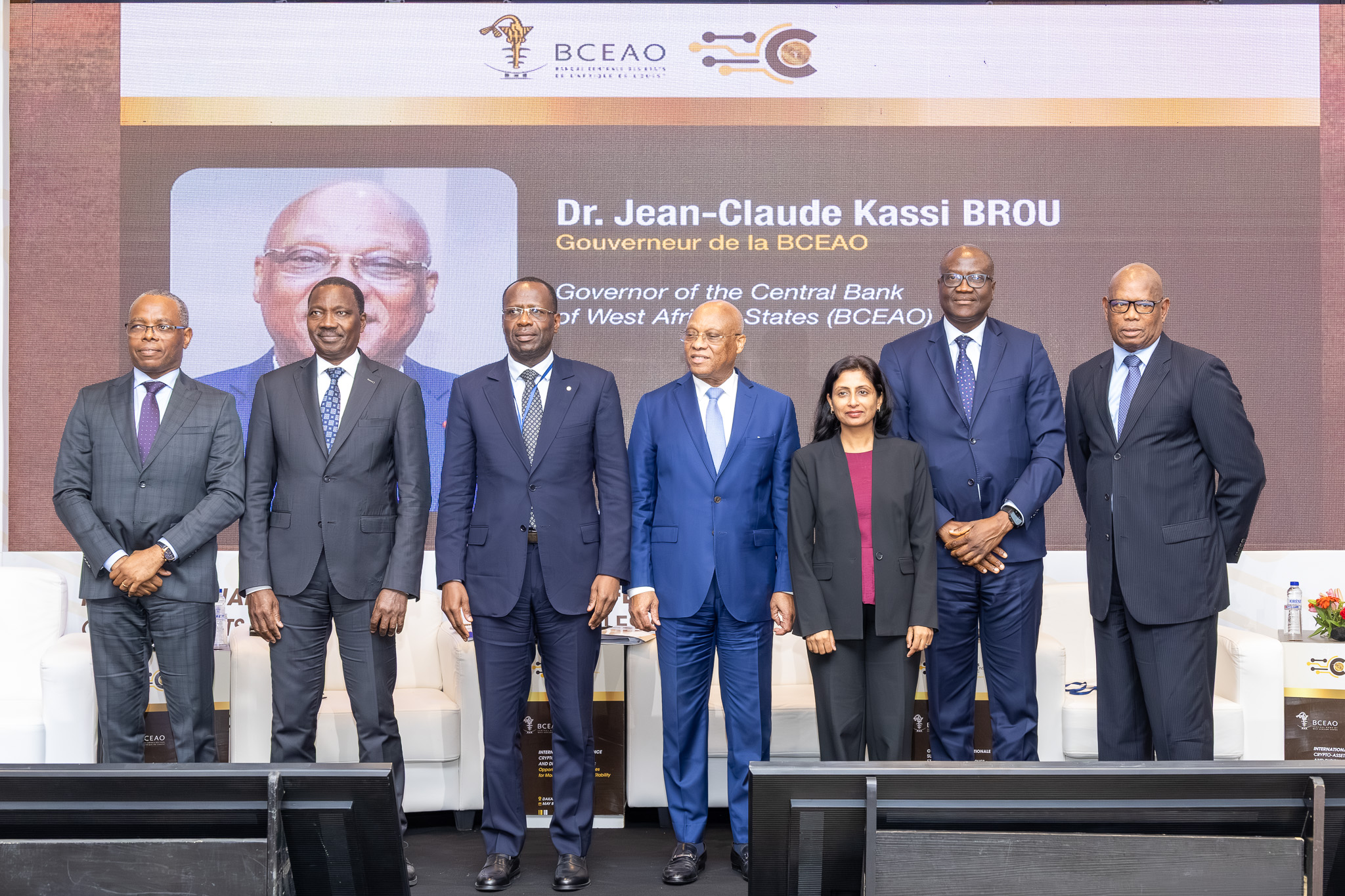
Gathered on May 8, 2026 in Dakar (Senegal), the leaders of several African central banks discussed the challenges posed by the rise of crypto-assets and digital innovations. At the heart of the discussions: regulatory framework, cybersecurity, modernization of payments, and the preservation of financial stability in economies still largely dominated by cash.
Organized under the auspices of the Central Bank of West African States (BCEAO), the International Conference on Crypto-assets and Digital Innovations brought together several central bank governors in Dakar to discuss the issues related to the rise of digital assets. The discussions focused on the regulation of these instruments, their potential effects on financial stability, and the responses to be provided in the face of technological diffusion faster than the adaptation of supervisory frameworks.
A surge in crypto-assets that challenges regulators
In his opening remarks, the governor of the Central Bank of São Tomé and Príncipe, Agostinho Quaresma dos Santos Afonso Fernandes, highlighted that the current absence of crypto-assets in his country could constitute a useful phase of observation and preparation. He added that this situation offers monetary authorities the opportunity to learn from foreign experiences before a possible surge in these instruments.
The governor of the Central Bank of Mozambique, Dr. Rogério Lucas Zandamela, emphasized the gap between the pace of growth of crypto-assets and the ability of African regulators to react. In an environment marked by the proliferation of cyber-attacks, he advocated for strengthening technical skills, partnerships, and international cooperation.
Between financial innovation and stability imperative
In Mauritius, the governor of the Central Bank, Priscilla Muthoora Thakoor, defended a pragmatic approach. In her intervention, she argued that crypto-assets are now part of the environment of open economies, which requires authorities to reconcile support for innovation and prudential vigilance.
This balance was present throughout the debates. For several speakers, the challenge is not only technological: it is also institutional. The dissemination of new financial tools can promote innovation, but it also increases requirements in terms of supervision, transparency, and user protection.
The governor of the Central Bank of Central African States (BEAC), Yvon Sana Bangui, reminded that trust remains the foundation of the financial system. He specified that innovations cannot replace the credibility of monetary and prudential institutions. He warned against possible abuses in the absence of clear rules, especially in the face of fraudulent schemes promising high returns.
Digital payments, financial inclusion, and monetary sovereignty
Beyond crypto-assets strictly speaking, the conference also highlighted the broader challenges of transforming payment systems in Africa. The governor of the Central Bank of Liberia, Henry F. Saamoi, presented the approach adopted by his country to interconnect mobile money, banks, and fintechs within a national switch.
This modernization aims at several economic objectives: improving financial inclusion, streamlining transactions, reducing costs associated with cash usage, and strengthening the effectiveness of monetary policy. According to Liberian authorities, it is accompanied by increased efforts in combating cybercrime, consumer protection, and financial education.
Sovereignty
A common concern dominated the discussions: that of monetary sovereignty. For the central banks present, the adoption of new digital instruments cannot come at the expense of control over financial flows, transaction security, and the ability of authorities to conduct their monetary policy.
In conclusion, the governor of the BCEAO, Jean-Claude Kassi Brou, emphasized that some countries still have a window to anticipate rather than react. He called for an approach based on the analysis of experiences observed elsewhere, as well as on enhanced cooperation between central banks, national authorities, security services, and data protection institutions.
While the Dakar meeting did not result in immediate normative announcements, it had the merit of highlighting a convergence: faced with the rise of crypto-assets, African central banks want to move forward cautiously, seeking to preserve both innovation, financial stability, and monetary sovereignty.

