



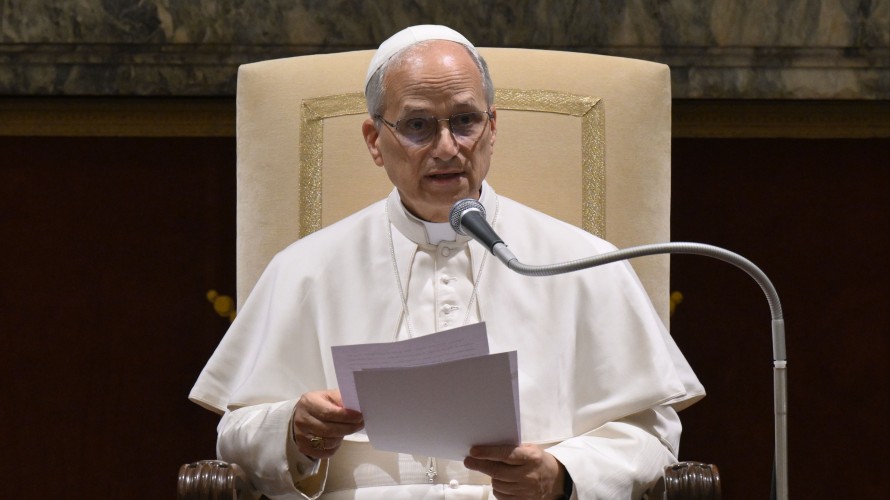
“It’s really ‘putting your foot in it’.” On April 15, 2026, a few hours after his arrival in Cameroon for a four-day visit, Pope Leon XIV called on Cameroonian authorities to “dare to examine their conscience”. But above all, the sovereign pontiff invites them to “break the chains of corruption”. The successor of the Apostle Peter, on whom Christ had founded his church, expressed himself at the Unity Palace (the name of the presidential palace in Cameroon) in front of the head of state, Paul Biya, who had just welcomed him in a speech and the accredited diplomatic corps in Yaoundé.
To justify his call for governance beneficial to the Cameroonian people, Leon XIV indicated that “transparency in the management of public resources and respect for the rule of law are essential to restore trust”. In his first speech delivered in French in Cameroon, the head of state of the Vatican emphasized that “it is time to dare to examine one’s conscience and take a courageous qualitative leap”.
The Pope’s speech comes at a time when, according to the National Anti-Corruption Commission (CONAC), one of the bodies responsible for fighting this scourge in Cameroon, “corruption [in Cameroon] generates colossal financial losses, exceeding 114 billion CFA francs (about 205 million USD) in 2023 and more than 4 billion (about 7.2 million USD) in 2024”. For one of the main actors in the fight against corruption in Cameroon (in addition to the ministry responsible for the Superior State Control (Consupe), directly under the presidency of the Republic, the Chamber of Accounts, the Special Criminal Court (TCS)), “corruption hinders economic growth, increases the cost of infrastructure, paralyzes the performance of public services and deepens social inequalities”. The figures declared by CONAC indicate the extent of the challenges in the fight against corruption despite the numerous institutions in charge. Just as imprisonments related to the phenomenon do not deter the presumed authors of these distortions from public financial orthodoxy.
As a reminder, as part of the cleaning up of public management, an operation called “Sparrowhawk” was launched by the Cameroonian justice system in 2006. In the talons of the bird of prey, there are two former secretaries general at the presidency of the Republic, Marafa Hamidou Yaya and Jean-Marie Atangana Mebara, a former Prime Minister, Inoni Ephraïm, and several ministers and directors general of public enterprises. A level of arrests and incarcerations which, according to Pope Leon XIV, has not been sufficient to reverse the phenomenon.
The intervention of the Sovereign Pontiff also echoes those, regular, of international financial institutions such as the World Bank, the International Monetary Fund (IMF) and, to a lesser extent, the African Development Bank (AfDB). Almost all of them have always conditioned their financial interventions on the improvement of public governance in Cameroon.
This country is the second stage of Pope Leon XIV’s African tour. On the agenda of this stage, a mass in Bamenda, the capital of the Northwest, one of the two English-speaking regions, along with the Southwest, which are demanding secession from Yaoundé. The message of peace that he will deliver there is also expected in Douala, the country’s economic capital, also considered a rebellious city opposed to the regime of Paul Biya.

