



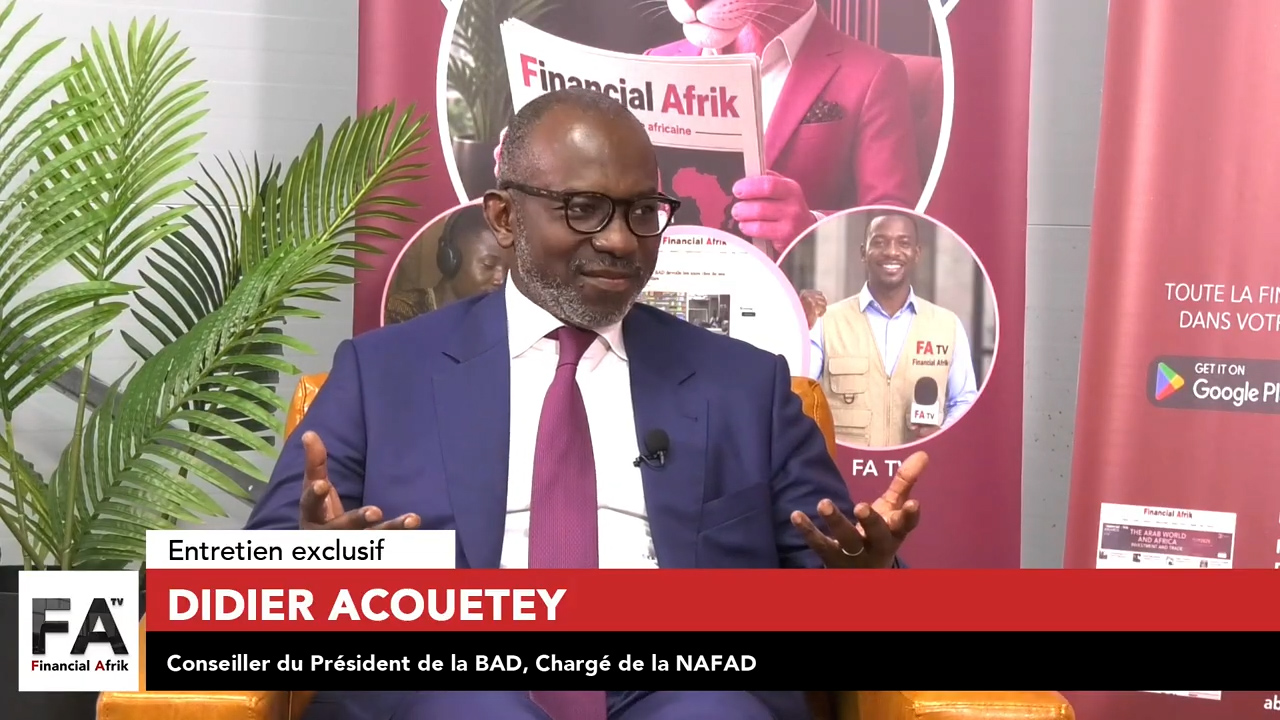
In a context marked by a chronic deficit in development financing in Africa, the New African Financial Architecture for Development (NAFAD) aims to deeply transform the continent’s financial ecosystem. Didier Acouetey, senior advisor to the president of the African Development Bank (AfDB), in charge of the private sector and NAFAD, spoke on May 28 with Financial Afrik on the sidelines of the AfDB Annual Meetings. He discusses the ambitions of this initiative, the challenges of SME financing, and the mobilization of African resources for development.
What makes NAFAD a turning point for the continent?
NAFAD is a unique initiative because, for the first time, Africa is undertaking to rethink its own financial architecture in order to mobilize its domestic resources on a massive scale. The continent needs around $400 billion annually to finance its development projects. However, at the same time, Africa has nearly $4 trillion in resources in various forms: long-term savings, central bank reserves, insurance company funds, deposit funds, and pension funds. The real problem lies in the fragmentation of the African financial system. Today, development banks, commercial banks, insurers, pension funds, and central banks still operate in silos, without real coordination. Transactions exist, but they are not part of an organized and complementary mechanism. The goal of NAFAD is precisely to create this complementarity and subsidiarity among actors. What local institutions do best, they will continue to do with more resources. The AfDB, as a continental institution, will play a role in strategic coordination and resource mobilization.
This architecture is based on three levels: continental, regional, and national. At the continental level, the AfDB acts as a conductor. At the regional level, regional development banks and pan-African banking groups take over. Finally, at the national level, local banks, guarantee funds, and local institutions ensure the financing of SMEs and local projects with a fine knowledge of the field.
It is a new, structured, and coordinated approach that comes at a crucial time for Africa. External financing is dwindling, while the continent has significant internal resources. The challenge now is to successfully carry out this transformation to accelerate Africa’s economic development.
SME financing remains one of the weak links in the African economy. How can this new financial architecture concretely improve their access to financing?
SMEs are at the heart of the continent’s development. They represent nearly 95% of the African economic fabric and generate about 60% of jobs. Yet, they still struggle to access financing. The financing needs of African SMEs exceed $300 billion, while barely 20% of these needs are covered by the traditional financial system. The AfDB therefore considers this issue a strategic priority. NAFAD aims to address it through several levers.
The first involves technical assistance and capacity building. Many SMEs still lack the governance, organization, or management tools necessary to reassure banks. The AfDB aims to mobilize significant resources to support these companies in their structuring and upgrading.
The second lever focuses on access to bank financing. A better-organized SME, with a clear strategy and strong financial statements, becomes more credible to banks and investors. The third pillar concerns equity. Many African companies lack capital to support their growth. The AfDB plans to mobilize resources that will be directed towards banks, investment funds, and financial intermediaries to strengthen SME financing capacities.
Finally, the issue of guarantees is essential. Institutions like ATIDI, AGF, FAGACE, or the African Solidarity Fund already play an important role in reducing risks associated with investments in Africa. The AfDB intends to strengthen these instruments to further facilitate SME access to credit. The goal is clear: to bring forth more African champions capable of driving growth and creating jobs massively on the continent.
The mobilization of African savings is at the heart of the debates. What instruments should be favored to further direct these resources towards productive investments?
Each year, the African diaspora transfers between $70 and $100 billion to the continent. However, these resources are still insufficiently directed towards productive investments. To mobilize this savings, appropriate instruments must be put in place. Specialized investment funds, diaspora bonds, funds dedicated to infrastructure, energy, digital, or artificial intelligence are concrete solutions. Energy, for example, is a transversal issue today. Without energy, there is no industrialization, no economic transformation, no infrastructure development. The needs are immense, and so are the investment opportunities.
Once the right instruments are in place, African resources can be more directed towards structuring projects capable of transforming the continent sustainably.
In this new configuration, what role should the African private sector play to accelerate the continent’s economic transformation?
The role of the private sector is fundamental. It is the one that creates growth and jobs. The president of the AfDB has placed the private sector at the heart of his action, notably through the dialogue initiated with African employer organizations and support programs for SMEs. The goal is to build a strong partnership between African financial institutions and the private sector to accelerate the continent’s economic transformation.
To prevent NAFAD from remaining at the stage of intentions, what priority measures should be taken now?
The consultative dialogue in Abidjan, held on April 19, marked an important step with the adoption of the Abidjan Consensus. More than 300 major actors in the African financial sector participated through several working groups dedicated to concrete solutions to implement. Today, some instruments are already being deployed. The momentum is therefore launched. Since President Sidi Ould Tah took office at the AfDB, things have been moving quickly, and NAFAD is already in its operational phase.
This initiative will not remain on the shelves because it meets a strategic necessity for the continent’s economic future.

