



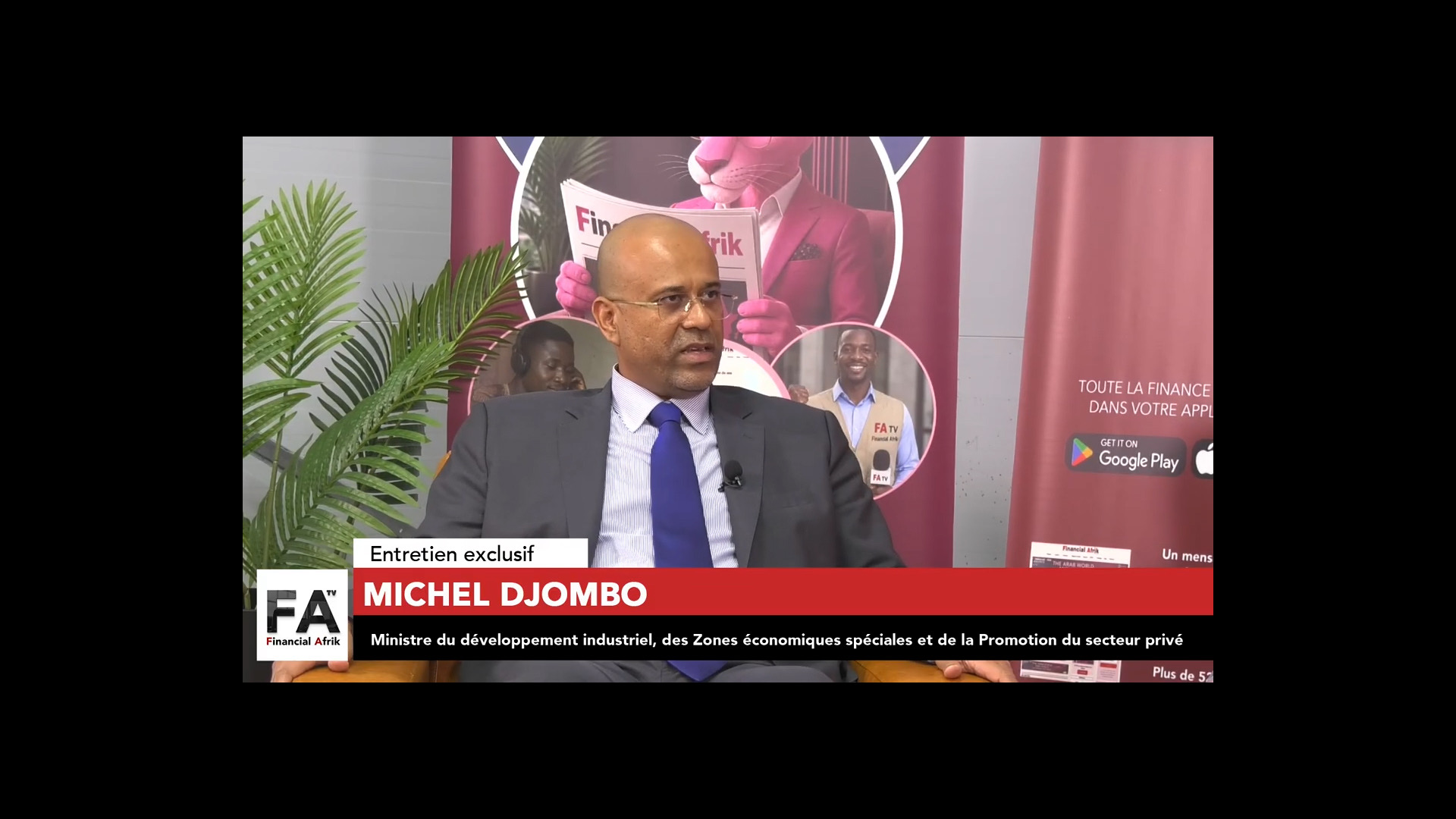
On the occasion of the Annual Meetings of the African Development Bank held in Brazzaville, Michel Djombo, Minister of Industrial Development, Special Economic Zones, and Private Sector Promotion, answered Financial Afrik’s questions. In this interview, he details the structuring projects aimed at attracting investors, the national strategy for local transformation of raw materials to enhance value-added on the territory, as well as the reforms undertaken to improve the business climate and support the emergence of a competitive private sector. Interview
Congo aims to accelerate its industrialization. What are the main industrial projects or special economic zones that the government considers strategic for attracting African and international investors today?
The projects mainly revolve around special economic zones, not because they are isolated elements, but because they are a real lever in the country’s industrialization policy. Some potential investors are still hesitant to establish themselves in Congo, considering the domestic market to be too limited. The country is facing an attractiveness challenge.
However, Congo has significant potential as a transit country, at the heart of a sub-region with logistical facilities. Even though some infrastructure remains to be completed, such as road sections of corridor 13 in the north of the country, Congo’s strategic position, combined with its efficient deep-water port, allows it to play a central role in regional trade. Through the Brazzaville corridor, the country can be competitive in exports to the DRC, the Central African Republic, the east of Gabon, and even some areas of Cameroon. Special economic zones aim to go beyond the limits of the domestic market by offering investors a regional vision. It is not just about investing in Congo but about exploiting sub-regional potential.
Beyond the restructuring of the industry-Special Economic Zones strategy, several projects are already underway. The country has four special economic zones in development: Pointe-Noire, Maloukou-Brazzaville (the most advanced), as well as Ouesso-Lombo and Oyo.
Two development models coexist. The Pointe-Noire and Brazzaville zones are entrusted to private developers responsible for developing industrial spaces. The state, on the other hand, provides basic infrastructure: electricity, water, fiber optics, and logistical access.
These developers act as industrial promoters, offering ready-to-use installations, factories, warehouses, logistics services, as well as tax and administrative facilities through one-stop shops bringing together various administrations.
The African private sector still faces difficulties in accessing financing and energy. What reforms or concrete measures is the Congolese government implementing to promote the emergence of national industrial champions?
The financing problem mainly concerns very small businesses. Many project holders have ideas, often driven by passion, but without real economic structuring. At this stage, banks cannot always keep up. In many cases, especially in agri-food processing, entrepreneurs complain about a lack of financial support, as their projects do not yet have sufficiently strong business models. A small business that has not yet proven itself cannot expect immediate funding or automatic trust from institutions. It is essential for project holders to improve the quality of their files and the viability of their economic models. Another major challenge concerns the quality of human resources and the ability to demonstrate project credibility.
What reforms or concrete measures is the Congolese government implementing to improve the business climate?
The business climate has long been a concern of the private sector. A white paper published in 2021 by the employers’ organization identified several structural barriers, to which the government intends to provide answers. Reforms are underway, and texts must be adopted to improve the business environment. The goal is to produce visible results in the next 18 months. A concrete example concerns the extractive sector, especially oil and mining. These companies face repeated financial seizures, often decided in the first instance, before being overturned on appeal. This situation creates legal and financial insecurity that limits the repatriation of revenues. The companies involved then reduce their transfers to the bare minimum necessary for their local operations.
What about the business climate for small businesses?
The private sector has often denounced the excessive pressure exerted on small businesses and small shops, especially through controls and parafiscal charges.
However, there are advances, such as the flat-rate tax regime for very small businesses with a turnover below a certain threshold. These businesses pay a single flat-rate tax, without in-depth tax control.
However, other administrations continue to intervene, limiting the effectiveness of the system. The challenge would be to harmonize all levies around a single mechanism, with a distribution key between administrations. This would reduce pressure on small businesses while ensuring better formalization of the economy. Only control structures related to hygiene, safety, and regulatory compliance should continue to intervene.

