



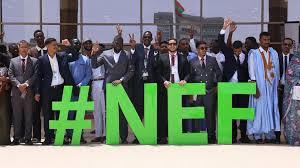
The second edition of the National Energy Forum (NEF), opened on May 20, 2026 at the Palais des Congrès in Nouakchott, highlighted the advances and vulnerabilities of Mauritania’s energy strategy. Under the theme of energy sovereignty and extractive potential, the meeting brought together public decision-makers, experts, and investors around a shared observation: Mauritania now has a modern regulatory framework and major geological assets, but still faces a critical deficit in infrastructure, financing, and execution capacities.
On the institutional level, speakers emphasized the progress made in recent years, including the adoption of the green hydrogen code – presented as a first at the regional level – as well as the strengthening of the legal framework governing extractive investment. This evolution aims to improve the country’s attractiveness to international investors looking for competitive sites for clean energy. Mauritania also relies on its long-standing membership in the Extractive Industries Transparency Initiative (EITI) and on a contractual regime based on production sharing, designed to balance the interests of the state and those of investors.
But behind this legal framework, experts have stressed the persistence of structural barriers. The first concerns commercial justice, deemed insufficiently effective in fully securing long-term investments. The second relates to the inadequacy of logistical and energy infrastructure, identified as the main obstacle to the effective valorization of resources. Several speakers have pointed out that without transport networks, railway corridors, port capacities, and suitable electrical infrastructure, discovered resources remain dormant assets.
Examples in Mauritania and the sub-region illustrate this constraint. The accumulated delays on several mining and gas projects, sometimes in gestation for over a decade, demonstrate execution difficulties. Successive delays due to the absence of critical infrastructure – especially railways and gas pipelines – have reduced the competitiveness of some projects, despite their initial economic potential. This issue is now acute for ambitions related to green hydrogen, the development of which will require significant investments in roads, specialized ports, high-voltage power lines, and logistic capacities adapted to the transport of oversized equipment.
The forum also emphasized that energy sovereignty cannot be reduced to national energy production alone. It requires an integrated vision articulating energy mix diversification, storage, supply security, regional cooperation, and the development of local value chains. In the Mauritanian case, the central issue remains the transformation of natural gas and renewable resources into a domestic industrial lever, rather than a simple export product. This implies the accelerated construction of transformation and distribution infrastructure that are currently absent.
Finally, participants emphasized the question of human capital. The development of the sector requires high technical skills, rapid qualification enhancement of young graduates, and strengthening of institutional capacities for management, control, and regulation.
In essence, the forum delivered a clear message: Mauritania has the resources and strategic framework to become a leading regional energy player, but the realization of this ambition will depend on its ability to quickly solve the tripartite equation of infrastructure, financing, and governance.

