



Brazzaville, May 29, 2026
The fourth day of the Annual Meetings of the African Development Bank in Brazzaville confirmed the strategic direction set for this 2026 edition: to accelerate the mobilization of African resources to finance the continent’s development in a global context marked by the decline of public aid, geopolitical tensions, and the rise of economic resilience requirements.
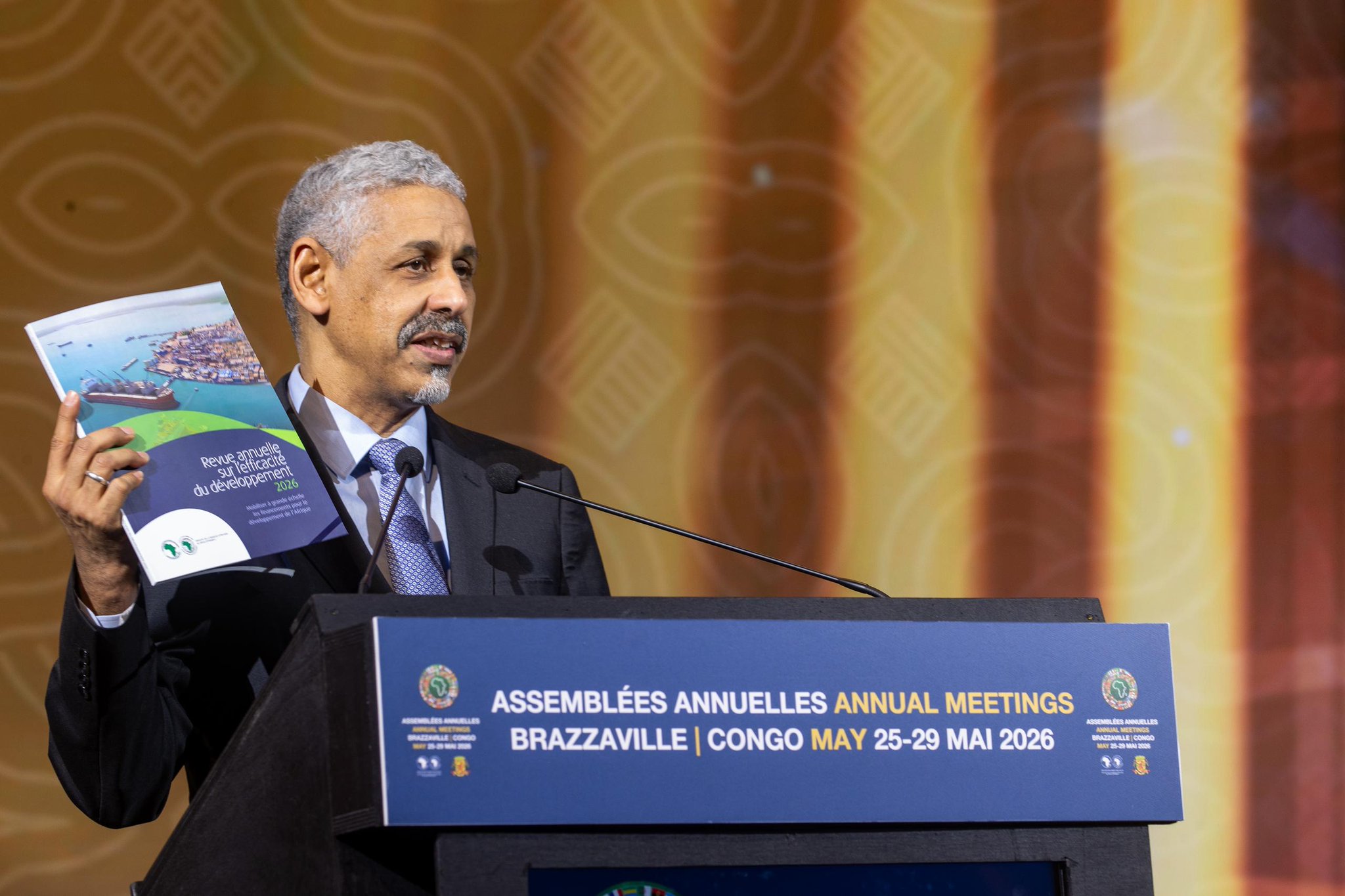
The AfDB has published its Annual Development Effectiveness Review (ADER) for 2026, a flagship document that measures the concrete impact of its interventions on the continent.
Under the theme “Mobilizing resources on a large scale for Africa’s development financing,” this publication highlights the results achieved in 2025 as part of the 2024-2033 decade strategy.
The President of the Group, Sidi Ould Tah, emphasized that Africa is now facing a structural transformation of its international financial environment.
The announced results reflect an increase in operational capacity:
– 1.5 million people have benefited from better access to healthcare;
– 5.4 million have gained access to clean water;
– 1.8 million have benefited from improved sanitation services;
– 2,000 km of roads have been built or rehabilitated;
– 1.5 million people have accessed electricity;
– 858 MW of renewable capacities have been installed;
– 6.9 million farmers have adopted resilient technologies;
– 18.4 million people have seen their food security strengthened.
Financially, the AfDB approved $10.9 billion in new operations in 2025, in addition to $4.3 billion mobilized from external partners.
This momentum is part of the “Four Cardinal Points” vision, a new strategic compass centered around:
– Liberating African capital;
– Restoring financial sovereignty;
– Leveraging demographic transformation for economic dividends;
– Developing resilient infrastructure.
The AfDB and the World Economic Forum have launched the Roadmap for Humanitarian Investment and Resilience in Africa, aiming to channel more private capital to the most fragile African economies and frontier markets.
Several pilot projects are already underway in Liberia, Somalia, Mozambique, and Djibouti.
Discussions on the Economic Outlook for Africa 2026 brought together several African and European decision-makers. The report projects an improvement in Africa’s average growth in 2026, driven by domestic demand, infrastructure investment, and increased regional trade.
However, several vulnerabilities persist, including debt servicing burden, reduced concessional financing, climate shocks, and budget constraints.
The central message from the panelists is that without ambitious tax reforms and enhanced regional integration, Africa will not be able to transform its growth potential into sustainable financial sovereignty.
Exclusive interviews by Financial Afrik continued from the studio set up at the Kintélé Conference Center.
– Sir Roger B. Jantio, CEO of Sterling Merchant Finance Ltd, advocated for structured finance to serve the new African financial architecture.
– Olivier Pognon, Director of the African Legal Support Facility, discussed the role of law in securing major African transactions.
– Didier Acouetey, President of AfricSearch, defended NAFAD as a lever for structural transformation.
– Jon-Pierre Fourie, Senior Director of Africa50, detailed Africa50’s vision on asset recycling and the bankability of major projects.
On today’s agenda:
– Roundtable on new China-Africa data
– Harnessing Africa’s financial resources to stimulate development
Watch the video journal of the Assemblies – Day 4: [link to video]
In Brazzaville, the AfDB refines its new direction: less external dependence, more mobilized African capital, and an increased demand for measurable results. The debate on the new African financial architecture is now entering its operational phase.

