



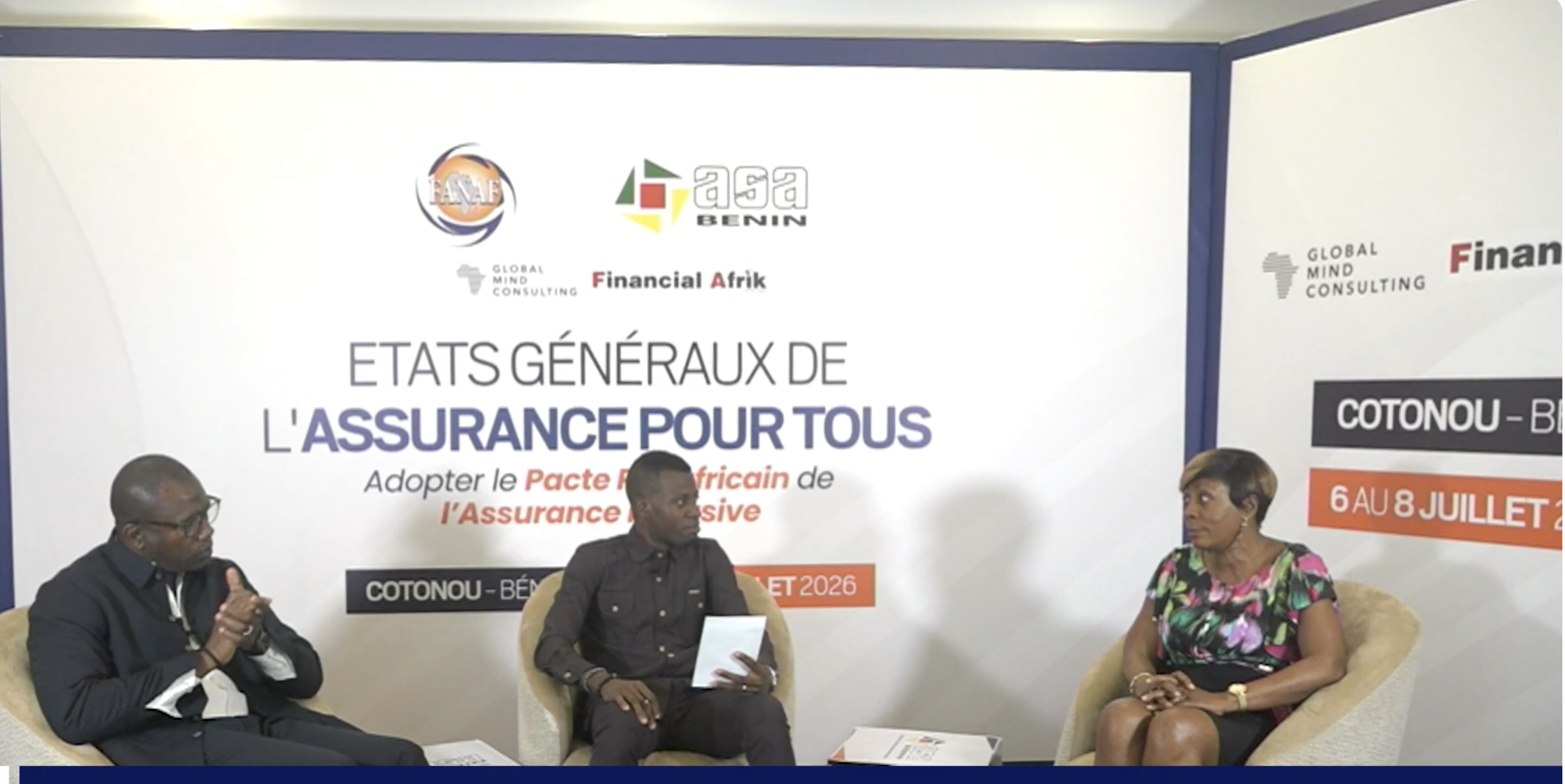
Cotonou. On the sidelines of the General States of Insurance for All (July 5-8, 2026), Financial Afrik brought together two prominent leaders in the sector: Eudoxie Douya, president of the Association of Insurance Companies of Cameroon (ASAC), and El Hadji Amar Kébé, president of the Senegalese Federation of Insurance Companies (FSSA). Through their discussions, a common observation emerged: without more accessible, transparent, and tailored health insurance to the realities of African households, trust between the populations and insurers will remain fragile. The two leaders also praised the initiative of the Federation of African National Insurance Companies (FANAF), which aims to achieve a Pan-African Pact for inclusive insurance.
At the start of the interview, the question of the low insurance penetration rate in Cameroon led Eudoxie Douya to defend the strategic role of health insurance. According to the president of ASAC, this branch is now the main entry point in the relationship between insurers and their clients. Because it puts companies in regular contact with policyholders, it fosters a proximity that can gradually establish a climate of trust, a necessary prerequisite for the development of other coverages such as housing, professional risks, or provident. Health insurance thus appears as a true “gateway” to a more sustainable insurance relationship.
This analysis is widely shared by El Hadji Amar Kébé, who observes a structural evolution of the CIMA zone markets. Long dominated by mandatory automobile insurance due to regulation, growth is now being driven by health insurance. In Senegal as in Ivory Coast, he points out, this branch has become one of the most important in the market, not due to a legal obligation but because it meets a fundamental need of the populations. In countries where public social protection systems remain incomplete or insufficiently funded, households are increasingly turning to private insurers to cover their medical expenses. For the president of FSSA, health now emerges as a major risk, even though it remains a technically demanding activity due to high claims ratios that weigh on companies’ profitability.
Asked about the articulation between private insurance and public policies, especially in light of Universal Health Coverage in Senegal, El Hadji Amar Kébé advocated for complementarity between the State and insurers. According to him, governments naturally have a role in establishing public social protection schemes, but budgetary constraints limit their ability to cover all needs. Private insurers then have a space to offer complementary guarantees, capable of extending protection to underserved segments. This public-private partnership logic appears, in his view, as one of the most realistic ways to improve healthcare coverage on the continent.
In Cameroon, Eudoxie Douya placed this reflection within the priorities of her mandate at the head of ASAC. Before generalizing new health products, she intends to secure the market’s operation through the digitalization of automobile insurance, a project aimed at combating fraud, false certificates, and insurance defaults. This project, whose launch is announced soon, according to her, constitutes a first step before extending this platform to health contracts, which also face management difficulties and high claims ratios. For the Cameroonian official, improving trust also involves better data management and modernization of management tools.
On the inclusion front, the president of ASAC recalls that several non-life companies already offer coverage extensions inspired by microinsurance, even though Cameroon does not yet have actors exclusively specialized in this activity. These offers complement existing public schemes, with premiums adapted to the incomes of the most vulnerable populations. However, their success requires a broader approach, integrating local communities, proximity organizations, service digitalization, as well as social protection institutions. The goal is to build simple, understandable, and financially accessible products.
Beyond technical solutions, the two leaders emphasized the need to change the perception of populations traditionally referred to as “informal.” El Hadji Amar Kébé believes that this terminology is reductive. According to him, these populations already have their own organizational, savings, and solidarity mechanisms, notably through groups, cooperatives, or community associations. The challenge is not to impose products designed according to traditional insurance standards on them, but to build solutions adapted to their practices and contributory capacities with them. For the president of FSSA, inclusive insurance can only progress if insurers are willing to adapt their economic models to the realities on the ground.
The General States of Insurance for All precisely aim to address this issue. The two speakers praised the initiative led by FANAF, which aims to bring forth a Pan-African Pact for inclusive insurance. El Hadji Amar Kébé sees this as a strong signal sent to the millions of Africans still excluded from traditional protection mechanisms. He points out that the vast majority of current offers are aimed at households with regular incomes, leaving out a large part of the active population.
Eudoxie Douya shares this assessment. She considers that the new mandate of FANAF finally places microinsurance among the sector’s strategic priorities. According to her, the challenges encountered are largely similar from one African market to another: low incomes, product unawareness, access difficulties, and lack of sufficiently adapted solutions. The future Pact could thus establish a common set of principles while allowing each market to integrate its own regulatory, economic, and social specificities.
A common conviction emerges from this interview: inclusive insurance is no longer just a market segment, but an economic and social development issue. Faced with health expenses that still push many households into precarious situations, the leaders of the Cameroonian and Senegalese sectors advocate for simpler, more transparent, and financially sustainable products. The success of the announced Pan-African Pact in Cotonou will now depend on the ability of insurers, regulators, and governments to translate these commitments into concrete solutions for the millions of Africans who still lack insurance coverage.

