



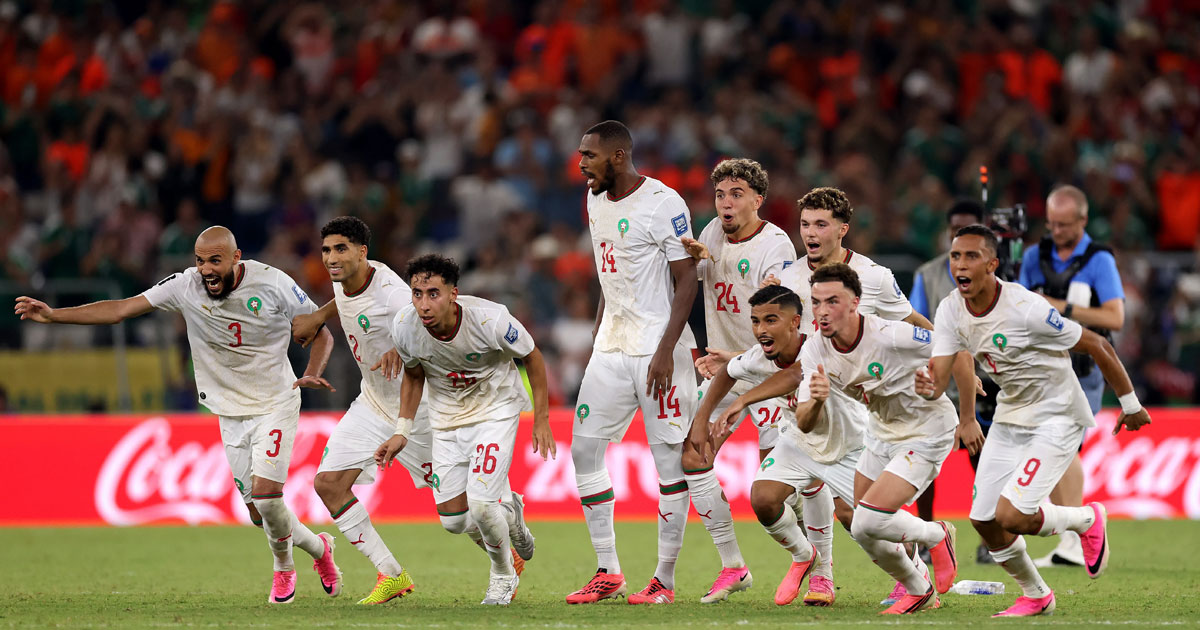
At kick-off, the scoreboard clearly leans towards the Canadian side, as we await the first match of the round of 16 of the FIFA World Cup 2026. With populations that are fairly close – 41.65 million inhabitants for Canada against 38.43 million for Morocco in 2025 – the gap in economic power remains considerable. The World Bank estimates the Canadian GDP at 2,507 billion dollars in 2025, compared to 182.37 billion for Morocco. In other words, the Canadian economy weighs nearly thirteen times that of the kingdom, even though both countries have comparable demographic reservoirs.
The real gap becomes even more pronounced when we look at wealth per capita. GDP per capita reaches 55,697.7 dollars in Canada, compared to 4,672.5 dollars in Morocco, according to the latest aggregated data from the World Bank. This differential does not tell the whole story about a country’s vitality, but it summarizes the depth of markets, average productivity, and domestic consumption capacity. In football terms, one could estimate that Canada plays in an economic division where budgetary leeway, average income, and productive sophistication offer more solutions on the bench.
However, recent dynamics tell a less unbalanced match than it seems. The IMF projects a real growth of 1.5% in Canada for 2026, compared to 4.9% in Morocco. Canada is moving at a management pace, that of a mature economy protecting its assets. Morocco, on the other hand, plays more vertically, with a much faster expected progression. This contrast pits two classic models against each other: on one side, a large developed economy seeking stability; on the other, an emerging country trying to accelerate its rise in quality. The volume remains Canadian, but the momentum is Moroccan.
On the price front, the duel tightens even further. The World Bank places inflation in 2025 at 2.1% in Canada and 0.7% in Morocco, while the Bank of Canada still reported a 3.2% increase over twelve months in May 2026. This means that the Canadian economy retains higher purchasing power, but with a slightly more visible inflationary pressure in the short term. Morocco benefits from a calmer price environment, supporting clarity for households and businesses, even if it does not offset the overall wealth gap.
In the end, this economic “Canada-Morocco” match pits established strength against ambitious progress. Canada clearly dominates in terms of GDP size, income per capita, and market depth. Morocco responds with faster growth and more contained inflation. In short: if we judge pure power, Canada is clearly ahead; if we look at the trajectory, Morocco refuses to be passive and shows that it has earned the right to aim higher.
Beyond the raw comparison of aggregates, Canada and Morocco maintain a steadily growing economic relationship. In 2024, their bilateral trade in goods exceeded 1.82 billion dollars, up 15% in one year, a sign of a relationship that is denser than it appears. Canadian exports to the Moroccan market include cereals, vegetables, fertilizers, machinery and equipment, as well as aircraft and vehicle parts, while Canada imports mainly fertilizers, edible fruits and nuts, inorganic chemicals, and equipment from Morocco.
In addition, there is a growing Canadian presence on the ground: Canadian direct investments in Morocco reached 283 million dollars in 2023, with strengthened positions in mining, clean technologies, aerospace, automotive, information technology, education, and agri-food.
In short, behind the size gap between the two economies, the bilateral relationship is expanding, driven by increasingly concrete complementarities.

