



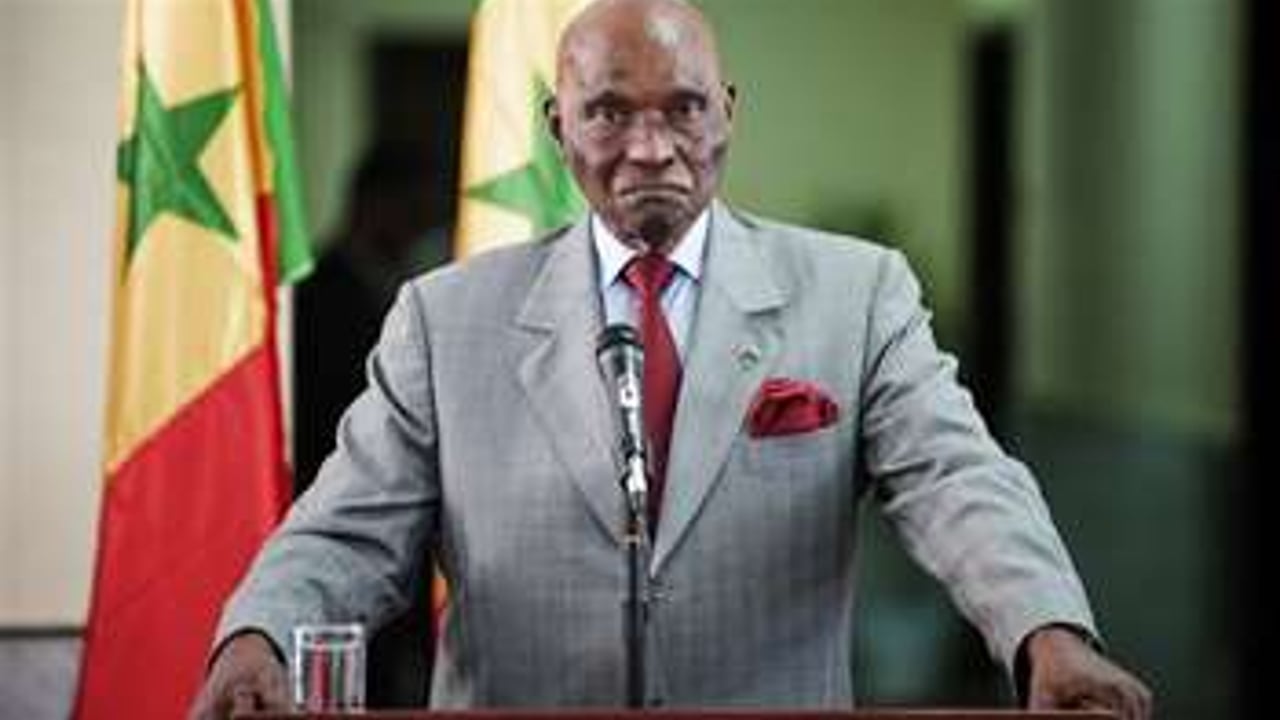
On May 29, 2026, Abdoulaye, “Gorgui,” “the old man” in Wolof, turned 100. On this occasion, the Senegalese government pays tribute to this political figure whose legacy transcends political divisions on June 4 and 5, 2026. The commemoration was postponed because it coincided with Eid al-Adha – the Tabaski festival.
By Eric Topona, Journalist, Writer, Former Secretary General of the Chadian Journalists’ Union (UJT).
Some birthdays have a particularly symbolic dimension because they celebrate a longevity that we are not accustomed to. This is the case of those rare individuals who can claim and be proud of the exceptional existential privilege of reaching the age of 100. Abdoulaye Wade, the former Senegalese president, is one of them.
Indeed, on May 29, Senegal celebrated another illustrious centenarian as only it can produce, and beyond Senegal, the entire Africa, as was the case in March 2021 on the occasion of the celebration of the 100th birthday of the former Director-General of the United Nations Educational, Scientific and Cultural Organization (UNESCO), Amadou Mahtar Mbow, a great man of culture and the first African to hold this illustrious position.
Abdoulaye Wade, now retired in the commune of Versailles (capital of the Yvelines department in the Île-de-France region, in the Paris region), is one of those leading politicians who can be said to have had a thousand and one lives in one. The “Gorgui” (the old man in Wolof), as his compatriots affectionately call him, is both a witness to the birth of modern Africa and an actor in its long march towards emergence.
Historical Context
It is not possible to understand the political figure that Abdoulaye Wade was without going back to the historical context that shaped his militant consciousness and pan-African commitment. It all began with the Federation of Black African Students in France (FEANF), created in 1950, after the Lyon congresses (April 1950) and Bordeaux (December 1950). We are in post-World War II France. Many Africans, some of whom were on the front lines to rid Europe and the rest of the world of the Nazi threat, often at the cost of their blood, dream of seeing the African now recognized as worthy of the humanistic ideals for which he fought. This legitimate demand must be translated into the international sovereignty of colonized countries and the abandonment of the racist and dehumanizing prejudices that the black man was then a victim of. Within the FEANF, Abdoulaye Wade was involved in these struggles. A brilliant student at the University of Grenoble (1958-1959), he wrote:
“The immediate objective must therefore be the liberation of the African man, the Negro-African, the colonized, and this is the goal of nationalism.”
Return to Senegal for a Political Fight
However, the dynamic university student, who accumulates academic titles like keys that will open the doors to the future, is convinced that the mastery of speech alone will not be enough to carry out his fight. Like his compatriot Cheikh Anta Diop, Abdoulaye Wade decided to return to Senegal to engage resolutely in political struggle. He first distinguished himself with a brilliant career as a lawyer at the Bar of Senegal. For his first feat, in December 1963, he defended the President of the Council of Senegal, Mamadou Dia, a former political ally of Léopold Sédar Senghor, who accused him of attempted coup d’état. Upon his return to his homeland in the early 1960s, he engaged in defending political causes, but it was in 1974 that he truly took the plunge when he founded, on July 31, the PDS (Senegalese Democratic Party) under which he was elected as a deputy to the National Assembly in 1978.
He thus began his political career as a deputy. However, aware of his high stature and carrying a national ambition, he soon realized that it was his civic duty to aspire to the highest positions in his country. This new life was not a smooth sailing journey. Far from it.
The long and winding path that led him to the victorious presidential election in 2000 was marked by numerous defeats. He was a candidate in the presidential elections of 1978 against Senghor, then in 1983, 1988, 1993, and 2000 against Abdou Diouf, who had the republican and democratic elegance to finally acknowledge his defeat.
A rare political feat in Africa, Abdoulaye Wade did not have an uninterrupted political career as an opponent before his accession to the highest office. He went back and forth between coalition governments and opposition. A fine strategist, a formidable tactician, he understood that it would not be easy to exercise power at the highest level without first being confronted with the reality of power. From his exercise of power from 2000 to 2012, the picture is mixed. His departure from power was not without difficulties. To say the least. History will remember that it was under Wade, in a country presented as a democratic model in Africa where institutions are safeguarded, that what is now called the “temptation of the third term” was born. It took an unprecedented mobilization of political parties from various backgrounds, civil society, for Abdoulaye to decide to withdraw his controversial constitutional reform project aimed at establishing a “presidential ticket” (simultaneous election of the president and vice-president) and lowering the threshold of votes to 25% to elect the head of state in the first round on June 23, 2011. He did not attempt to establish a dynastic succession, but this project, barely veiled, aimed in reality to see his son Karim Wade succeed him. Despite the criticisms, he sought a third term in the 2012 presidential election. He was 85 years old.
In his defense, it can be acknowledged that few political careers are straightforward.
However, his exceptional political journey is rich in lessons for African political actors of today and tomorrow.

