



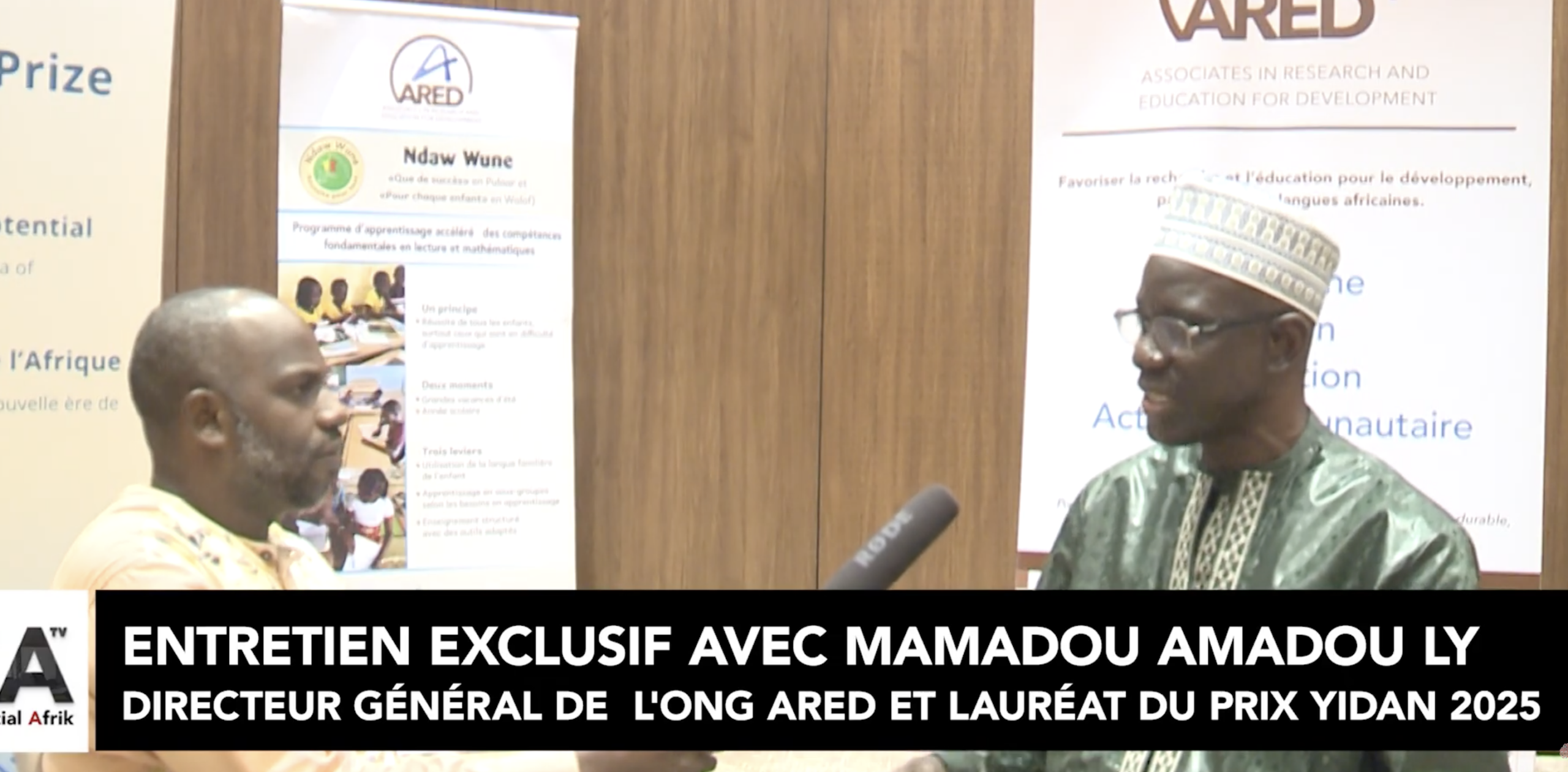
When he receives the call informing him that he has won the Yidan Prize 2025 for education development, Mamadou Amadou Ly is in Oxford. On the other end of the line, the announcement is historic: for the first time since the creation of this award in 2017, an African is honored by what is often referred to as the “Nobel Prize of Education.”
As the Executive Director of the NGO Associates in Research and Education for Development (ARED), Mamadou Amadou Ly becomes the first Senegalese and the first African to receive this international award presented by the Yidan Foundation, a philanthropic organization based in Hong Kong and considered one of the leading global references in funding and promoting educational innovation.
“It is a pride for ARED, for our team, for our partners, and for Senegal. But beyond that, it is all of Africa that is celebrated,” he confides. After thirty-five years dedicated to research, pedagogical innovation, and the promotion of African languages in education, this recognition crowns an exceptional journey and a long-held conviction considered audacious: children learn better when they start their schooling in a language they understand.
For more than three decades, Mamadou Amadou Ly and ARED have been working to overcome one of the main obstacles to basic education in West and Central Africa: learning in a foreign language often imperfectly mastered by students from the beginning of their school years. Under his leadership, the organization has developed innovative bilingual educational models combining national languages and official languages, with the ambition of durably improving fundamental skills in reading, writing, and arithmetic.
This approach has given rise to several programs now recognized for their effectiveness, including the Harmonized Bilingual Teaching Model of Senegal (MOHEBS) and school remediation devices that have allowed thousands of students to catch up on their learning delays. The results obtained have attracted the attention of public decision-makers, donors, and international institutions. In Senegal, ARED has become a major technical partner of the Ministry of National Education. Its open educational resources are also used in Gambia and Mauritania, demonstrating their adaptability to diverse linguistic and cultural contexts.
The Yidan Prize 2025 precisely rewards this ability to transform research into concrete, measurable, and scalable solutions. Endowed with several million dollars to support the work of the laureates, this distinction aims to identify the most promising educational innovations in the world. For the international jury, Mamadou Amadou Ly’s work demonstrates that bilingual, inclusive education rooted in the cultural realities of communities can significantly improve learning while reducing educational inequalities.
This international recognition comes at a particularly symbolic moment. Just a few months after this historic accolade, Dakar will host the first African edition of the Yidan Prize Conference from June 29 to July 1, 2026. Under the theme “Unlocking Africa’s Potential,” this meeting will bring together nearly 200 decision-makers, researchers, donors, government officials, social investors, and private sector actors to reflect on educational innovations capable of durably transforming the continent.
For many, this event marks a form of return to origins: that of an Africa that is no longer just a consumer of educational models designed elsewhere, but now offers its own solutions to the rest of the world. The journey of Mamadou Amadou Ly is the most striking illustration of this.
Through this conference, Dakar aims to become the global capital of educational innovation for three days. A strong symbol for a continent whose youth will represent one of the main talent pools on the planet in the coming decades.
Through the journey of Mamadou Amadou Ly, an entire vision of education is highlighted: a school rooted in local realities but open to the world, capable of transforming Africa’s tremendous demographic potential into human capital, economic growth, and shared prosperity.
While waiting for the Dakar meeting scheduled from June 29 to July 1, 2026, discover this exclusive interview with Mamadou Amadou Ly, focused on the lessons from an experience that places Africa at the heart of global debates on the future of education.

