



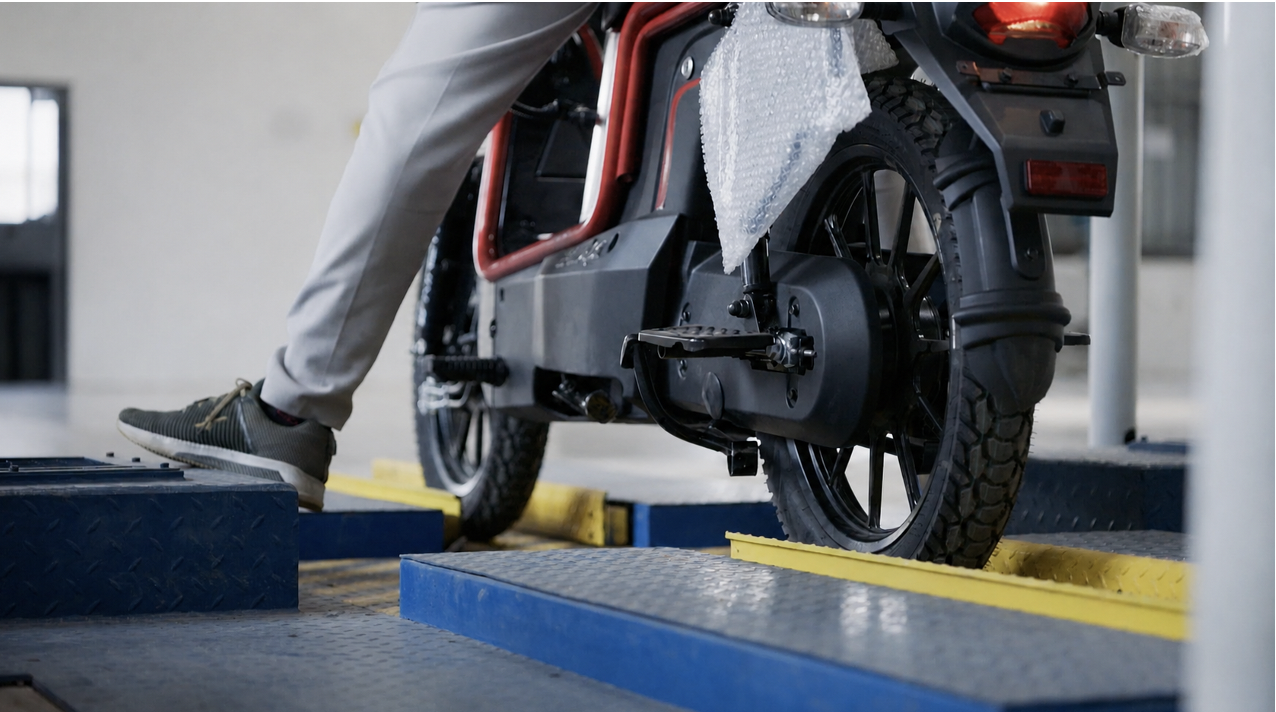
Africa is home to nearly 30 million people who rely on two and three-wheeled vehicles to make a living. However, less than 200,000 of these vehicles are currently electric. While the economic arguments in favor of electrification are becoming increasingly convincing, a major obstacle remains: the limited availability of vehicles designed to meet African realities. A new partnership between Shell Foundation, the Foreign, Commonwealth & Development Office (FCDO) of the UK, and Indian manufacturer Kinetic Green aims to address this challenge by testing electric models in local conditions and producing evidence to encourage future investments.
A market where demand is growing but supply remains limited
Across Africa, two and three-wheeled vehicles are more than just a means of transportation. They provide essential connectivity for the last mile, support local trade, and enable millions of people to generate income.
While electric mobility is gradually gaining ground on the continent, its development remains uneven. Kenya and Rwanda are among the pioneers thanks to favorable public policies and increased private investments, while Uganda is also experiencing strong growth. Elsewhere, adoption remains more timid, hindered by limited access to suitable vehicles as well as inadequate charging and maintenance infrastructure.
For many transporters, electric vehicles offer lower operating costs than models equipped with internal combustion engines. They reduce dependence on fuel price fluctuations and improve the profitability of activities. Despite these obvious economic advantages, their adoption remains modest.
According to Shell Foundation, around 30 million people in Africa rely on two and three-wheeled vehicles for their livelihoods, but less than 200,000 currently use electric models.
One of the main barriers lies in the availability of vehicles capable of meeting African operating conditions. Manufacturers must deal with often degraded roads, heavy loads, and intensive daily use, even as charging infrastructure and maintenance networks remain underdeveloped in many countries.
As Jonathan Berman, CEO of Shell Foundation, points out:
“In Africa, the main challenge of electric mobility is often not demand, but supply, especially access to vehicles available on a sufficient scale, affordable, robust, and truly adapted to the working conditions of transporters.”
Proven technologies adapted to local realities
To address this challenge, Shell Foundation, the UK FCDO, and Indian electric vehicle manufacturer Kinetic Green have announced a partnership to experiment and adapt electric two and three-wheelers to African markets.
Instead of exporting existing models, this initiative will evaluate the performance of vehicles in real operating conditions, taking into account road conditions, payload requirements, and intensive commercial use. Pilot projects deployed in several countries will also collect data on the charging infrastructure and maintenance networks necessary for large-scale deployment.
The ambition is significant. Through this partnership, Shell Foundation aims to contribute to putting an additional 200,000 electric vehicles on African roads. These vehicles must be both robust and economically viable for their users, with the goal of increasing their income by at least 20%.
For Kinetic Green, this collaboration also represents an opportunity to leverage the experience gained in India while avoiding a one-size-fits-all approach. As explained by its founder and CEO, Dr. Sulajja Firodia Motwani:
“Africa represents an opportunity of remarkable scale and diversity, where transporters deserve solutions designed for their realities, not simply imported from other markets.”
Catalytic capital to attract future investments
The program benefits from catalytic funding provided by Shell Foundation and the British government as part of the Research on Infrastructure in Developing Economies (RIDE) program and the Transforming Energy Access (TEA) platform of the FCDO.
Unlike traditional commercial investments, catalytic capital is intended to absorb initial risks to allow companies to test products and business models that would otherwise struggle to obtain financing.
As part of this initiative, these resources will fund pilot projects, including vehicle trials and essential charging infrastructure for their effective operation in African markets.
Beyond demonstrating technical performance, the partnership aims to produce concrete data to inform future investment decisions and accelerate the development of a true electric mobility ecosystem, integrating maintenance services and, ultimately, local assembly capabilities.
Ultimately, the success of electric mobility in Africa may depend less on the technology itself than on the ability to build an ecosystem tailored to the needs of transporters. If these pilot projects demonstrate that it is possible to reconcile emission reduction and income increase, they could serve as a model to accelerate the deployment of electric two and three-wheelers in many African markets.

