



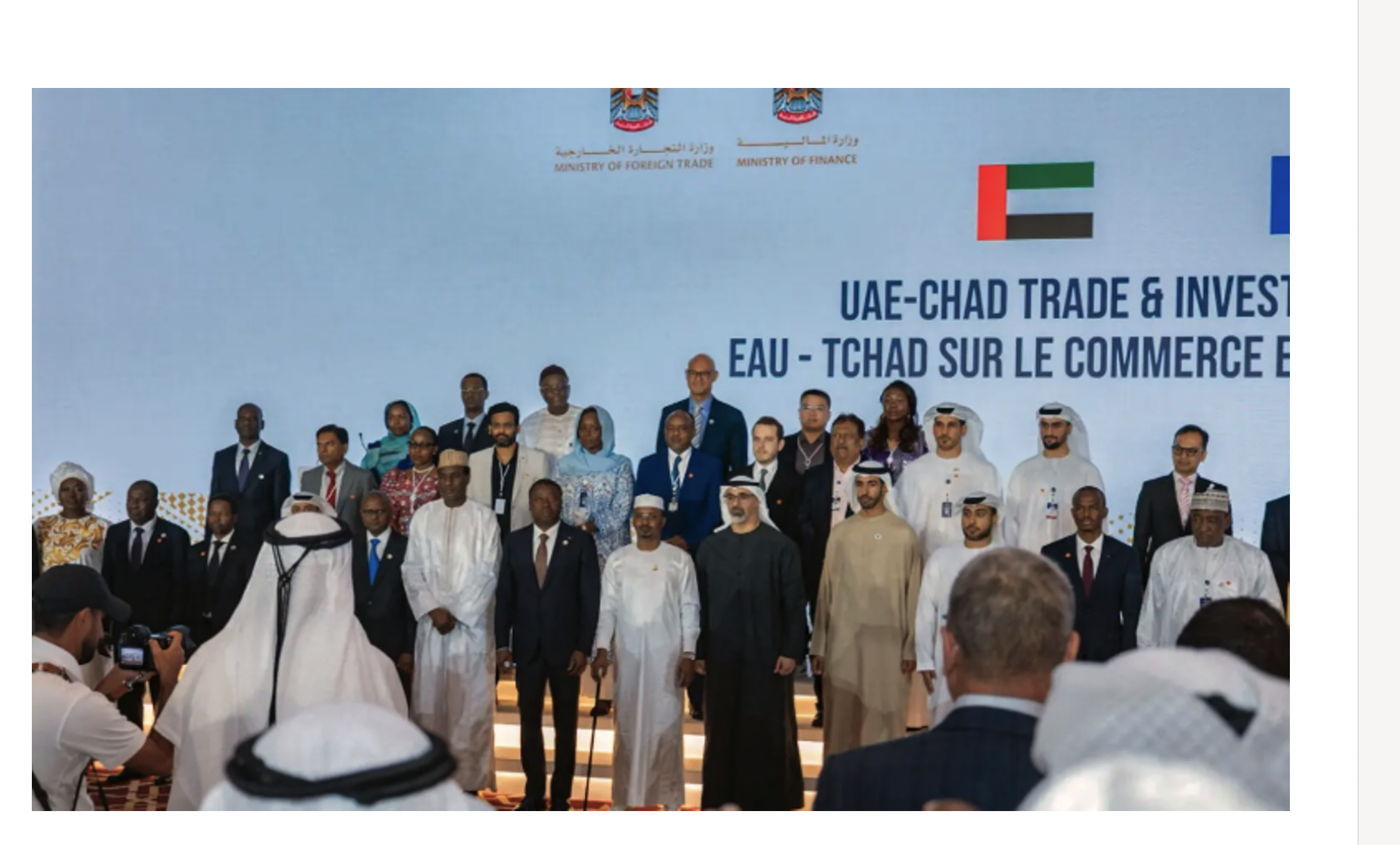
Chad is going through a pivotal period. Recent investment announcements and renewed support from international partners demonstrate a positive momentum around the national development plan “Chad Connexion 2030”, but structural challenges remain. Between stated ambitions and persistent constraints, one question remains: do the government and its international partners have the means to succeed in transforming the country and setting it on a path of sustainable and long-term economic development?
A strategic turning point initiated in Abu Dhabi
After a decade of complex political transition and an economy weakened by its dependence on oil, Chad is embarking on a new beginning. The government formalized its vision in “Chad Connexion 2030”, presented in November 2025 in Abu Dhabi. The stakes are high: demonstrating the country’s stability, the announced improvement in the business climate, and reducing poverty. In this context, more than 20.5 billion dollars were mobilized in the first phase, a sign of renewed confidence from international partners.
Beyond the announcements, the Abu Dhabi event led to concrete agreements. This momentum owes much to the diplomatic activism of the government, embodied in particular by the Minister of Finance and Economy, Tahir Hamid Nguilin, the driving force behind the national development plan on the international stage.
His presence at the IMF and World Bank Spring Meetings in Washington in mid-April, a scheduled meeting with the French MEDEF in June, an upcoming visit to China, and the co-organization of a regional water forum in N’Djamena with the World Bank demonstrate a proactive and structured approach. The embassy network also appears mobilized to keep private sector actors engaged in contributing to the projects of the national development plan, in a security and political context that the authorities present as stabilized, up to the shores of Lake Chad, long plagued by instability.
Investments reflecting thoughtful implementation
Since the launch of the national development plan, announcements seem to be followed by concrete projects. In the energy sector, for example, a pillar of the plan, the African Development Bank has been financing the construction of solar-diesel hybrid power plants in several secondary cities since February, for nearly 5 billion CFA francs. The announced objective is to expand access to electricity, currently limited to about 6% of the population, and support local economic activity.
At the same time, in December, the World Bank reportedly committed 170 million dollars to the Chad Connectivity and Integration Project, aimed at opening up the Lake region and structuring commercial hubs. Roads, markets, solar warehouses: an infrastructure ecosystem aimed at facilitating trade and strengthening local value chains.
The momentum also extends to the water sector, now identified as a central development lever. In January 2026, a memorandum of understanding was signed with SUEZ to support the country on technical and financial aspects, while a 100 million dollar financing from the World Bank is being prepared to sustainably improve access to clean water through the Almé Djah project.
On the budgetary and institutional level, support from partners such as the French Development Agency, to the tune of 15 million euros, would help finance structuring projects, particularly in transportation and agriculture, while supporting macroeconomic consolidation.
State modernization is another key focus, perhaps the first key project of the national development plan initiated by the government: the deployment of a national biometric registry, mobilizing over 15 billion CFA francs, aimed at improving public finance management and combating fraud, as part of a broader digital transformation strategy.
Finally, the Islamic Development Bank reaffirmed its commitment to Chad at the beginning of 2026 during a grand visit to N’Djamena, emphasizing the clarity of the “2030 vision” and the need to translate it into concrete projects.
Enhanced credibility, but persistent challenges
Internationally, this momentum seems to be starting to bear fruit, reflected for example in assessments by financial institutions. In March 2026, S&P confirmed Chad’s sovereign rating at “B-” with a stable outlook, praising robust growth, estimated at 5% in 2026, moderate debt, and progress in revenue mobilization.
The International Monetary Fund, engaged in a program with the country since 2025, also mentions a “robust” economic activity, driven in particular by the non-oil sector. Regional economic performances confirm this trend: Chad is among the most dynamic economies in the CEMAC, with expected growth around 3.7%.
These initial results seem to reflect the implementation of a national development plan supported by a more operational ministerial coordination, a strategic refocusing on the country’s key resources to diversify the economy, and a gradual return of confidence from institutional and private investors. They also reflect an improvement in some macroeconomic fundamentals, such as inflation control or debt management.
However, this trajectory remains conditioned by several factors. The government’s ability to continue its structural reforms over the long term, governance consolidation, and the ability to maintain an attractive business climate will be decisive. Likewise, the persistent dependence on the oil sector and vulnerabilities related to the regional context are points of vigilance.
For now, the signals are encouraging for Chad. The real challenge will be to translate these dynamics into concrete and sustainable results for the Chadian people – in terms of jobs, income, and living conditions.
The idea of Chad becoming an economic champion in the Sahel may still seem distant to the average Chadian. However, it is gradually gaining ground in the economic circles of N’Djamena, which envision better tomorrows, encouraged by renewed ambitions and projects that seem to be materializing, with a more visible impact day by day.

