



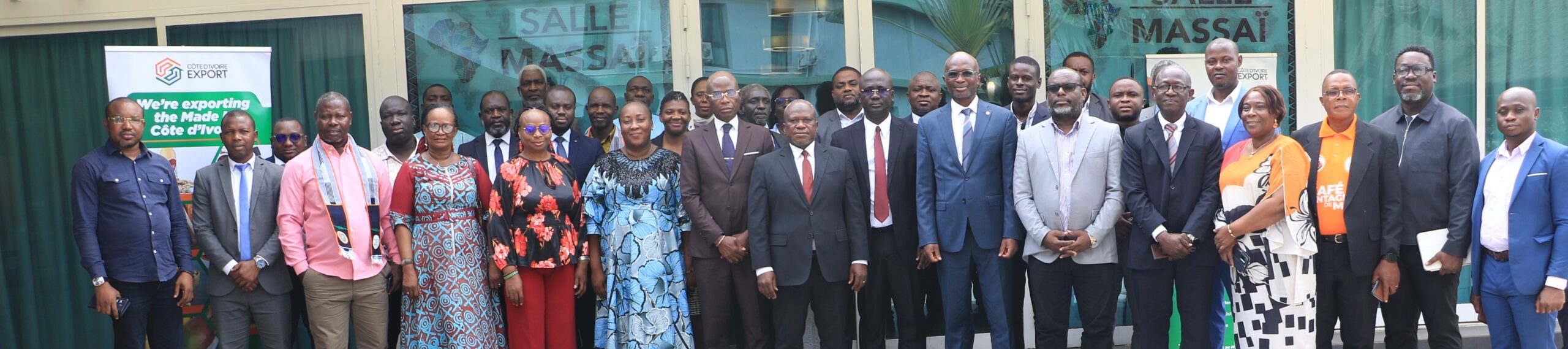
During a reflection workshop dedicated to the creation of a national label, organized by the Ivorian Export Agency, Dr. Koffi Paul Assandé, Director General of the Ivorian Office of Intellectual Property (OIPI), highlighted the country’s already achieved successes. Ivory Coast has indeed obtained the labeling of three emblematic products: attiéké, Baoulé cloth, and mountain coffee. According to him, a new step is about to be taken with five other products currently in the process of being labeled: shea butter, Kent mango, red oil, Danané rice, and purple onion from Comoé.
To ensure the protection and valorization of these exportable products, OIPI, the Ivorian Export Agency, and the Directorate of Quality Promotion and Standardization (DPQN) are pooling their efforts on Thursday, June 25 in Abidjan. Their objective is to develop rigorous technical documentation to materialize the national label “Made in Ivory Coast”. This project is in line with the establishment of specific sectoral labels for several strategic sectors.
Dr. Kaladji Fadiga, Director General of the Ivorian Export Agency, emphasized that the creation of the “Made in Ivory Coast” label represents “an opportunity to significantly increase Ivorian exports”. This initiative will, according to him, “unite producers, processors, and exporters around a strong national economic identity”.
According to Ibrahim Coulibaly, technical advisor to the Minister of Commerce, Industry, and Handicrafts, trade occupies a central place in the country’s development strategy. “Our country has made the deliberate choice of an economy open to the world, resolutely focused on the local transformation of its resources and the increase of national added value. This ambition is based on several fundamental pillars, including industrialization, the promotion of exports of goods and services, economic diversification, improvement of the business climate, and strengthening the competitiveness of the private sector,” he declared.
He believes that in an economic environment marked by increasing competition between territories and national brands, “origin labels are now strategic instruments of differentiation, valorization, and promotion of local products and services”.

