



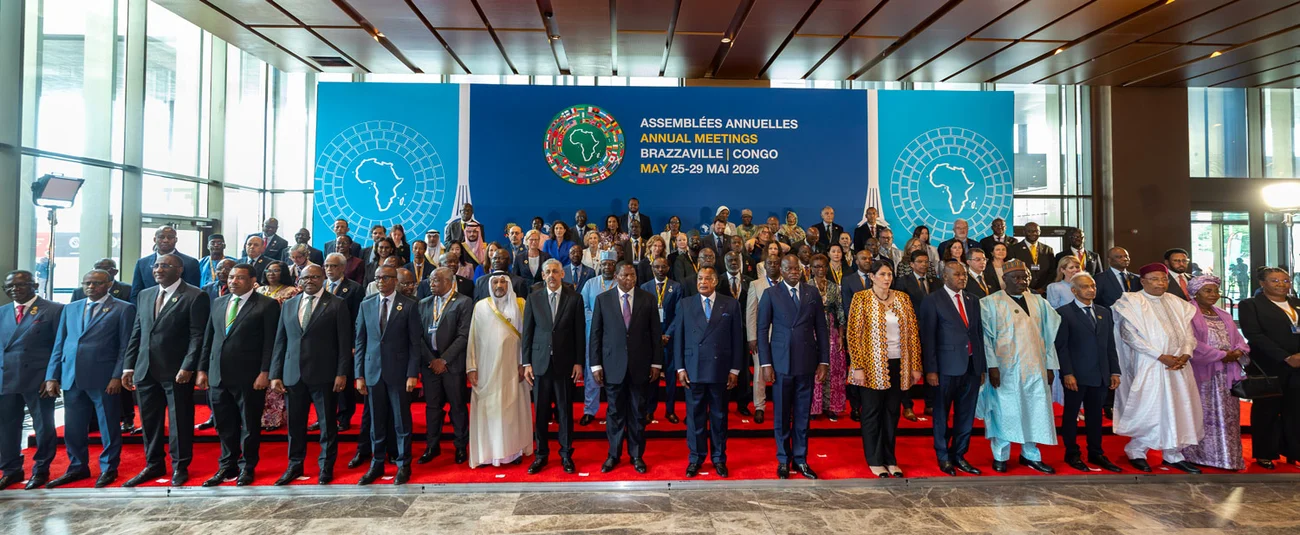
Brazzaville closes on May 29 a sequence that is expected to mark a milestone in the recent history of African development financing. Over five days, the 61st Annual Meetings of the African Development Bank Group will have offered much more than a statutory meeting: they will have laid the foundations for a new continental financial narrative, at a pivotal moment for both the pan-African institution and the Congo, engaged in its transformation trajectory through the Congo 2060 vision and its National Integrated Development Plan.
At the end of the meetings, the Congolese Minister of Economy and Chairman of the Board of Governors, Ludovic Ngatsé, stated that the conclusions were “up to expectations”, praising an intellectual and political mobilization that has aligned the continent’s ambitions with the necessary instruments for their realization.
One of the major highlights of this edition remains the Board of Governors’ endorsement of the vision put forth by the Group’s President, Sidi Ould Tah. His “four cardinal points”, a new strategic compass for the institution, received clear approval, cementing a direction based on the massive mobilization of African savings, the acceleration of strategic investments, productive transformation, and the strengthening of the continent’s financial sovereignty.
In Brazzaville, the new head of the Bank set the tone for a presidency that intends to make the AfDB “a bank of solutions for the Africa we want”. A statement that resonates as a manifesto for an institution called to move beyond mere financing logic to become a catalyst for transformation.
By summoning the Congolese poet Tchicaya U Tam’si – “My continent is a question mark on the world map” – Sidi Ould Tah issued a call to transform this question into an affirmation. Africa, he emphasized, can no longer wait for external solutions; it must build its own financial architecture, draw on its internal resources, and invent mechanisms suited to its ambitions.
This is precisely what now symbolizes the momentum of Brazzaville.
In a fragmented world, marked by the decline of public aid, geopolitical volatility, and tensions in financial markets, the 2026 Meetings have affirmed a strong conviction: African development financing can no longer rely on inherited patterns.
For the host country Congo, this sequence comes at a highly strategic moment. Hosting these continental meetings has showcased a renewed national ambition. By aligning pan-African reflection around NAFAD with the goals of Congo 2060, Brazzaville sought to demonstrate that the reform of African financial architecture finds concrete expression in national development trajectories.
Beyond speeches, these meetings have above all marked a turning point: that of an AfDB which, under the impetus of Sidi Ould Tah, shows the will to become the central instrument of an Africa that finally finances its own destiny.
Brazzaville thus closes its doors with a certainty: more than a summit, this 2026 edition has been the starting point of a movement. A political, financial, and symbolic signal. An impulse.
History may remember that it is here, on the banks of the Congo, that the operational translation of the New African Financial Architecture truly began.

