



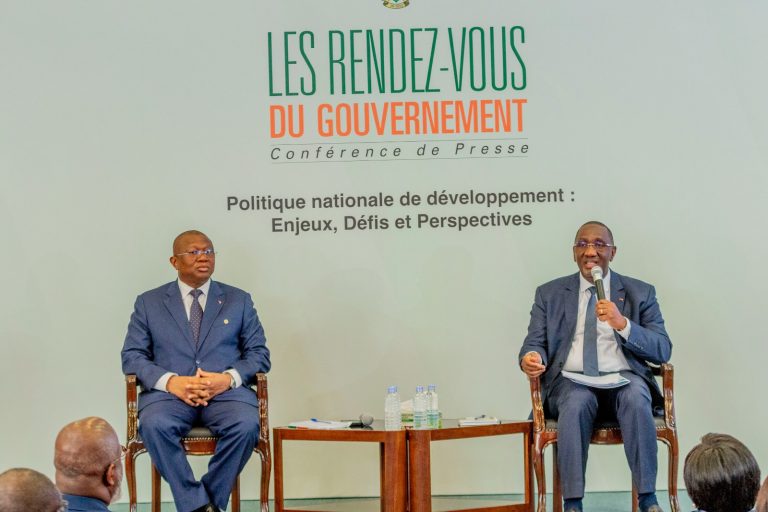
Minister of Planning and Development, Souleymane Diarrassouba, presented the main macroeconomic indicators of Ivory Coast, as part of the “Government’s rendez-vous” forum organized on July 20, 2026 by the Government Information and Communication Center (CICG). According to the minister, the Ivorian economy recorded an average growth rate of 8.1% between 2012 and 2019, before slowing down to 0.7% in 2020 due to the Covid-19 pandemic. He indicated that it then stabilized at an average of 6.5% over the period 2021-2025.
Souleymane Diarrassouba also stated that GDP per capita increased from 1,546.9 US dollars in 2012 to 3,148.2 US dollars in 2025. According to the figures presented, the volume of merchandise trade increased from 4,985.2 billion CFA francs in 2012 to 28,885.1 billion CFA francs in 2025 (approximately 480%). He added that the state budget reached 15,339.2 billion CFA francs, compared to a level he presented as more than 4.7 times lower in 2012.
Regarding public finances, Souleymane Diarrassouba indicated that tax revenues are expected to reach 8,542.1 billion CFA francs in 2025. He also mentioned a budget deficit reduced to 3% of GDP, an inflation rate of 1% in 2025, and a tax pressure rate of 15%. According to him, the International Monetary Fund (IMF) and the World Bank classified Ivory Coast as a low-risk country for debt on June 24, 2026.
On the investment front, the minister stated that the overall investment rate increased from 14.1% of GDP in 2011 to 24% in 2025. He specified that private investment represented 15.9% of GDP in 2025. Foreign direct investments (FDI), he continued, amounted to 1,051.8 billion CFA francs in 2024.
Finally, Souleymane Diarrassouba indicated that the National Development Plan (PND 2021-2025) mobilized 55,466 billion CFA francs in investments, representing an execution rate of 94.01% compared to the overall envelope of 59,000 billion CFA francs.

