



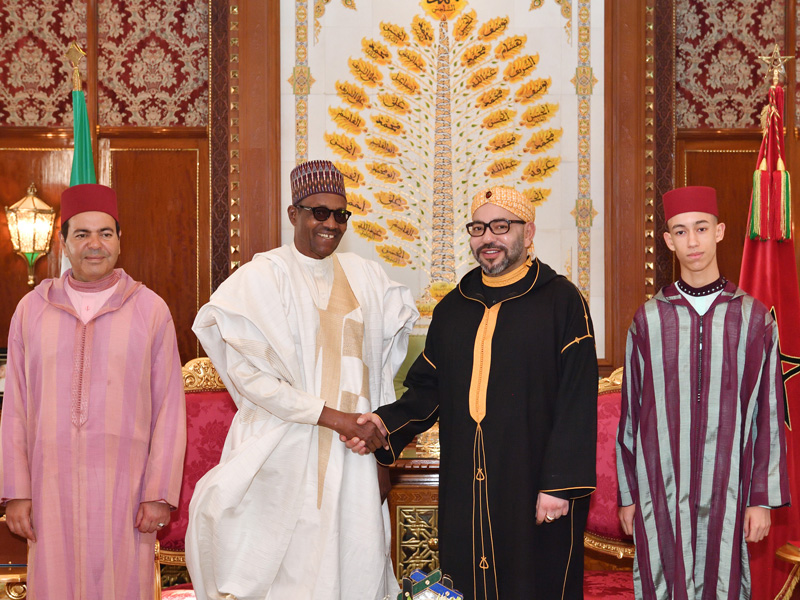
On July 19, 2026, in Freetown (Sierra Leone) for its 69th ordinary session, the summit of the Heads of State and Government of ECOWAS saw the signing of the Intergovernmental Agreement framing the development of the Atlantic African Gas Pipeline, initiated by His Majesty King Mohammed VI and the late Nigerian President Muhammadu Buhari with nearly 6,800 kilometers along the Atlantic coast, thirteen countries crossed and $20 billion in investment. Analysis.
ECOWAS has just endorsed in Freetown the Atlantic African Gas Pipeline initiated by the Kingdom of Morocco. What is your interpretation of this moment?
In line with the vision of His Majesty King Mohammed VI, may God assist him, Atlantic Africa asserts itself as a center, after having long been on the periphery. What happened in Freetown is about epistemological autonomy, a project designed in Africa for Africans, the gas will first meet the needs of West African development before meeting the demands of European markets. Africa is transitioning from a model of insertion in an extraverted globalization, marked by extractivism, to an endogenous model characterized by additivity and local value capture.
With the Intergovernmental Agreement signed in Freetown, the collective membership at the very heart of the regional integration body of ECOWAS gives political and institutional support to the Atlantic African Gas Pipeline, consolidating the founding impetus given by His Majesty. Ghana hailed it as a “historic” initiative, Togo as a Vision that opens up, and Gambia as a flagship project for the entire region. The project has become the property of all.
His Majesty conceived this gas pipeline as an instrument of African sovereignty and a vector of regional interdependence in the service of peace. As noted by the Minister of Foreign Affairs and International Cooperation Nasser Bourita, “Morocco’s true interests are never far from Africa’s true interests; and Africa’s true interests are never incompatible with those of the Atlantic.”
You are the Ambassador in Abidjan. What does this gas pipeline change for a host country like Côte d’Ivoire?
The tripartite memorandum of understanding signed in June 2024 between Côte d’Ivoire, Nigeria, and Morocco for the Atlantic African Gas Pipeline is expected to accelerate the industrialization of West Africa, by providing competitive electricity to over 340 million Africans.
It strengthens Côte d’Ivoire’s vocation to become the electric hub of the region. Trade between African countries still represents only 14% of the continent’s exports, while this rate reaches 68% in Europe. The African Continental Free Trade Area (AfCFTA) offers the appropriate legal instrument to correct this historical anomaly. The World Bank estimates that it could increase intra-African exports by 81% and the continent’s income by $450 billion by 2035. However, it needs to be filled with projects, and the PND 2030 is working on it.
No plan of this ambition can be successful without abundant and competitive energy. In fact, the gas pipeline is the fuel of the PND. Let’s look at the facts: natural gas provides about 70% of Ivorian electricity, and demand is growing by 10 to 15% annually. Côte d’Ivoire aims to increase its capacity to 5,000 MW by 2030 while remaining a net exporter of electricity in the sub-region. The gas pipeline brings to this trajectory its critical input, namely firm, predictable, competitive gas compared to diesel and spot LNG, in addition to the Baleine and Calao gas fields.
The first phase of the southern section of the gas pipeline is about 300 kilometers between Takoradi and Abidjan. Côte d’Ivoire is one of the pillars of the project, with its ports, diversified economy, and regional driving capacity. This role as a pillar dates back to before the 2024 memorandum: on February 18, 2020, Côte d’Ivoire opened a Consulate General in Laâyoune, the most populous city in the Southern Provinces that the gas pipeline will cross to connect to the Moroccan network.
This project has been ten years in the making. Many African mega-projects have not survived such a long time. Why this one?
Freetown crowns ten years of method and strategic patience: the course set in Abidjan since 2014 (“Africa must trust Africa”), the visit of His Majesty to Abuja in 2016, the ONHYM-NNPC agreement financing engineering studies in 2017, the joint declaration in 2018, the memorandum with ECOWAS and eleven countries between 2021 and 2023, the draft intergovernmental agreement agreed in Rabat in 2023, the provisions validated by the host countries at the end of 2024, and the signing in 2026.
This consistency is not unique to the gas pipeline, as more than 1400 agreements have been signed with African nations since His Majesty’s accession to the Throne, the result of a quarter-century of on-the-ground diplomacy. Grand designs are built at the pace of trust.
Today, the launch sequence is precise, first the creation of the project company based in Casablanca, and the governance authority of the gas pipeline, with its headquarters planned in Abuja. Then the mobilization of investors and the preparation for the final investment decision. Finally, the joint signature of Morocco and Mauritania, non-member states of ECOWAS. The first sections are expected to be operational at the beginning of the next decade.
Remind us of the purpose: what exactly are we building?
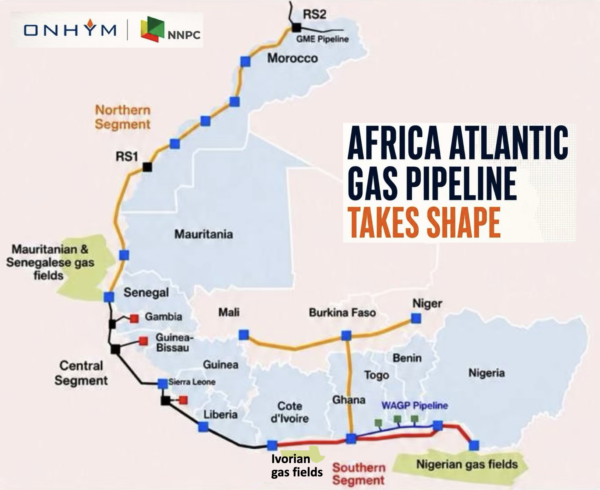
Nearly 6,800 kilometers, a capacity of 30 billion cubic meters per year, a connection to the European gas network via the Maghreb-Europe Gas Pipeline in the north of the Kingdom. The distribution says it all: up to 15 billion cubic meters can be exported to Europe through Morocco, while the other half will supply the regional markets of ECOWAS. This is the creation of an integrated natural gas market in West Africa, with a European window that consolidates its economic model.
The construction will be phased by sections, each supported by a dedicated company: to the south, extending the flows of the existing West African gas pipeline to Abidjan; to the north, connecting the gas fields of Senegal and Mauritania to the Moroccan network; in the center, unifying the whole. And this structure should be seen as a backbone with branches that will supply power plants and industrial zones along the route. This is already being done by ONHYM and JESA in Senegal with the gas-to-industry project.
Finally, I would like to add that the physical infrastructure is complemented by an intangible governance infrastructure. Just to give one example, the Atlantic African States Alliance has a component that brings together more than twenty countries around maritime security, intelligence, and counter-piracy, the security counterpart of the gas pipeline. Security is an invisible asset class, it is what makes a 6,800 km structure insurable. The gas pipeline is also designed to transport green hydrogen in the future, we are building for the century.
$20 billion. How to finance a project of such magnitude?
I would like to provide three clarifications. First, $20 billion is not financed in one go, but rather bankable sections, each backed by identified demand and a dedicated project company. Second, demand is not a working hypothesis, it is a demographic reality as there will be more children born in West Africa in the coming decades than in all OECD countries combined, and nearly 600 million Africans still do not have access to electricity. Finally, the execution risk is lower than one might think: Nigeria has been supplying gas to Ghana, Togo, and Benin through pipelines for over fifteen years. The Atlantic African Gas Pipeline does not start from a blank page, it extends a proven system.
Freetown adds a new guarantee, political and institutional mutualization on a regional scale. This is what long-term investors are looking for. According to BMCE Capital Global Research, this gas pipeline is expected to generate up to 50,000 temporary jobs per year at the peak of construction during its construction phase, and create up to 5,000 permanent jobs for its operation.
The added value of the gas pipeline starts with its African content in terms of intellectual capital. African engineering is already mobilized alongside ONHYM on project segments, as demonstrated by the engineering company JESA, which brings together 4000 experts, 38 nationalities with 95% African talent, and generates $1.8 billion in revenue with projects in 11 African countries.
Morocco defends the thesis of pan-African co-industrialization. How does the gas pipeline contribute to this?
His Majesty takes a humanistic approach to sustainable development, which is not only measured by GDP per capita growth. True social progress over time is measured by the upgrading of human capital and specializations, and therefore by the density of the intersectoral exchange table of an economy. The gas pipeline literally adds lines and columns to this table.
However, deeply transforming African agricultural and mining upstream sectors, rather than sticking to initial processing or refining, requires stable and competitive industrial energy.
Now there is nothing stopping us from thinking that an aircraft tire produced from Ivorian rubber transformed in Côte d’Ivoire will come out of the Moroccan aeronautical ecosystem tomorrow without going through Asia. The same logic applies to avocado transformed into guacamole for the American market, cotton transformed into textiles, or palm oil valued in agri-food, biscuit, spread, and cosmetic industries. In all these sectors, the constraint is the same: without competitive energy, there is no local transformation; and without transformation, there is no brand premium and no valuable CSR premium.
The Togolese Foreign Minister mentioned in Freetown the opening up of the Sahel. How does the gas pipeline fit in with the Atlantic Royal Initiative?
His Majesty the King launched this Initiative in November 2023, calling for the Atlantic coast of Africa to become “a space of human communion, a pole of economic integration, and a center of continental and international influence.” It aims to facilitate access for Sahel countries to the Atlantic Ocean.
The UN diagnosis is clear, isolation reduces a country’s development potential by about 20%. The sustainable response to the Sahel’s vulnerabilities lies in development as much as security. To this equation, His Majesty opposes on-the-ground, concrete, and solidarity-based solutions.
These projects form a single system, the gas pipeline, port infrastructure (Dakhla Atlantic and its 1650 hectares of industrial zones), road infrastructure in the Southern Provinces of the Kingdom (the largest bus station on the continent in Laâyoune), and electrical interconnections. All of this carries the seeds of an integrated African Atlantic space, therefore stable, therefore prosperous. The Atlantic Africa is not a symposium concept, it’s an ongoing project.

