



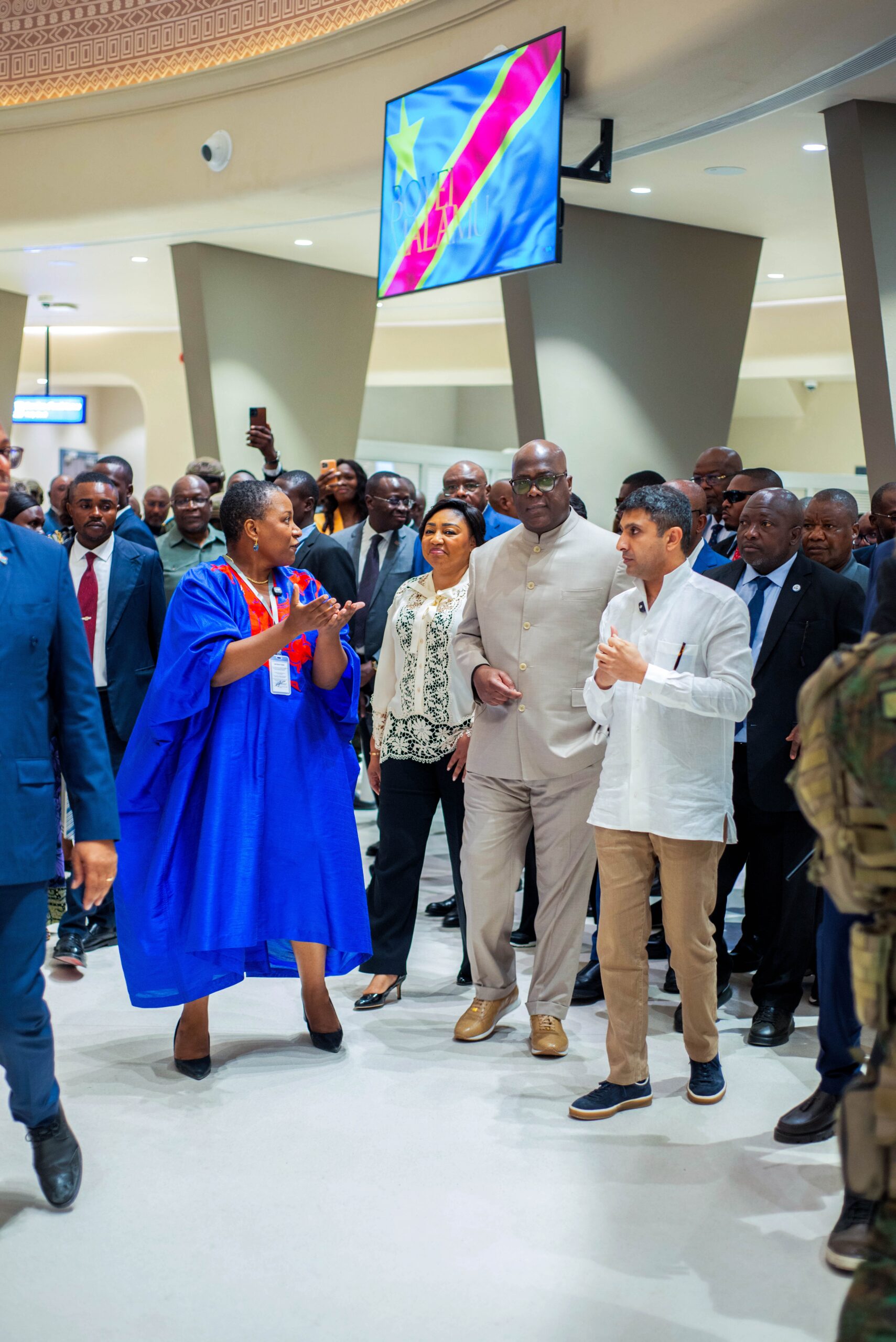
The inauguration of the renovated Rotunda at N’Djili International Airport has given new visibility to Infrarose, a subsidiary of Vinmart Group. Beyond the restoration of an iconic building, this project is part of a broader dynamic of modernizing infrastructure in the Democratic Republic of Congo, where needs remain significant.
On June 30, in Kinshasa, President Félix Tshisekedi inaugurated the rehabilitated Rotunda of N’Djili International Airport. The ceremony also marked the reception of a Boeing 787-800 for Air Congo and the symbolic reopening of a railway connection between the city center and the airport, which had been interrupted for over twenty years.
Beyond these announcements, this day reflected a larger ambition: to improve transport infrastructure to enhance the country’s connectivity and support its economic development. In a territory of continental dimensions, where logistical constraints continue to impact competitiveness, the modernization of transport platforms is a major challenge.
In this context, Infrarose, a subsidiary of Vinmart Group, led the rehabilitation works of the Rotunda, one of the historical buildings of N’Djili Airport. “The Rotunda is not just a renovated building. It is a symbol that we wanted to put back into motion. Our role at Infrarose is to show that it is possible to preserve the memory of an infrastructure while adapting it to today’s operational requirements,” explains Gracia Kabanga, director of stakeholder relations at Infrarose.
Reviving airport heritage
Built in the late 1950s, the Rotunda is part of the heritage of Congolese aviation. For several decades, it was one of the first images of the DRC for travelers arriving in Kinshasa. Over time, however, the building no longer met the expected standards in terms of reception, comfort, and operation.
The project aimed to preserve this heritage while adapting the structure to current requirements. The renovation is part of a broader strategy to improve airport infrastructure, as authorities aim to enhance the attractiveness of the country’s main entry points.
However, the Rotunda is not intended to replace Terminal 1. With an area of approximately 4,200 m² and a capacity to accommodate nearly 250 passengers in the departure area, it is designed to handle regional flows and complement existing facilities. Its efficiency will now depend as much on the quality of equipment as on the smoothness of daily operations: passenger processing, baggage handling, coordination between security, police, immigration services, and airlines.
Infrastructure at the heart of Congolese challenges
This renovation comes in a country where infrastructure remains one of the main challenges of development. Despite its significant mineral resources, hydroelectric potential, and an internal market of over a hundred million inhabitants, the DRC still suffers from a significant deficit in roads, energy, logistics, and public facilities.
For several years, the African Development Bank has estimated the continent’s annual needs at between $130 and $170 billion, with a financing gap estimated at between $68 and $108 billion. The OECD and the African Union, on their part, estimate that an annual investment effort of $155 billion could more than double Africa’s GDP by 2040. For Vinmart Group, the infrastructure deficit in the DRC is not just a diagnosis of delay. It outlines a map of opportunities. The group seems to have understood that the country’s next economic battle will not only be fought in the extraction of its resources but in the platforms that will enable their valorization.
In this perspective, the modernization of airport infrastructure responds to both an economic imperative and an image issue. Air platforms are often the first experience of a country for investors, international partners, and travelers.
Vinmart Group, a long-term strategy
The Rotunda project also highlights Vinmart Group, a pan-African group that is about to celebrate nearly thirty years of activity. Led by Rahim Dhrolia, a discreet profile, a shadow builder, it has gradually expanded into several sectors, including infrastructure, energy, real estate, hospitality, and agriculture.
Born in Toronto and raised between Kinshasa and Canada, Rahim Dhrolia studied at the Schulich School of Business in Toronto before returning to settle in Kinshasa. He has been working in the Democratic Republic of Congo for twenty years now, where he has developed an approach based on long-term investments in sectors that are structuring for the country’s economy.
According to several close associates of the group, the renovation of the Rotunda had a special dimension. Beyond its operational interest, the project concerned an iconic building in the history of Kinshasa. The goal was not only to restore an infrastructure but also to preserve a national heritage element while giving it functionality adapted to current needs.
This logic is found in the group’s other activities, also present in the hospitality sector through its subsidiary CHIC, as well as in real estate, energy, and public facilities. The whole reflects a strategy focused on sectors directly linked to the real economy and the improvement of living conditions.
A reference for Infrarose
For Infrarose, the renovation of the Rotunda is now a reference achievement. This project gives it increased visibility in a Congolese market expected to have significant infrastructure needs in the coming years.
“Our ambition is not to build isolated objects. We want to contribute to creating infrastructure that works, lasts, and concretely improves users’ experience. In a country like the DRC, reconnecting territories is also about restoring confidence in the ability to deliver structuring projects,” emphasizes Gracia Kabanga.
Beyond the architectural quality of the project, the success of this renovation will now be measured over time. Like any airport infrastructure, the Rotunda will be judged on its ability to offer efficient service, improve passenger experience, and meet the operational requirements of a modern platform.
In a context where the DRC intends to continue modernizing its transport infrastructure, the rehabilitation of the Rotunda is a significant step. For Infrarose and Vinmart Group, it represents a showcase of their expertise. For Congolese authorities, it illustrates the willingness to equip the country with more efficient facilities to support its economic development and its opening to the continent.

