



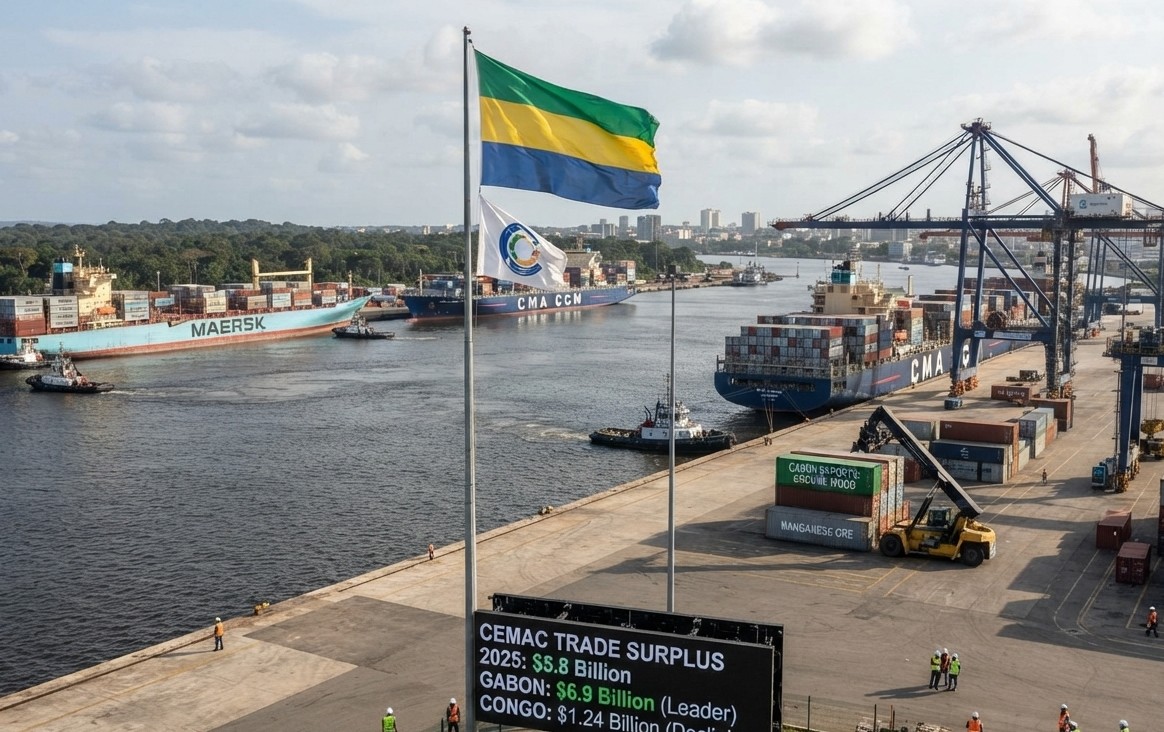
Gabon confirms its status as the main contributor to the trade surplus of the Economic and Monetary Community of Central Africa (CEMAC). In 2025, the country recorded a positive trade balance of 4,008.9 billion CFA francs (approximately 6.9 billion USD), according to data from the African Trade Report 2026 by the African Export-Import Bank (Afreximbank). This performance comes in a global context marked by falling commodity prices, logistical chain tensions, and a slowdown in global trade.
Regionally, the results remain mixed. While Gabon strengthens its external position, Congo has seen a dramatic deterioration in its trade surplus. This fell to 720.5 billion CFA francs (approximately 1.24 billion USD) in 2025, down from 2,644 billion CFA francs (approximately 4.55 billion USD) a year earlier. This represents a decline of over 70% on an annual basis.
Afreximbank’s report explains this underperformance by a double unfavorable movement. Congolese exports fell by 10.15% to 4.660 billion CFA francs (approximately 8.02 billion USD), while imports surged by 54.85% to 3.940 billion CFA francs (approximately 6.78 billion USD). This development significantly reduced the country’s trade surplus.
In contrast, Gabon demonstrated better resilience. Despite an unfavorable environment, the country maintained a high level of exports thanks to its sales of oil, manganese, and wood, while relatively controlling the growth of its imports. This combination allows Gabon to remain the leading trade surplus power in the sub-region.
Beyond national performances, these developments reflect the weakening of the CEMAC’s foreign trade. Forecasts from the BEAC and national administrations show a regional trade surplus of 3,370 billion CFA francs (approximately 5.8 billion USD) in 2025, down from 6,914 billion CFA francs (nearly 11.9 billion USD) in 2024. In one year, the community loses more than half of its external trade cushion.
This deterioration mainly reflects the decline in export revenues of oil-producing countries, due to falling oil prices and less dynamic global demand. It also highlights the strong dependence of the CEMAC economies on commodities, the fluctuations of which continue to influence the region’s macroeconomic balances.
In its analysis, Afreximbank emphasizes that “the diversification of African economies remains essential to strengthen their resilience to external shocks.” The institution also believes that “the development of intra-African trade is a major lever to reduce countries’ vulnerability to fluctuations in international markets.”
For the CEMAC, the 2025 figures illustrate two opposite realities. On one hand, Gabon consolidates its role as the commercial locomotive of the sub-region. On the other hand, the marked decline in Congo reminds us that the strength of trade balances is closely linked to the evolution of global oil markets and the ability of states to diversify their sources of growth.

