



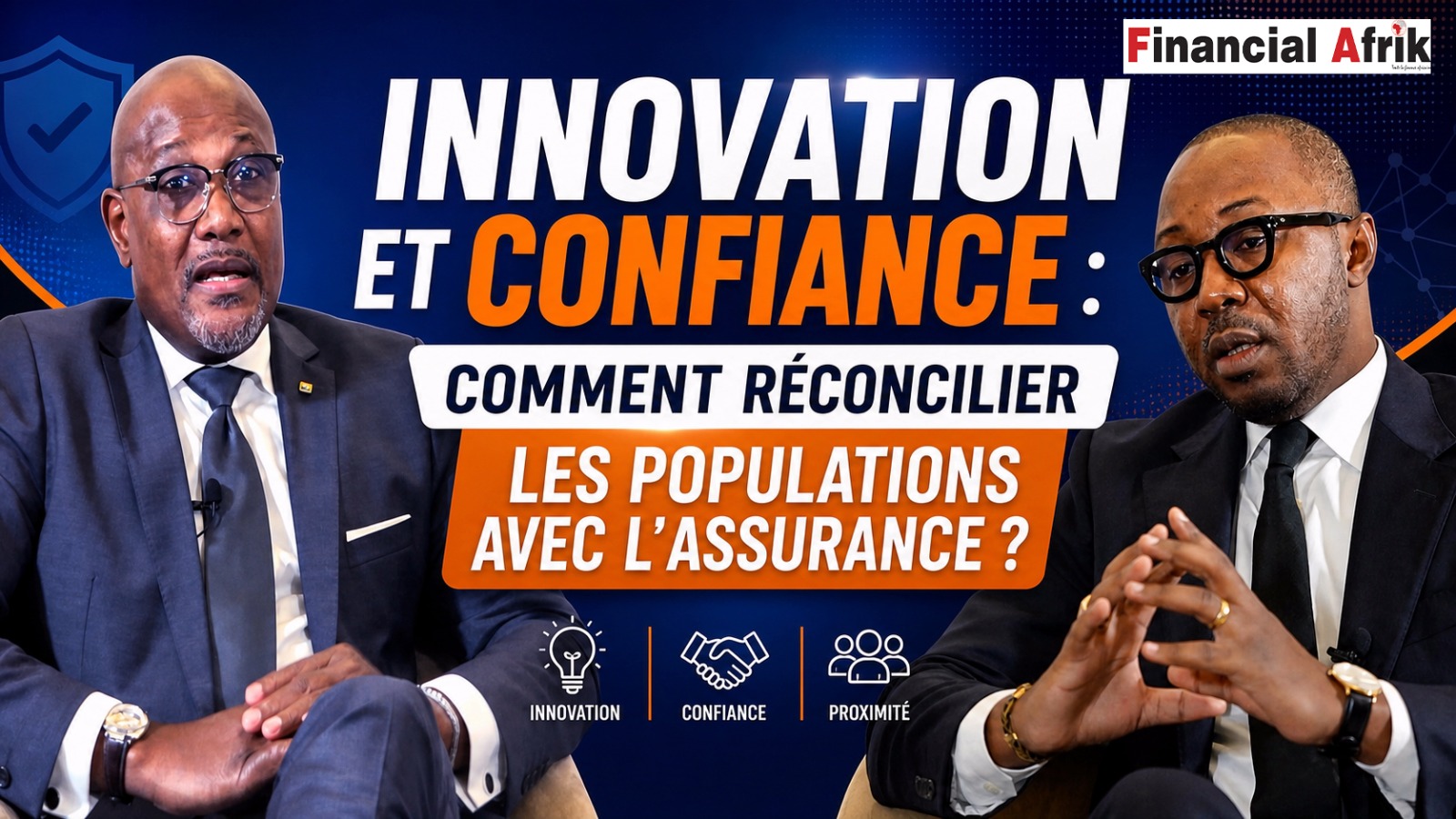
Gathered in Cotonou during the General States of Insurance for All, stakeholders in the sector have made an observation: insurance still struggles to convince a large part of the African population. Guests on Financial Afrik TV, Guy Lawson-Body, CEO of Wafa Assurance Vie Côte d’Ivoire, and Yves Kessin, general agent of Wafa IMA Assistance for the CIMA zone, pleaded for a profound transformation of the relationship between insurers and insured, based on simplicity, proximity, and concrete proof of the service provided.
Right from the start, Guy Lawson-Body recalled that the issue of trust is not a temporary one. “Consumer mistrust (…), it is as old as the world,” he observes, pointing out that insurance still appears as a technical, opaque universe, sometimes distant from the real expectations of the public. For the executive, the answer lies first in a massive effort of education: “there is clearly a need for a high level of information, a high level of education.” In other words, the sector can no longer be content with selling guarantees; it must also learn to speak more clearly to its clients.
This reconquest also requires a review of the offer itself. Guy Lawson-Body emphasizes the need to “create products that our future clients understand,” but also to “speak the language they want to hear, that they can hear.”
Behind this formula, there is an implicit critique of traditional practices: complex contracts, heavy procedures, distribution often concentrated on formal channels. This is what leads the head of Wafa Assurance CI to indicate that innovation should not only concern products, but also “processes, distribution processes, customer access processes.”
To this demand for clarity, Yves Kessin adds that of immediate usefulness. For the head of Wafa IMA Assistance, one of the best ways to reconcile populations with insurance is to show that it acts when the need arises. “This is precisely the purpose of assistance, being available 24/7,” he explains. He describes a “hot claim management,” focused on action and logistics: towing, breakdown assistance, replacement vehicle, ambulance, doctor or emergency medical advice. This service, he says, transforms the abstract promise of insurance into concrete, perceptible, immediate assistance.
The two speakers mainly agree on one point: the speed of settlement now conditions the sector’s credibility. “He paid a premium, he wants to be compensated and in the best possible timeframe,” summarizes Guy Lawson-Body. Who emphasizes especially the “simplicity in claims settlement” and “in the payment of premiums.” Because, he warns, “compensating the client but with a lot of delay is perceived as a refusal of compensation.”
In essence, this discussion outlines a clear roadmap for inclusive insurance in Africa: better explanation, further simplification, diversification of distribution channels, acceleration of payments, and proving the value of the service through assistance. A way to remind that, in this sector more than any other, trust is not decreed: it is built, daily, through the client’s experience.

