



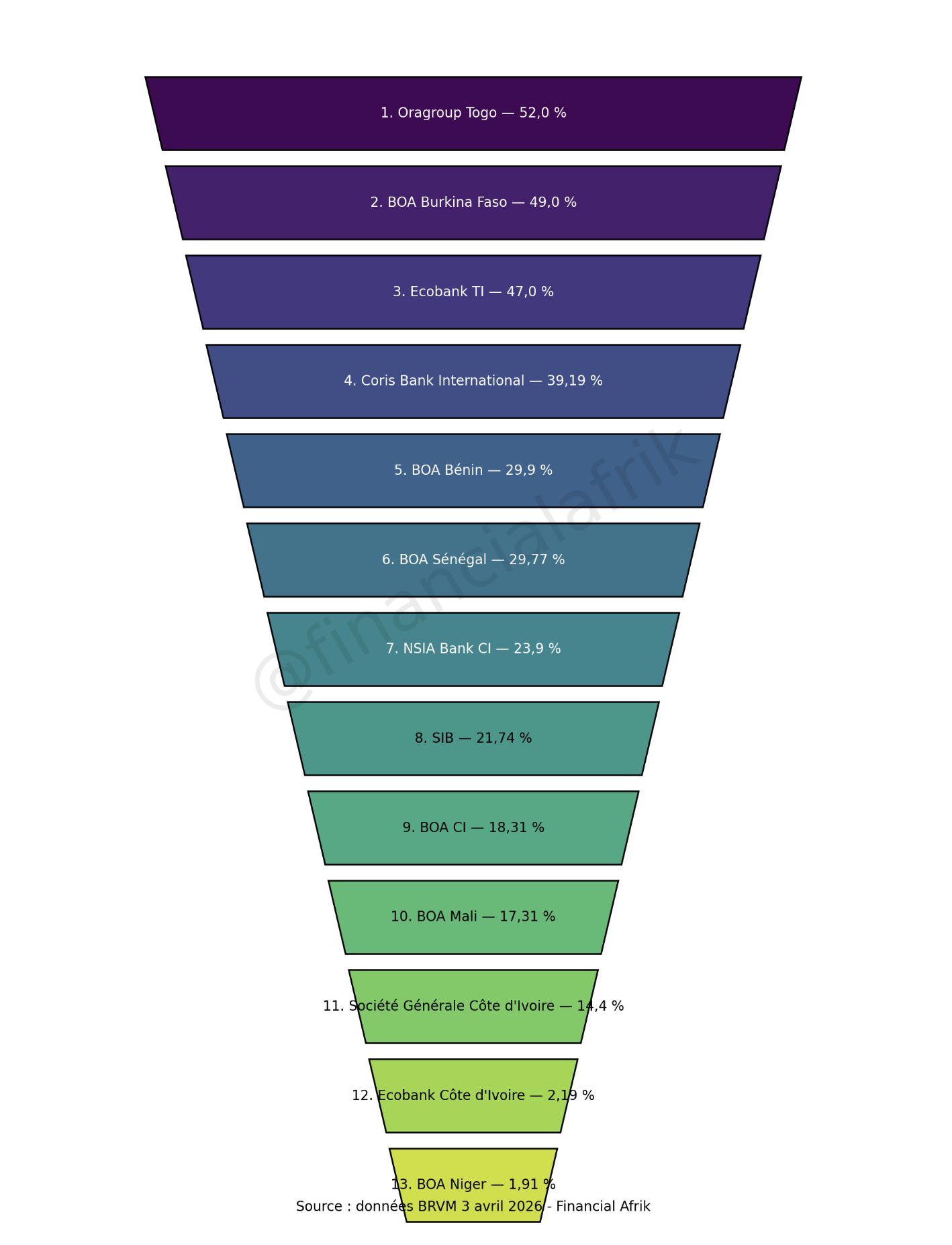
As of Friday, April 3, 2026, the hierarchy of banking performances on the Regional Stock Exchange of Abidjan (BRVM) over the past year places Oragroup (+52%), BOA Burkina Faso (+49%) and Ecobank Transnational Incorporated (+47%) at the top of the sector’s performances. This ranking is based on price variations which, in the specific context of the BRVM, must be correlated with trading volumes and, ultimately, the liquidity of the securities in question. Indeed, price formation on the regional market of the West African Economic and Monetary Union (UEMOA) is largely influenced by occasional, sometimes shallow transactions, which can mechanically amplify price fluctuations. In the absence of sustained liquidity, stock performance alone cannot be a robust indicator of value creation.
Furthermore, Oragroup’s leading position raises questions considering the situation of the banking group, which has been looking for new shareholders for almost two years after Vista’s unsuccessful attempt. Oragroup’s stock is at the top of the ranking without the market having recent updates on its consolidated financial statements. The last update of Oragroup’s financial statements on the official BRVM website dates back to September 30, 2024. Under these conditions, the recorded progress seems more like an anticipation of revaluation, reflecting market expectations of operational recovery or future strategic arbitrations, rather than a strict analysis of actual performances.
Overall, the recent market trend suggests a well-known phenomenon to observers: pre-dividend positioning. As general meetings approach, investors – both institutional and individual – reposition themselves on banking stocks offering visibility on dividends distribution. The shareholders’ meetings of Coris Bank International on April 16 and Bank of Africa Côte d’Ivoire on April 15 illustrate this classic mechanism, where the quest for yield outweighs pure capital appreciation.
In this context, the dispersion of performances – from over 50% for the best stocks to less than 2% for some – reflects both differentiated economic realities and amplified market effects. It also highlights the persistent duality of the BRVM: a place with strong potential, structured around solid banking actors, but still under construction in terms of informational efficiency and market depth.
Overall, this ranking, useful for capturing trends, should be read for what it is: an instantaneous snapshot of prices, and not a verdict on the intrinsic value of listed banks. On the BRVM more than anywhere else, analysis requires going beyond surface price fluctuations to focus on fundamentals, flows, and distribution schedules.

