



Despite a long-standing presence and close ties with local markets, French groups are seeing their positions in Africa erode. However, the dynamism of the continent offers significant growth opportunities, a potential highlighted during the Africa Forward summit. Several companies are strengthening their positions in Africa, such as Orange, Engie, Limagrain, and GBH.
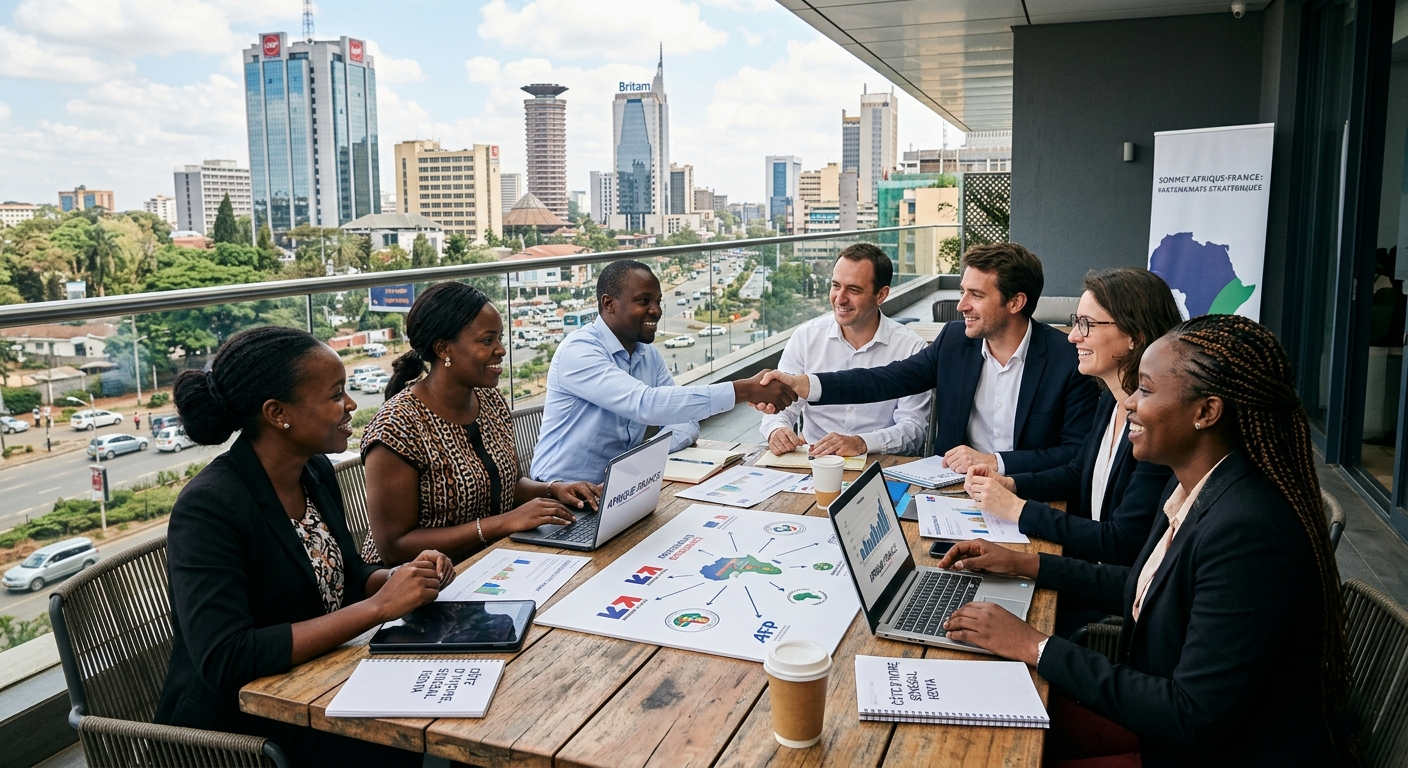
23 billion euros in investments announced, bilateral contracts with Kenya, thousands of business leaders gathered in Nairobi: on May 11 and 12, 2026, the Africa Forward summit underscored the strategic role of Africa for the French economy.
More than 5,000 French companies are established in Africa, where they generate over 100 billion euros in revenue. Apart from the extractive sector, with companies like TotalEnergies or Orano, both large groups and SMEs primarily target the needs of local markets.
Seed company Limagrain, the fourth global player in the sector, has expanded its presence in southern Africa since 2006: South Africa, Lesotho, Eswatini, Namibia, Mauritius, and Madagascar. The group relies on local agronomic research units to adapt its seeds to the soils, climates, and agricultural practices of each country.
Orange, Engie, GBH: French groups accelerating in Africa
Following in Limagrain’s footsteps, several major French groups are increasing their investments in Africa. Orange continues its expansion in telecommunications, while Engie and Veolia are involved in numerous projects related to water, sanitation, and energy. In the construction sector, Vinci, Bouygues, and Eiffage remain highly active in major road, port, and public infrastructure projects.
Groupe Bernard Hayot (GBH) has also significantly expanded its presence in Africa, in agribusiness and automotive distribution. Through its subsidiaries Banaci and Bacibam, the company has become the leading producer of organic bananas in Côte d’Ivoire in a decade, focusing on eco-responsible agriculture that supports producers.
GBH has also developed a vast network of automotive dealerships in West Africa and the Maghreb, distributing several international brands. In Morocco, the group recently strengthened its activities in transportation by partnering its subsidiary Bamy Trucks with the industrial vehicle manufacturer Forland Motors.
International competition reshuffles the deck
However, these successes contrast with the caution adopted by several major French groups. According to Étienne Giros, president of CIAN, the association of French companies present in Africa, many executives overestimate the “African risk” to the point of abandoning their projects.
EDF has abandoned several projects citing “country risk”, while BNP Paribas, Crédit Agricole, and BPCE have divested a large portion of their African subsidiaries. This retreat also affects medium-sized companies, such as GreenWish Partners in solar energy or Artelia in engineering.
French positions are also being undermined by increasingly aggressive foreign competition. In Senegal, French companies, which once dominated public markets, now only hold 5%, compared to over 30% for Chinese groups. A similar situation is observed in Côte d’Ivoire, where Chinese and Turkish companies are winning major road projects historically dominated by Vinci or Eiffage. In the energy sector, Chinese and American groups, as well as Gulf investors, are rapidly gaining ground in West Africa at the expense of French players.
Can French companies regain ground?
Contrary to the perception of many French executives, Africa is not a particularly risky investment zone. According to data from Moody’s Analytics relayed by the African Development Bank, the average loss rate on the continent stands at 1.7%, well below the levels observed in Latin America (13%) or Eastern Europe (10%).
According to Étienne Giros, the profitability prospects in Africa are even higher than in many other regions of the world. Driven by the rise of the middle class and demographic dynamics, many African markets are expected to quickly increase in size and purchasing power. In this context, the president of CIAN believes that French companies are still “too hesitant in Africa” and calls on them to “re-engage on the continent”.
Events like Africa Forward aim to strengthen economic ties between France and African countries. In Nairobi, the business forum held alongside the summit brought together several thousand French and African leaders to identify new opportunities and forge partnerships. A sign of renewed interest in the continent, business meetings organized by Business France attracted many more entrepreneurs than expected. “We had estimated the number of appointments at 400 and we had more than double that,” says Louis Margueritte, CEO of the public organization. Companies of all sizes are attracted by these prospects. “Africa is now part of our development priorities. We are carrying out school sports projects, leisure projects, but also high-level competition projects,” explains Adil Sarhiri, export manager of the SME Metalu Plast, the leading French manufacturer of sports equipment. In Nairobi, the company has held discussions with several African sports federations that could lead to future contracts.

