



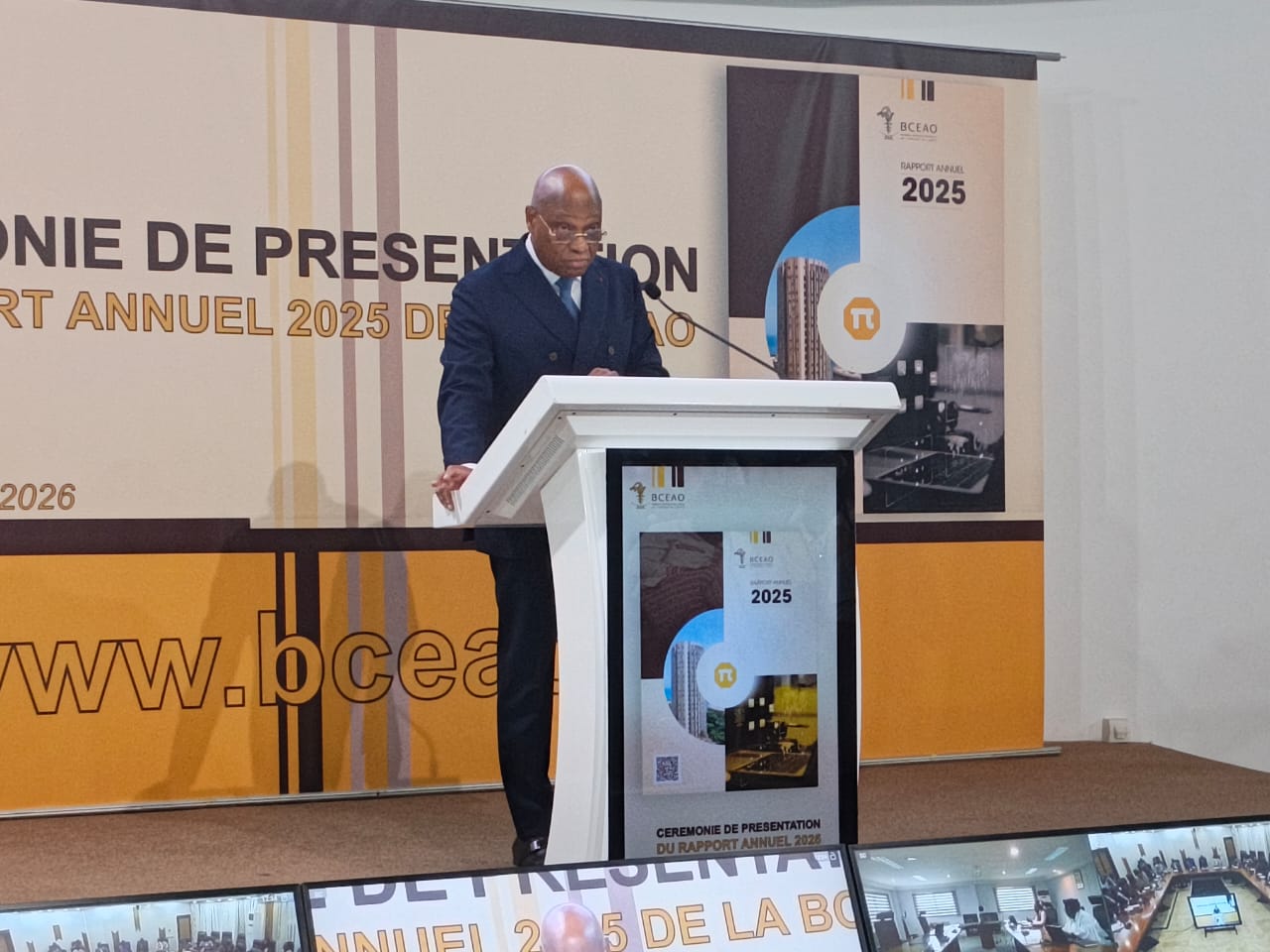
The Central Bank of West African States (BCEAO) presented its 2025 Annual Report on Wednesday, July 22 in Dakar. The document outlines the actions taken, decisions made, and results achieved in the exercise of its missions, in an economic and financial environment marked by profound changes. In 2025, the institution structured its actions around three strategic priorities: controlling inflation, strengthening financial system stability, and accelerating financial inclusion and innovation.
The year 2025 unfolded in an uncertain international context, marked by rising protectionism, tightening trade barriers, persistent fragmentation of global trade, and financial market volatility. Regionally, security challenges and the effects of climate change continued to weigh on the economies of the Union. Despite these constraints, the West African Economic and Monetary Union (UEMOA) economy, according to the BCEAO, demonstrated resilience.
Inflation and financial stability at the heart of action
In this context, “the first priority of the BCEAO was to contain inflation in order to preserve the purchasing power of the population and maintain an environment conducive to investment. To achieve this, the Central Bank adjusted the orientation of its monetary policy based on the evolution of inflationary pressures,” said BCEAO Governor Jean-Claude Kassi Brou.
The institution also continued to strengthen the regulatory and prudential framework, especially in the banking and microfinance sectors, as well as in the fight against money laundering and the financing of terrorism. “These reforms aim to strengthen the solidity, resilience, and stability of the regional financial system,” added the governor.
Financial inclusion, innovation, and instant payments
Promoting financial inclusion remained another major focus of the Central Bank’s action. To this end, the BCEAO adopted a new regional financial inclusion strategy, with the objective of improving access to financial services and their use, with particular attention to women, youth, and small and medium-sized enterprises.
The Central Bank also established a financial innovation laboratory to experiment with new products and services, while supporting the development of financial technologies within the Union.
The ‘PI-SPI revolution’
The year 2025 also saw the continued modernization of payment infrastructures, notably with the launch of the PI-SPI platform. According to the BCEAO, this innovation aims to reduce the fragmentation of payment systems in the UEMOA by offering more interoperable, faster, instant, accessible, secure, and cost-effective services, benefiting populations and businesses.
Lastly, in the face of accelerating technological innovations, the BCEAO continued its work on digital transformation and the integration of artificial intelligence into its activities. To this end, it organized a conference dedicated to artificial intelligence to define the strategic directions of its integration within the Central Bank, while involving financial sector actors, public authorities, and other stakeholders in the digital ecosystem, concluded the governor.

