



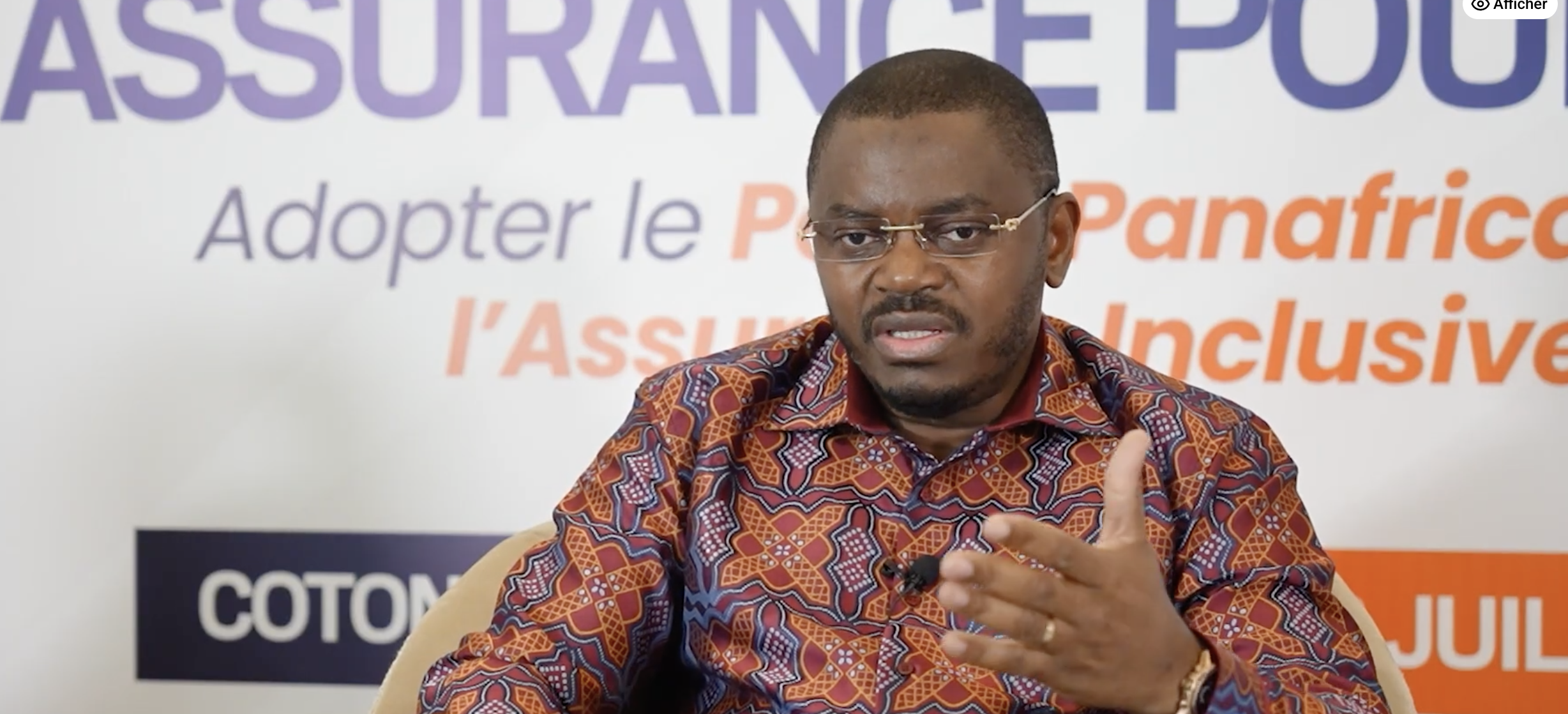
Cotonou. As the first General States of Insurance for All conclude with the adoption of the African Pact for Insurance for All, Dr. Crépin Gwodog, founder and CEO of Samba Insurance, defends a conviction: the real challenge of African insurance is no longer to improve existing products, but to change the paradigm. For this former Gabonese minister, with twenty-five years of experience in the sector, the future lies in inclusive insurance designed for the economic and social realities of African populations.
A graduate of the International Institute of Insurance (IIA) and after a career in several companies in the CIMA zone, then at the head of the Gabonese Commercial Reinsurance Company (SCG Ré), before a stint in the Gabonese government, Crépin Gwodog believes he has drawn the same conclusion throughout his career: the traditional insurance model fails to cover the majority of Africans.
With a penetration rate of less than 2% in most countries in the CIMA zone, insurance remains largely inaccessible to low-income households and informal sector workers. “The question is no longer why the penetration rate is low, but how to bring insurance to populations that are excluded from it,” he summarizes.
It is on this conviction that Samba Insurance was born, a company specializing in microinsurance. Its ambition is to design products adapted to irregular incomes, professional realities, and daily constraints of populations traditionally excluded from the market. In Gabon, the company even claims the nickname of “insurer of the Makaya,” a popular expression referring to people with modest incomes. For Crépin Gwodog, it is precisely this silent majority that constitutes the main growth market for African insurance.
According to him, innovation does not only lie in technology, but first and foremost in the ability to adapt contracts to the needs of policyholders. Distribution channels must also evolve, combining physical proximity networks and digital solutions accessible via mobile phones to reduce costs and reach territories still far from traditional circuits.
Present in Cotonou, the leader sees in the first General States of Insurance for All a turning point for the profession. For the first time, he emphasizes, the entire ecosystem – insurers, public authorities, regulators, and partners – is coming together around a common goal: to make insurance inclusion a true continental project. In the expert’s view, the adoption of the African Pact for Insurance for All should not remain a mere commitment. It should lead to concrete reforms, including an evolution of the regulatory framework for microinsurance.
“We can no longer regulate microinsurance like traditional insurance,” he insists. Prudential requirements, distribution methods, and operating rules must be adapted to the specificities of a market where policyholders have limited incomes and low banking penetration.
Crépin Gwodog also calls on states to support this transformation by making microinsurance a public policy instrument, similar to microfinance. He finally invites companies to invest heavily in this segment rather than seeking to replicate models designed for an already solvent clientele. His message also directly addresses African populations: insurance should no longer be seen as a service reserved for a minority. “It is now up to insurers to reach out to populations, listen to them, and transform their needs into suitable products,” he asserts.
For the founder of Samba Insurance, if the commitments made in Cotonou are followed by action, the continent could gradually increase its penetration rate from less than 2% to 3%, 4%, or even 5% in the coming years. A progression that would make insurance not a privilege reserved for a few, but a true tool of economic and social protection in the service of African development.

