



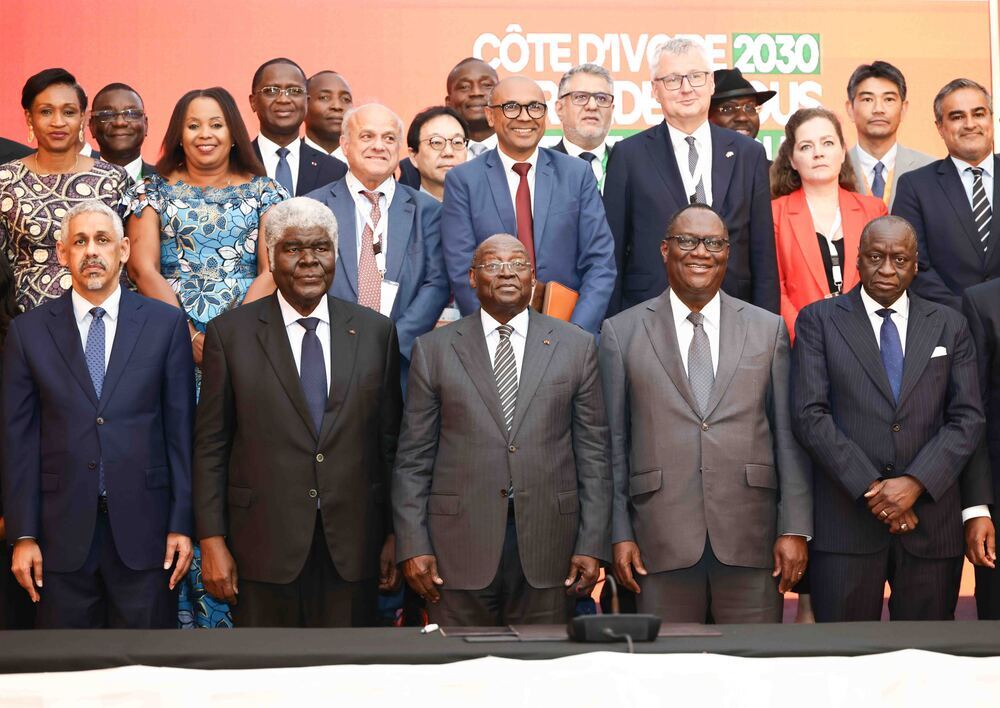
Ivory Coast marked a turning point on Wednesday, July 8, 2026 during the first day of the Consultative Group meeting for the financing of its National Development Plan (NDP) 2026-2030. Gathered in Abidjan under the chairmanship of Vice-President Tiémoko Meyliet Koné, representing President Alassane Ouattara, development partners expressed renewed confidence in the Ivorian economy. The announced financing intentions reached a total amount of 47,820 billion CFA francs (80 billion US dollars), nearly four times the initial target set at 11,138.2 billion CFA francs (20.3 billion US dollars). The meeting brought together more than 3,000 participants from 49 countries.
This financial success crowns the country’s macroeconomic performance, which maintained an average annual growth of over 6.5% over the period 2021-2025, despite the effects of the Covid-19 pandemic, geopolitical tensions, and climate change. This dynamic has doubled the GDP in fifteen years and reduced the poverty rate from 55.4% in 2011 to 37.5% in 2021. It now serves as the foundation for the new vision “building a stable, prosperous, united, and ambitious Ivory Coast.”
With a target annual average growth rate increased to 7.2% for the next five years, the 2026-2030 NDP displays a clear ambition: to accelerate the structural transformation of the country through a comprehensive investment program of 114,838.5 billion CFA francs, approximately 209 billion US dollars.
The financing mechanism of the NDP is based on a strategic articulation between the public and private sectors. While the state covers 29.8% of the total investment cost, amounting to 34,223.9 billion CFA francs, the private sector is called upon to play a leading role by covering 70.2% of the needs, totaling 80,616.6 billion CFA francs. The exceptional mobilization recorded in the early hours of this conference testifies to the attractiveness of the Ivorian model for major international donors, including the World Bank, the African Development Bank (AfDB), the United Nations system, the European Union, and the Islamic Development Bank (IDB), all mobilized alongside the government. Among the personalities present were Ousmane Diagana, Vice President for West and Central Africa at the World Bank Group, and Amina Mohammed, Deputy Secretary-General of the United Nations.
To ensure the optimal implementation of this ambitious program, Vice-President Tiémoko Meyliet Koné reiterated the government’s commitment to maintaining high standards of governance. Transparency, accountability, and performance have been placed at the heart of the monitoring and evaluation system, with the aim of securing investments and maximizing the socio-economic impact of projects. In closing the meeting, the Vice-President emphasized that “the shared responsibility will now be to translate these announcements into effective commitments and projects that are concretely implemented.”
Meanwhile, Prime Minister Robert Beugré Mambé reaffirmed Ivory Coast’s role as an economic powerhouse in the West African sub-region.
The work continues on July 9, 2026 with a day dedicated to private investors, who are called upon to provide more than 70% of the plan’s financing.

