



While Côte d’Ivoire has just obtained financial commitments well above expectations for its National Development Plan 2026-2030, another challenge is emerging: the ability to transform national priorities into bankable, exploitable, and attractive projects for private investors. It is in this dynamic that the project of the Artisans Village of Grand-Bassam, led by Africa Currency Network, with MOPAT Group as a strategic partner, fits.
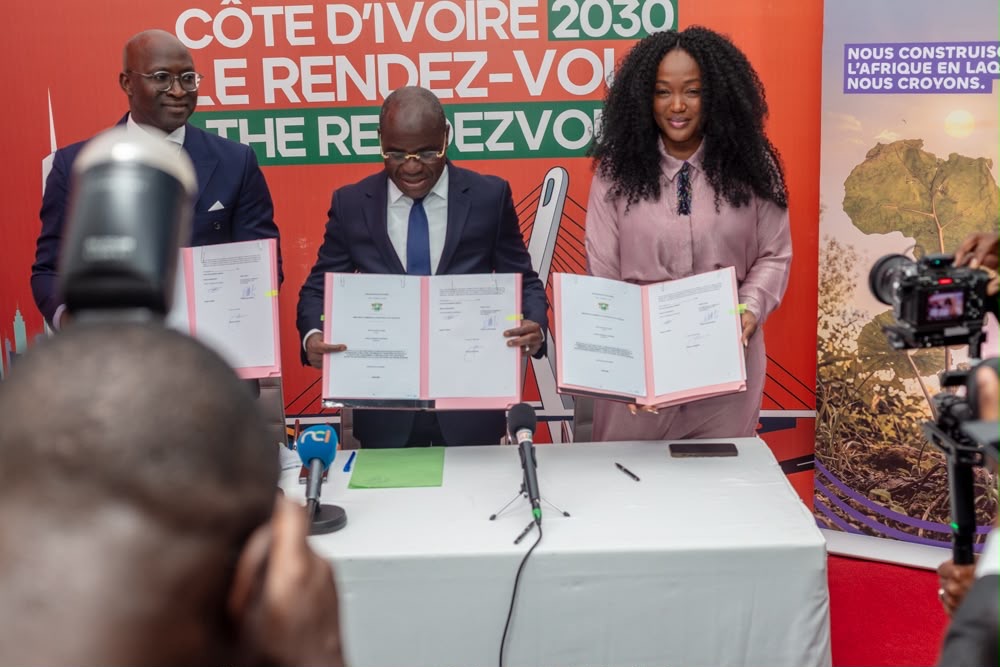
On July 8, 2026 in Abidjan, the State of Côte d’Ivoire, represented by the Ministry of Commerce, Industry and Handicrafts, signed a memorandum of understanding with the National Steering Committee for Public-Private Partnerships (CNP-PPP) and Africa Currency Network (ACN) to launch the project development phase.
Estimated between 18 and 20 billion FCFA, the Artisans Village of Grand-Bassam aims to structure an integrated destination around craftsmanship, living heritage, hospitality, gastronomy, events, and cultural and creative industries. Developed on a land of approximately 22,130 m², the future site should accommodate and professionalize over 600 artisans.
The National Development Plan 2026-2030 places the private sector at the heart of execution
The project intervenes in a particular economic context. The National Development Plan 2026-2030 foresees a total investment volume of 114,838.5 billion FCFA, with an average annual growth target of 7.2%. Of this amount, 70.2% of investments are expected from the private sector. During the first day of the Consultative Group for the financing of the NDP, development partners announced 80 billion dollars in financial commitments, approximately 47,820 billion FCFA. These announcements far exceed the initial objective of public financing mobilization. However, the success of the Plan will also depend on the ability to develop concrete, structured, and robust projects to mobilize private operators, investors, and financial partners.
The Artisans Village of Grand-Bassam precisely illustrates this transition from ambition to operational structuring. It is not only about rehabilitating a craft space, but about building an economic model around a territorial, cultural, and tourist asset. “This signature is an important step, as it marks the opening of the project development phase. It is now a matter of deepening studies, specifying the program, and structuring the various institutional, technical, legal, and financial aspects of the project,” said Moussa Kouyaté, President of the CNP-PPP.
The project is part of a broader economic dynamic. According to UNESCO, cultural and creative industries represent 3.1% of the global GDP and 6.2% of global employment. In Côte d’Ivoire, the NDP 2026-2030 also aims to increase the value added of tourism and leisure from 8.6% of GDP in 2024 to 11% in 2030.
Transforming living heritage into an economic platform
The project aims to go beyond the classic artisan market model. It includes workshop-boutiques, craft galleries, training spaces, hotel offerings, a Gourmet Hall, event spaces, coworking, services, and cultural programming. “The goal is to make our craftsmanship a more competitive sector, capable of better valorizing Ivorian talents and know-how, both in the national and international markets,” said Ibrahim Kalil Konaté, Minister of Commerce, Industry, and Handicrafts.
This diversification is a central element of the model. It avoids the economic balance of the project relying solely on artisans. The challenge is rather to make craftsmanship the heart of a larger ecosystem, integrating tourism, design, training, creative economy, and territorial attractiveness. “Our ambition is not simply to build another place or market. We want to create a true ecosystem around craftsmanship, creation, knowledge transfer, and experience. Africa has extraordinary know-how, but today we must succeed in better structuring the entire value chain. Behind each object, there is a material, a gesture, a technique, a story, and above all an artisan. It is essential that the created value also benefits those who are at the origin of this creation,” said Habyba Thiero, CEO of Africa Currency Network.
Complementarity between ACN and MOPAT Group
Africa Currency Network acts as the initiator and carrier of the project. The pan-African holding company intends to make the Village an integrated economic platform, capable of combining social impact, heritage valorization, territorial development, and sustainable operating model.
MOPAT Group acts as a strategic partner of ACN. Its role will be crucial in the development phase, which must structure the institutional, technical, legal, financial, and operational setup of the project. “As a strategic partner of Africa Currency Network, MOPAT Group is fully committed to supporting this development phase. Our role will be to contribute to the structuring of the project, mobilization of expertise and partners, and preparation of an economic and financial model capable of ensuring its realization and sustainability,” said Mouhamad Rassoul Dieng, CEO of MOPAT Group.
This intervention positions Africa Currency Network and MOPAT Group in a key segment: that of transforming a public or territorial priority into a financeable project. In the context of the Artisans Village, the challenge will be to mobilize technical, operational, and financial expertise, identify partners, structure the revenue model, and prepare the conditions for sustainable operation.

