



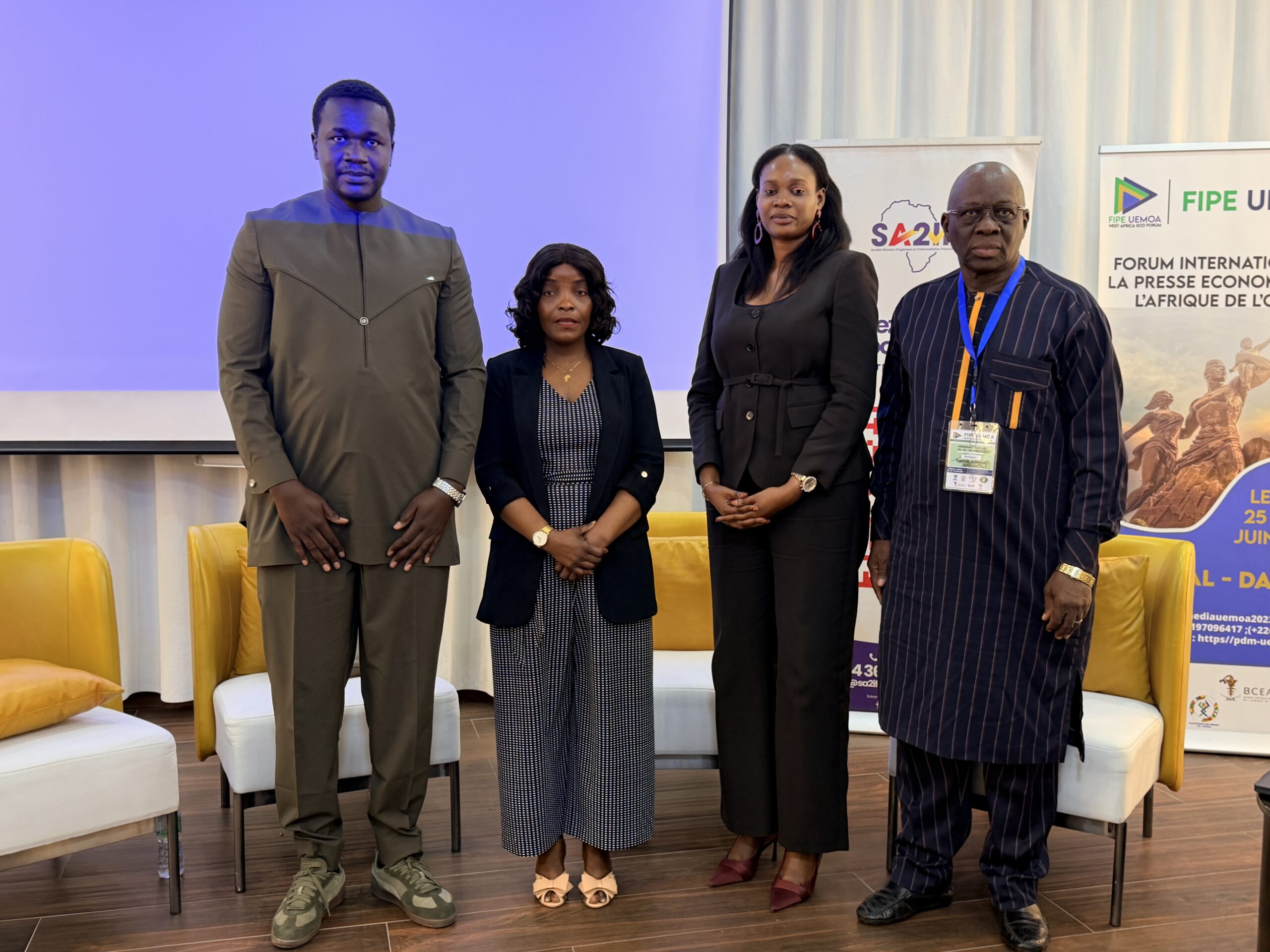
Gathered in Dakar as part of the first International Forum of Economic Press of West Africa (FIPE-UEMOA), experts in public finances, tax officials, and civil society actors emphasized the central role of tax harmonization, transparency, and the fight against corruption in the success of regional economic integration.
Speaking at a panel dedicated to governance and regional economic policies, Ndèye Nangho Dioum, Inspector of Taxes and Domains of Senegal, pointed out that the coordination of fiscal policies is an essential pillar of any integrated economic space. According to her, tax harmonization helps to avoid harmful tax competition between states and ensure fair conditions for businesses within the UEMOA.
She recalled that the Union’s tax harmonization process has been ongoing since the late 1990s, with reforms covering both indirect and direct taxation. The objective is to strengthen domestic resource mobilization while preserving the economic attractiveness of member states.
Progress, but persistent challenges
Despite the progress made, participants noted that Union countries still fall short of the community goal of a tax burden set at 20%. Senegal appears to be the country closest to this target with a rate of 18.2%, while several states still lag behind community standards.
Experts also stressed the need to strengthen the fight against tax evasion, abusive transfer pricing, and aggressive tax optimization practices used by some multinationals. In this regard, UEMOA and ECOWAS have adopted several instruments in recent years to facilitate the exchange of tax information and combat erosion of tax bases.
Senegal, a good student of budget integration
Treasury Inspector Modou Bèye highlighted Senegal’s efforts in transposing community directives. According to him, the country is among the best students in the Union in terms of integrating budgetary and tax standards.
He explained that the convergence of economic and budgetary policies is essential to ensure the macroeconomic stability of the Union. Delays in transposing community texts can create disparities, reduce states’ visibility on their public revenues and expenditures, and hinder the effectiveness of regional policies.
Modou Bèye also emphasized the need to strengthen the Union’s resilience mechanisms in the face of external shocks, whether they are health, climate, or energy-related. He particularly advocated for the creation of a regional stabilization fund to help states cope with future crises while preserving community budget discipline.
The Treasury Inspector also reminded that a country’s attractiveness does not depend solely on its level of taxation. The stability of tax rules, legal security, the quality of institutions, and the predictability of public policies are also decisive criteria for investors.
Corruption, a hindrance to economic attractiveness
President of the National Network for Anti-Corruption (REN-LAC) of Burkina Faso, Pissyamba Ouédraogo, pointed out that regulatory disparities and deficiencies in control mechanisms favor corruption practices and illicit financial flows.
According to him, the fight against corruption cannot rely solely on public institutions. It also requires the active involvement of civil society, the media, and citizens to strengthen accountability and control over the management of public resources.
The expert also emphasized that the perception of corruption directly influences investment decisions. Poor governance increases risks for investors and reduces the economic attractiveness of the countries concerned.
A strategic role for economic media
The panelists unanimously recognized the importance of economic press in promoting transparency and good governance. By facilitating access to economic and budgetary information, the media contribute to enlightening public debate and strengthening citizen control over the management of public finances.
At the end of the discussions, participants called for an acceleration of reforms in economic governance, budget transparency, and regional cooperation to consolidate West African economic integration and strengthen states’ resilience to economic, climate, and health shocks.

