



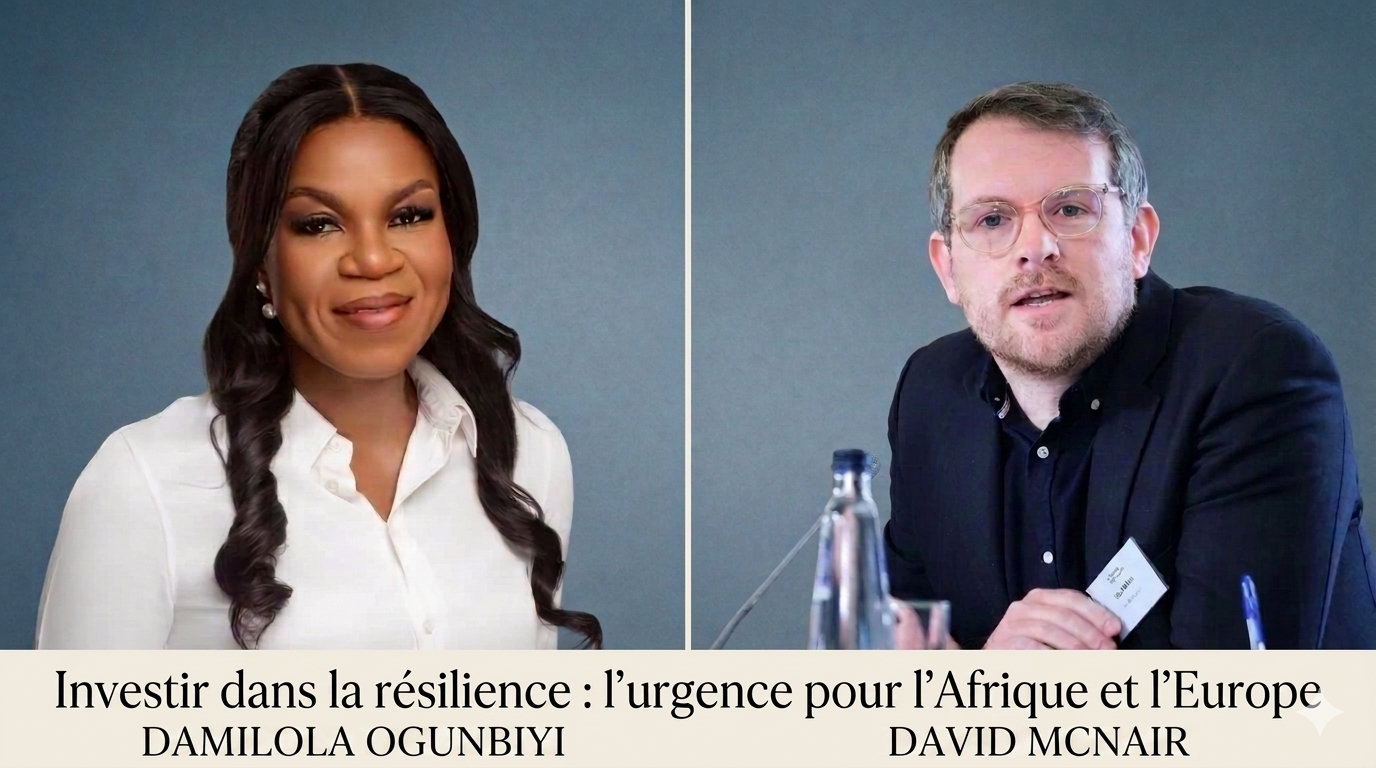
In this op-ed, Damilola Ogunbiyi, CEO of Sustainable Energy for All and Special Representative of the UN Secretary-General for Sustainable Energy, and David McNair, Executive Director of Global Policy and Strategy at ONE, argue a simple idea: resilience is no longer just a development goal, but a condition for economic security for both Africa and Europe. Faced with geopolitical, climate, and financial shocks, they advocate for reforming development financing to accelerate investments in clean energy, resilient infrastructure, and sustainable industrialization.
As tensions escalate in the Gulf and uncertainties surrounding the Strait of Hormuz shake global markets, Africa and Europe once again face the fragility of an interconnected economic system increasingly exposed to geopolitical, climate, and logistical shocks. The repercussions of these disruptions – from rising maritime transport costs and energy prices to fertilizer shortages and currency tensions – spread simultaneously across both continents.
The assessment is clear. Economic resilience and sustainable development can no longer be seen as separate priorities. Sustainable finance has become an issue of economic security, especially when it accelerates access to clean, reliable, and affordable energy. Few investments strengthen resilience as much as these, supporting food and health systems, industrial productivity, and economic growth, while reducing exposure to future crises.
For both Africa and Europe, the priority must now shift from short-term crisis management to building long-term resilience. Three reforms appear essential.
First, reduce the cost of capital. African economies continue to bear disproportionately high borrowing costs despite significant investment opportunities in renewable energy, critical minerals, infrastructure, and sustainable agriculture. This mismatch also compromises global goals to combat climate change and energy transition by limiting investments in regions that will be at the heart of tomorrow’s growth and decarbonization. A fairer risk assessment, the development of blended and concessional finance, strengthened guarantee and insurance mechanisms, as well as reforms related to the G20’s Compact with Africa 2.0, the Common African Position on Debt, and ongoing reforms of multilateral development banks are essential.
Second, reduce exposure to currency volatility and external financial shocks.
Thirty-one African currencies have depreciated since the Gulf crisis began, while several governments will face over $11 billion in debt repayments this year. Developing local currency financing, strengthening domestic capital markets, and consolidating regional financial systems will be crucial to support long-term investments in resilient infrastructure and clean energy.
Third, enhance domestic resource mobilization. Better international tax cooperation and stronger public finance systems will have a more lasting impact than marginal increases in aid. Increased domestic savings mobilization, combined with targeted European risk reduction instruments and better alignment between African and European financial institutions on green bonds, blended finance, and sustainable investment platforms, could help reduce the annual financing gap for Sustainable Development Goals in Africa – estimated between $670 and $848 billion – while boosting investments in climate change adaptation, resilient infrastructure, industrial decarbonization, as well as sustainable food and energy systems.
These reforms are increasingly essential for Europe’s competitiveness, energy transition, and economic security. As supply chains fragment and strategic dependencies receive increased attention, both continents have a common interest in building more resilient and sustainable economic foundations.
Increasingly, this convergence revolves around green industrialization. What was once a climate imperative has now become an economic security imperative for both continents. Africa’s ambitions for industrial transformation, energy access, and job creation increasingly align with Europe’s search for resilient value chains, a more competitive clean industry, and diversified sources of critical minerals supply. Accelerating investments in renewable energy, electrical networks, energy storage, and clean cooking solutions not only strengthens resilience, creates opportunities, and reduces vulnerability to future geopolitical shocks. Perhaps for the first time in decades, the structural interests of the two continents are converging.
It is now necessary to build a partnership based on co-investment and a shared vision of economic security. Africa and Europe already have many assets to achieve this. The challenge is no longer the absence of commitments, but the ability to mobilize financing at the speed and scale required.
Following the United Nations High-Level Political Forum on Sustainable Development (HLPF) in New York, the adopted ministerial declaration clearly emphasizes that resilient infrastructure, clean and affordable energy, and sustainable industrialization are inseparable pillars of economic security, with benefits extending to all Sustainable Development Goals.
The real test now is whether policymakers will be willing to reform the international financial architecture, which continues to make resilience inaccessible to much of the world. They must turn commitments into concrete actions, aligning financial reform, climate resilience, and industrial policy around a common goal: building economies capable of withstanding shocks while creating sustainable prosperity. Africa and Europe cannot afford to wait for the next crisis to once again reveal the cost of inaction.
The geopolitical turbulence shaking the Gulf, Ukraine, and global supply chains today is unlikely to remain exceptional. It is on the verge of becoming the permanent condition of the 21st century. If resilience is to be more than just a political slogan, it must be funded before – and not after – the next shock.
* Damilola Ogunbiyi is CEO of Sustainable Energy for All and Special Representative of the UN Secretary-General for Sustainable Energy, Co-Chair of UN-Energy, and member of the High-Level Group of the Africa-Europe Foundation; and David McNair, Executive Director of Global Policy and Strategy at ONE and founding member of the board of the Africa-Europe Foundation.

