



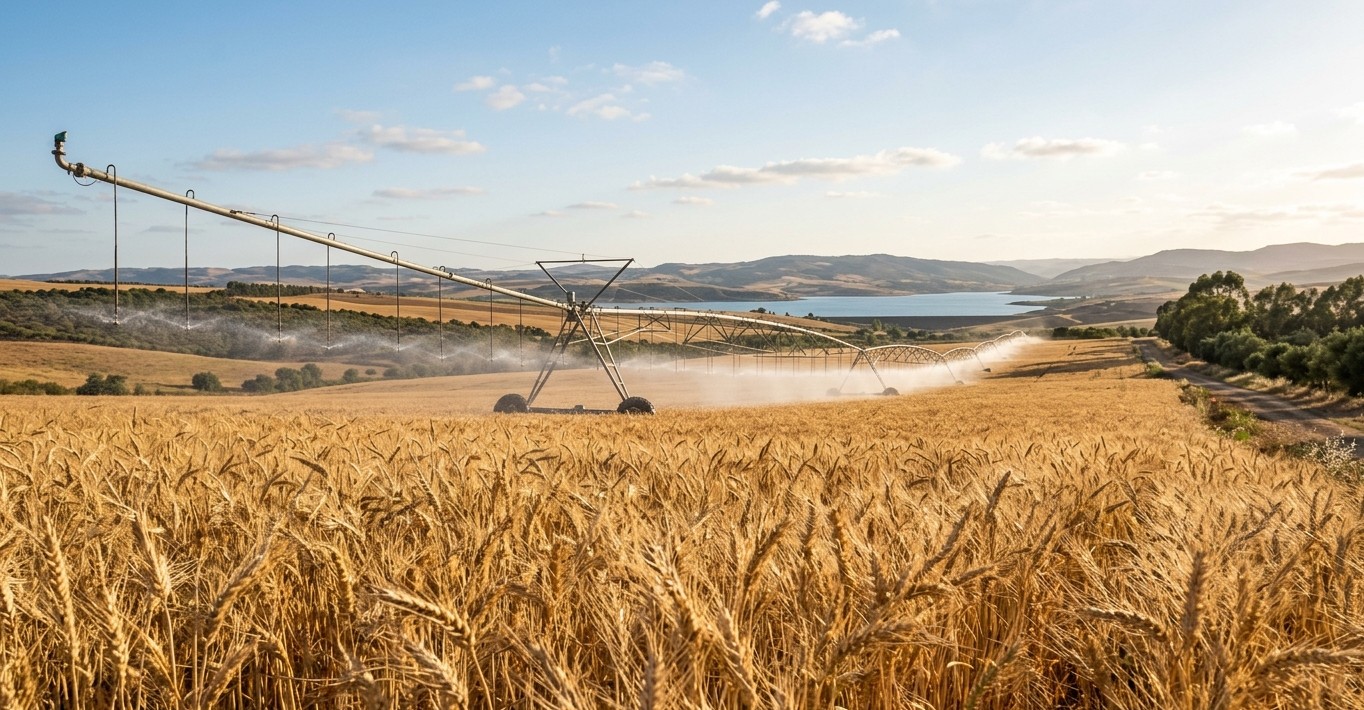
Morocco is accelerating its agricultural resilience strategy with the launch of a project worth 700 million dirhams (approximately $74.5 million) aimed at developing supplementary irrigation for cereals in the Dar Khrofa area in northern Morocco.
Led by the Ministry of Agriculture, this program will cover 5,000 hectares spread across eight municipalities and is expected to benefit over 7,000 farmers. It is part of Rabat’s efforts to reduce the strong dependence of cereal production on climatic fluctuations.
Cereals occupy a significant portion of cultivated agricultural land in Morocco. However, repeated droughts have caused significant fluctuations in production: the 2023-2024 season only generated around 3.1 million tonnes, compared to over 10 million tonnes in favorable years. The 2024-2025 season saw a rebound, with an estimated production of 4.4 million tonnes, an increase of about 41% from the previous year.
Supplementary irrigation involves providing small amounts of water to rainfed crops during critical phases of their development, such as germination, flowering, and grain filling. According to ICARDA (International Center for Agricultural Research in the Dry Areas), this technique can increase cereal yields up to 4 tonnes per hectare, compared to around 1 tonne without supplemental irrigation in water-limited contexts.
The Dar Khrofa project is part of the National Supplementary Irrigation Program, gradually implemented since 2025. By 2030, Morocco aims to extend this technique to nearly one million hectares of cereal and legume crops.
This direction addresses a major food security challenge. In the first seven months of 2025, Morocco imported approximately 5.84 million tonnes of cereals, confirming its position among the world’s leading wheat importers. Stabilizing local yields could help limit the country’s exposure to international market fluctuations.
Beyond agricultural production, the program mobilizes investments in water storage and distribution infrastructure, as well as irrigation equipment for farmers.
For investors and development partners, this initiative exemplifies the emergence of an agricultural model combining climate adaptation, infrastructure modernization, and food sovereignty. However, the main challenge will be the sustainable management of water resources in a context of structural stress, where expanding irrigated areas must be accompanied by more efficient water use.

