



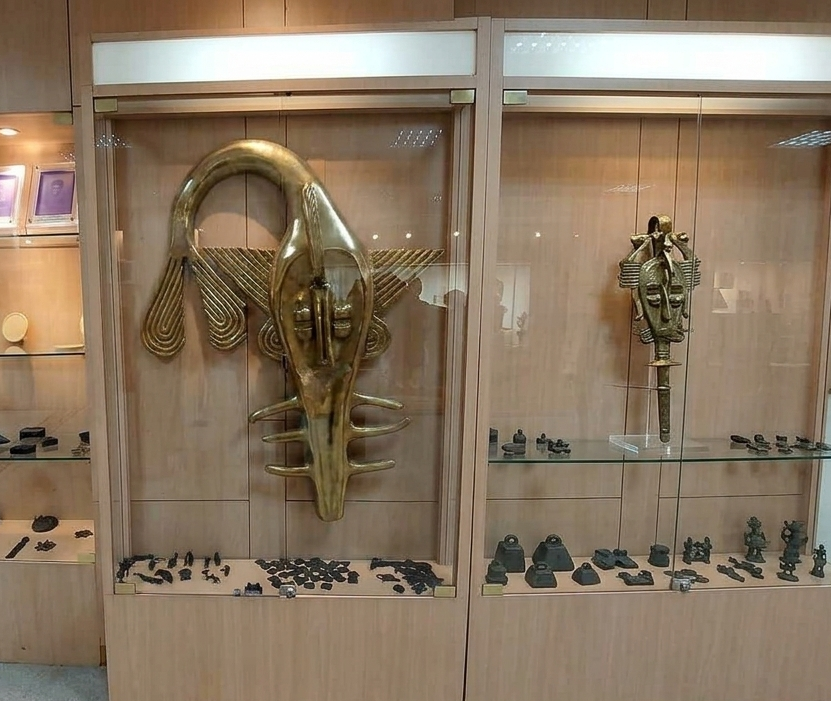
Did you know? The visual identity of the BCEAO, the central bank of the 8 UEMOA states, does not begin in the offices of a modern graphic designer, but on the gold trade routes. Between myths, Akan art, and institutional realities, Financial Afrik focuses precisely on the famous sawfish and explores the origins and true meaning of this unique monetary symbol.
Long before the appearance of banknotes and coins in the West African Monetary Union (WAMU) space, commercial exchanges were based on barter, cowries, salt, or even gold dust. Among the objects used in this system was a small bronze weight representing a sawfish, which over time became one of the most emblematic symbols of the Central Bank of West African States (BCEAO), as explained by a guide at the Money Museum in Dakar.
The origin of this symbol dates back to the Akan people, settled mainly in Côte d’Ivoire and Ghana, whose commercial activity was largely based on the trade of gold dust. To weigh this precious metal, traders used bronze weights molded in various geometric, human, or animal forms. Among these representations was the sawfish, chosen not for its market value, but for its strong symbolic significance.
The guide at the Money Museum also points out that it is a figurine of the sawfish and not the animal itself. This artistic representation, the work of the Akan people, illustrated their vision of the imposing fish – which could weigh up to nearly two tons – considered a symbol of greatness, fertility, and prosperity. Once present in the waters of the Gulf of Guinea, the sawfish embodied the wealth and economic power associated with the gold trade.
It is this heritage that explains the BCEAO’s choice. When the institution was created, the sawfish was chosen to recall the monetary roots of West Africa and the history of commercial exchanges that preceded the introduction of fiduciary currency. The symbol thus appears on the banknotes and coins of the Union as a tribute to the civilizations that contributed to building the region’s economic foundations. According to the museum, this reference pays homage not only to the Akan people but to all eight member states of the Union, in a spirit of regional integration.
The museum also provides an important clarification: contrary to a widely held idea, the sawfish is not the sole logo of the BCEAO. It is just one element. The official logo also includes a base and the inscription “BCEAO.” Until 2005, the sawfish was often used alone to identify the Central Bank, before the adoption of the current graphic charter that formalized the logo in its entirety.
Today, the sawfish remains one of the most recognizable symbols of the BCEAO. Beyond its graphic aspect, it reminds us that the monetary history of West Africa does not begin with banknotes, but with centuries of commercial exchanges, know-how, and traditions that have shaped the region’s economic identity.

