



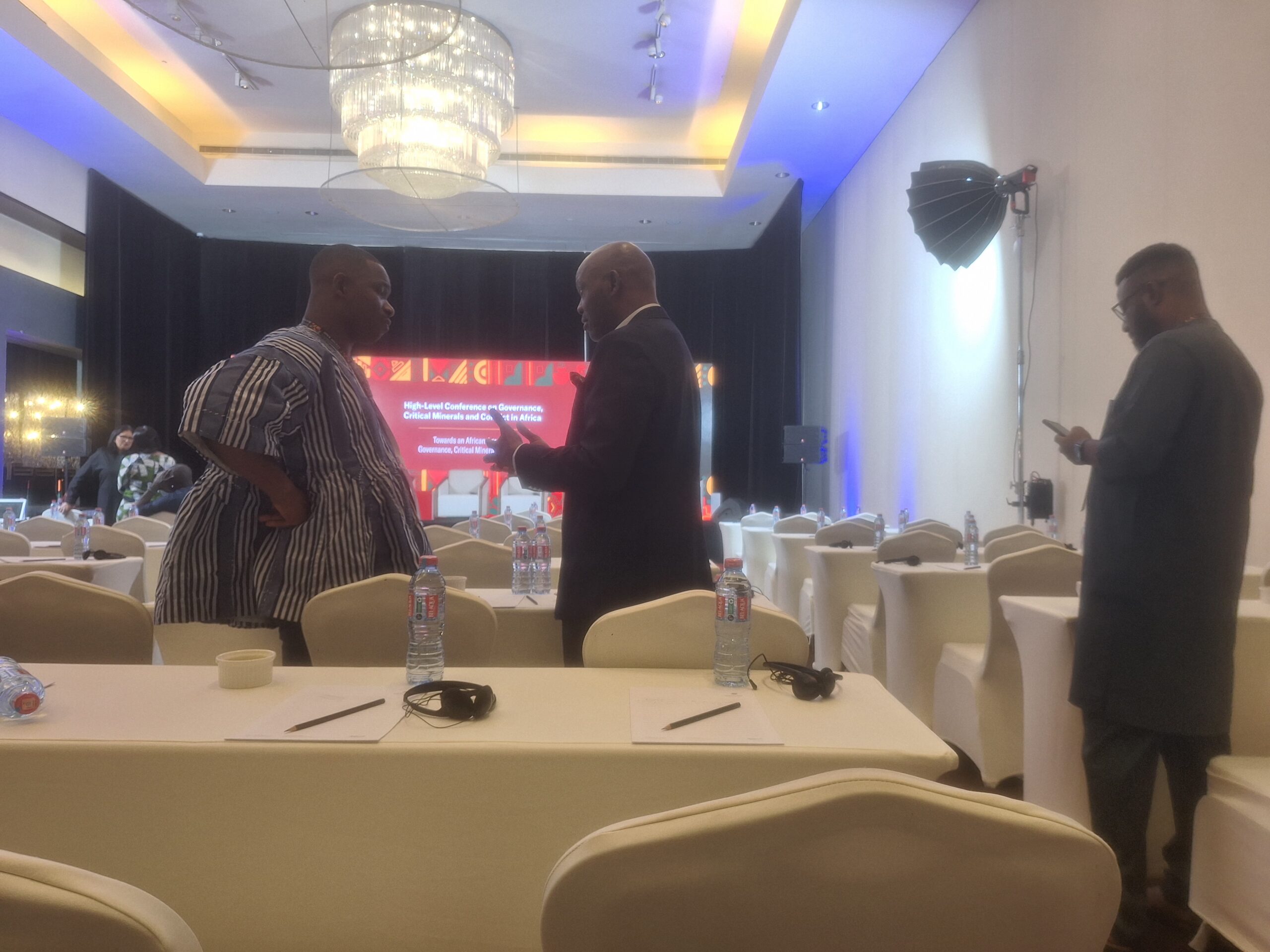
The high-level conference on governance, critical minerals, and conflicts in Africa brought together diverse profiles on Monday, July 27, around the theme: “Africa at a crossroads: navigating global geopolitical competition in the era of critical minerals.” Discussions focused on how the evolving geopolitical competition is reshaping the political economy, governance landscape, and security architecture of the continent.
According to all panelists and participants from across the continent, Africa finds itself at the center of a new global rush for its strategic resources, and its ability to benefit from this will depend on the quality of its governance and unity. Amadou Bah, director of Action Mines Guinea, illustrated these challenges using the example of his country.
“Taking revenge on history”
As the world’s leading bauxite producer, Guinea also has lithium, graphite, gallium, and iron, with the latter attracting attention around the Simandou project. The country is caught between the Chinese bloc, with a strategic $20 billion agreement tied to resources signed in 2017, and the Western bloc, notably through a memorandum of understanding (MOU) concluded with the United States in February 2024.
However, with 74 mining licenses granted in just 2023, a ranking of 142 out of 180 on the corruption perception index, and the absence of a national policy for the valorization of strategic minerals, Guinea exemplifies fragile governance that risks missing out on this “opportunity to take revenge on history,” as Simandou is expected to generate an additional $2.3 billion by 2040.
“What is our strategy?”
Kenneth Ashigbey, president of the Chamber of Mines of Ghana, advocated for a true “second independence.” Faced with the American Inflation Reduction Act, the European Critical Raw Materials Act, the Chinese New Silk Roads, and Gulf sovereign funds, he asked, “What is our strategy?”
The Ghanaian called for a redefinition of what constitutes a critical mineral from an African perspective, investment in geology to move away from “zombie statistics,” and, above all, overcoming national divisions. “No country can, on its own, ensure extraction and processing,” he emphasized. He also stressed the formalization of the artisanal sector, long synonymous with environmental damage.
Suliman Baldo, from the Sudan Transparency and Policy Tracker, issued a warning by mentioning the recent history of African gold. “Illicit flows to Dubai deprive the continent of colossal wealth,” he first recalled.
The speaker also highlighted that the war in Sudan is an illustration of the difficulties Africa faces with its critical minerals, adding that it is a struggle for resource control.
“Positive masculinity”
Petronille Vaweka, from Women Engaged for Peace in Africa, concluded with a passionate call for pan-African unity. “Without unity, there is no solution for Africa,” she declared, denouncing a creeping recolonization through resources.
She calls for a focus on the AfCFTA and the New African Financial Architecture for Development (NAFAD), among others, to build economic and industrial sovereignty. She also urges for a “positive masculinity” that fully includes women, “who carry Africa in their bellies, on their heads, on their backs, and in their arms,” in decisions related to peace and minerals.

