



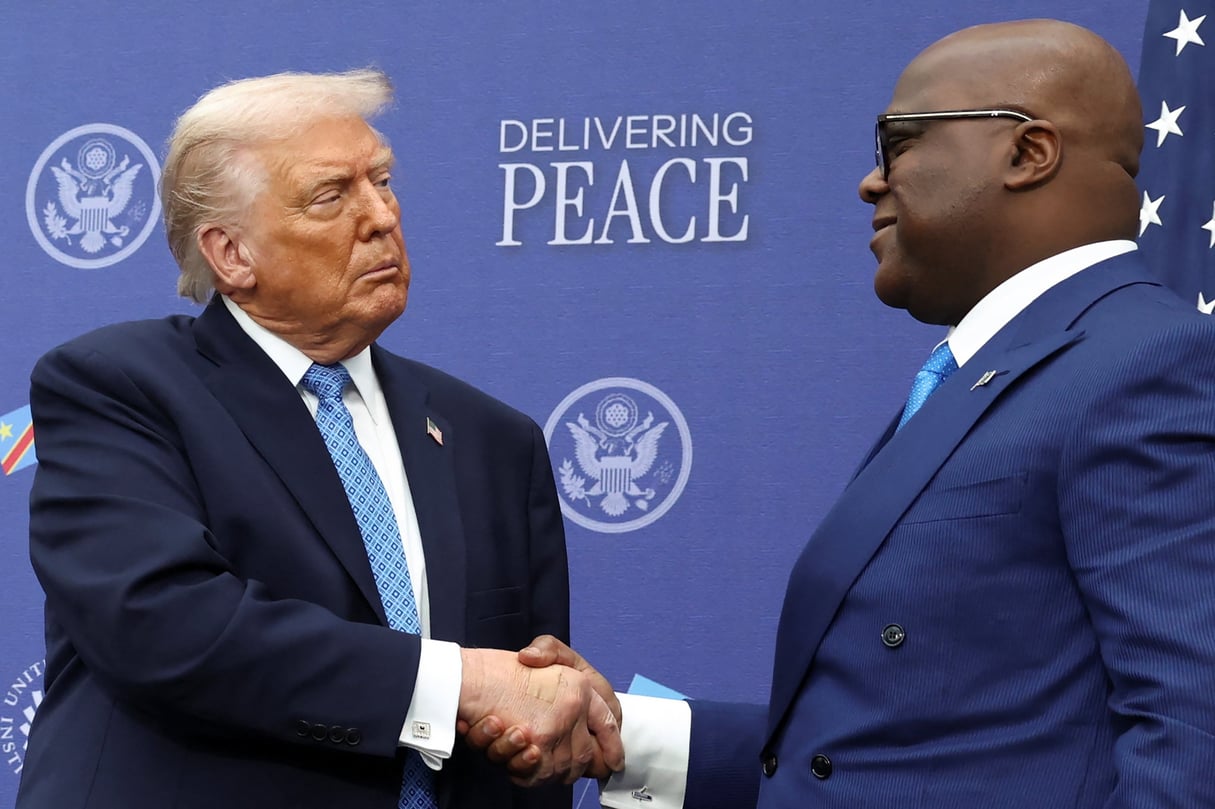
The Buenassa refinery has received a non-repayable grant of $3,385,000 from the U.S. Agency for Trade and Development (USTDA). For the first time, the U.S. government is providing direct support to a crucial mining project in the Democratic Republic of Congo, with a clear geopolitical harmonization perspective.
By Rodrigue Fenelon Massala
This is a step that Kinshasa already qualifies as historic. Buenassa, the bearer of an ambitious copper and cobalt refinery project in Lualaba, Democratic Republic of Congo, has received official approval for a non-repayable grant of $3,385,000 from USTDA to finance its pre-feasibility study (PFS). The information was made public by Julien Paluku Kahongya, Minister of Foreign Trade of the DRC and former Minister of Industry, following a strategic working session held on July 17, 2026 with the company’s management, led by its founder and CEO, Eddy Kioni.
Buenassa is not a project carried out by a foreign firm in the Republic of Congo. It is an initiative led by a Congolese business operator. In fact, since June 2023, the Congolese government holds a 10% stake in Buenassa Resources S.A., the company managing the project implementation. Furthermore, former Prime Minister Samy Badibanga serves as non-executive Chairman of the company’s board of directors. It was in Kinshasa, long before Washington’s involvement, that the process was initiated: the Congolese government provided the initial capital in the form of a non-repayable grant of $3.5 million, through the Industry Promotion Fund (FPI), to cover the framing studies. The American support is therefore an extension of the existing Congolese commitment, not a substitution.
Beyond the symbolism, it is the nature of the financing that is striking. This is the very first significant and direct injection of U.S. public funds into a strategic Congolese mining project aligned with the Lobito corridor, this logistical axis meant to transport minerals from the heart of the continent to the Atlantic, while stimulating a richer and more diversified regional industry. This gesture is part of the strategic agreement between the United States and the DRC, and Washington thus signals its intention to influence a sector long dominated by other powers.
The context underscores the importance of the issue. According to the Cobalt Institute, the DRC accounted for nearly 73% of global cobalt production in 2025, far ahead of Indonesia, and the country is the second largest copper producer in the world behind Chile, two metals at the core of electrification, energy storage, and defense and aerospace technologies. A decisive move, Kinshasa replaced its ban on cobalt exports at the beginning of 2025 with a quota system running until 2027, capping exports at 87,000 tons in 2026: by limiting the export of raw ore, the state tightens the global supply, supports prices, and accelerates the logic of on-site transformation carried by Buenassa. Global demand reached 276,000 tons in 2025, up 13% from the previous year, driven by batteries but also by defense and aerospace superalloys, whose consumption increased by 7.5%. Long exported in raw form, these minerals have become the subject of a fierce rivalry between Washington and Beijing for the securing of supply chains. This is precisely the role of the Lobito corridor, with its 1,300-kilometer railway connecting the Congolese mining heartland to the Angolan port, receiving financing of over $750 million, notably from the U.S. DFC. By aligning with it, the Buenassa refinery aims to capture value at the transformation point, rather than just extraction.
However, this initial American step requires a Congolese response. The USTDA grant letter itself is subject to Buenassa demonstrating the formal allocation of a project site. To maintain momentum, certain conditions still need to be met by the DRC government, starting with the allocation of land, a suspensive condition of the project. The continuation of the schedule will depend on its fulfillment.
The momentum does not stop there. Advanced discussions are underway with the U.S. International Development Finance Corporation (DFC) for technical assistance in the final feasibility study (DFS). The total investment envelope is estimated at $700 million for Phase I and $1.3 billion for Phase II, totaling nearly $2 billion for the entire project.
In terms of production, the framing studies presented forecast 120,000 tons of LME standard copper cathodes and 20,000 tons of cobalt metal, with an option for cobalt sulfate. Buenassa has recently refocused its positioning on the defense and aerospace sectors, in secure search of strategic minerals, while still maintaining an option for the energy storage sector. This repositioning places the project at the heart of the most strategic supply chains for Northern Hemisphere countries, with the United States at the forefront.
This financing would not have materialized without the direction set at the state level. In the eyes of Kinshasa, the Buenassa project embodies the vision of the President of the Democratic Republic of Congo, Félix-Antoine Tshisekedi Tshilombo: that of local transformation of Congolese resources, implemented by his government. “The DRC is thus asserting itself as a key player in global energy transition and security balance through the local transformation of its strategic minerals,” summarizes Minister Julien Paluku.
By focusing on refining on its own soil rather than exporting raw material, the DRC aims to capture more added value, and the American financial support gives it, for the first time, the concrete means to do so.
Sources
Cobalt Institute, Cobalt Market Report 2025 (May 2026).
U.S. Geological Survey, Mineral Commodity Summaries 2025 (Cobalt).
U.S. International Development Finance Corporation (DFC) and Partnership for Global Infrastructure and Investment, Lobito corridor.
Benchmark Mineral Intelligence and Fastmarkets, DRC cobalt export quota regime (2025-2027).

