



By Éric Topona
If there is one source of satisfaction for the People’s Republic of China, since Donald Trump returned to the White House, it is undoubtedly the lack of interest of the American president in soft power. Among the first measures taken by Donald Trump as part of his budget austerity policy, the suspension of Voice of America’s activities was one of the most spectacular and astonishing. Certainly, it was a godsend for Beijing and its informational expansion strategy, particularly in West Africa.
A recent note from the Institute of International and Strategic Relations (IRIS), entitled The Global South: an “informational cover” in the service of Beijing’s media influence in French-speaking West Africa, examines this little-studied dimension of China’s geopolitical strategy.
Community of interests and destiny with Africa
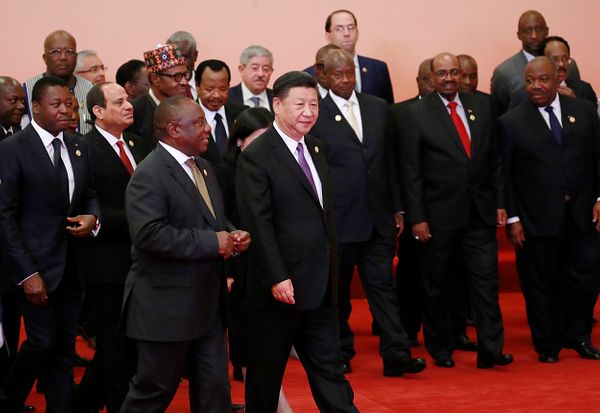
Indeed, this note immediately points out that, from the beginning of its expansion in Africa at the dawn of the 2000s, and especially under the presidency of Xi Jinping, China realizes that its status as the “world’s workshop” will not be the only vector of its presence and influence in French-speaking West Africa. It will not be satisfied with playing the sole role of providing Africa with essential products at low prices, or that of a major consumer of raw materials. It will be essential for China to disseminate a narrative on the theme of a community of interests and destiny with Africa.
To do this, China will first draw from history. It is in this informational dynamic that it will bring out the concept of “Global South”, which is widely used today by politicians and specialists in political science or international relations.
Ideological recycling of the non-aligned movement
However, when we look at its origins, we can rightly conclude that there is nothing new under the sun. The concept of “Global South” is reminiscent of the non-aligned movement in the mid-20th century. Noting an extreme ideological bipolarization of the international scene between East and West, which made any alternative worldview almost inaudible and ignored the specific concerns of formerly colonized or emancipating peoples, they gathered in 1955 at the Bandung Conference in Indonesia (from April 18 to 24, 1955) and launched the non-aligned movement.
In its geopolitical ambition to work towards the advent of a multipolar world, Beijing believed it necessary to ideologically recycle the non-aligned movement into the Global South movement.
Countering Western hegemony in Africa
French-speaking West Africa is one of the geographical areas in Africa where China’s ambitions are most pronounced. Beijing has deployed an informational network that ranges from the exportation of its official discourse internationally, as desired by the Chinese Communist Party (CCP), to a questioning of what it calls Western hegemony.
This narrative suggests that China’s centuries-old struggle against Western imperialism is in every way similar to that waged by these African countries for true sovereignty. Therefore, this common belonging to the “wretched of the earth” is perceived by China as a favorable a priori.
Model of success in Africa
However, having overcome the hardships of underdevelopment, Beijing positions itself as a model of success in Africa.
This informational architecture of China is not only ideological. It also aims to export knowledge of China to French-speaking West Africa, as Chinese leaders want their country to be perceived in this region of Africa.
It is with this perspective that Chinese media have established themselves on the continent. And the Chinese news agency Xinhua graciously provides local media with information files, while Western competing agencies make this information paid, while also contributing to the training of local journalists and technicians, as well as to the construction of radio or television infrastructure.
“The tree that hides the forest”
Moreover, this informational architecture of Beijing is the tree that hides the forest of increasingly contested realities of Chinese presence in Africa. Never, in the information disseminated by Chinese media or their African satellites, is there mention of the liberties taken, for example, by Chinese companies with the social rights of their workers in Africa or of the protests that these violations provoke.
Furthermore, there will never be mention of the domestic political situation in China or opposition to the central power in Beijing.
Hence the conclusion of the IRIS note: “Chinese media have established their presence and found local relays that echo Chinese narratives, more out of economic interest than ideological.
In addition to West African partner media, local political figures also echo pro-CCP narratives in interviews relayed by Chinese international media, in an effort to legitimize these narratives.
Publications promoting the Global South also aim to damage the image of Western powers in French-speaking West Africa and contribute to creating an information environment hostile to these states.”
About
Éric Topona is a Chadian journalist and writer, born on November 19, 1984 in N’Djamena. Graduated in legal sciences, specializing in political science and international relations, he began his career at the Chadian national radio before collaborating with international media such as BBC Afrique. Since 2014, he has been a journalist in the French editorial office of Deutsche Welle in Bonn. Former Secretary General of the Chadian Union of Journalists, he is also the author of essays dedicated to press freedom and the political reform of Chad.

