




By Dr. Mohamed H’MIDOUCHE
Creative artificial intelligence is already transforming video, video games, animation, digital caricature, advertising, education, and cultural industries. For Africa, the challenge goes beyond technological adoption: it is about whether the continent will be able to mobilize investments, finance its talents, protect its cultural data, valorize its languages, and master its narrative in the era of platforms and generative models.
The issue: creating value without losing control of the narrative
Artificial intelligence is entering a new phase. After being mainly associated with automation, language models, and decision support, it is now becoming a powerful engine of cultural and audiovisual creation. The generation of videos, images, voices, characters, settings, interactive games, educational or advertising content is profoundly transforming the global economy of creative industries.
PitchBook’s analysis of the evolution of investments in AI-generated video highlights a major turning point: capital is no longer solely directed towards large technological models. It is starting to finance studios, production infrastructures, interactive platforms, intellectual property catalogs, and companies capable of transforming algorithmic tools into content, franchises, licenses, and recurring revenues.
The central issue for Africa can be posed as follows: how can the continent leverage creative AI – video, gaming, animation, digital caricature, educational and cultural content – without losing control of its data, heritage, languages, imaginaries, and authentic narrative?
This question is not only technological. It is economic, cultural, legal, educational, and geopolitical. In the digital economy of the 21st century, nations that control their narratives also control a part of their influence.
A global AI economy already dominated by major investors
The global race for AI is primarily a race for capital. The United States dominates private AI financing, notably through the ecosystem of large technology platforms, venture capital, cloud, semiconductors, research laboratories, and universities. According to the Stanford AI Index 2026, US private investment in AI reached $285.9 billion in 2025, compared to $12.4 billion for China, even though private figures likely underestimate the real weight of China’s public and parapublic efforts.
This asymmetry is decisive. It means that the ability to develop models, build data centers, attract talent, finance startups, and set technological standards remains highly concentrated. It also explains why Africa must avoid a naive interpretation of AI: innovation does not only stem from talent but also from access to energy, data, computing power, funding, and markets.
Creative AI accentuates this reality. Video generation tools, animation, voice, or interactive experiences require significant computing power, but value is gradually shifting towards uses: studios, content, catalogs, platforms, and intellectual property. This shift can open a strategic window for African countries, provided they invest in the links where they can capture value.
Comparative table: investments and positions in AI
The rough estimates below should be read with caution: private investments, public announcements, digital infrastructures, and research expenditures are not always comparable. The table aims to shed light on power dynamics and trajectories, rather than establish a comprehensive accounting ranking.
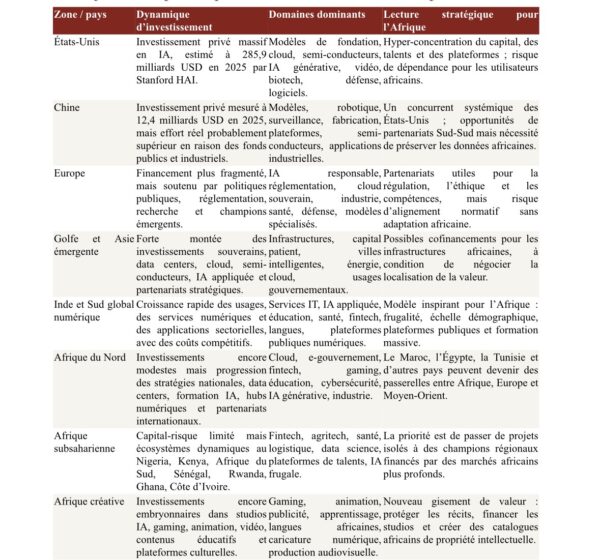
Comparative Table
The African challenge: turning event momentum into sustainable ecosystems
Recent events organized in Morocco and other African countries show that the ecosystem is in motion. The Morocco Gaming Expo in Rabat, Africa AI Creativity Week in Marrakech, GITEX Africa Morocco, as well as emerging initiatives in countries like Nigeria, Kenya, Senegal, Rwanda, South Africa, Tunisia, Egypt, or Ivory Coast, confirm that Africa is gradually taking its place in this revolution.
These events play a useful role: they give visibility to talents, connect startups with investors, stimulate exchanges between creators, researchers, companies, and public decision-makers, and contribute to integrating creative AI into national and continental economic agendas.
The challenge now is to extend this momentum through sustainable mechanisms: structured sectors, specialized funds, African studios, university partnerships, frameworks for protecting rights, innovative public markets, and platforms capable of disseminating African content on a continental and global scale.
The real goal is to transform enthusiasm into an industry. Trade shows, conferences, competitions, hackathons, and exhibitions are necessary catalysts. But their impact will be even stronger if they are part of a broader strategy based on patient capital, infrastructure, talent, contracts, markets, rules, and a long-term vision.
Create without being dispossessed: the question of cultural data
Artificial intelligence can reduce production costs, accelerate creation, democratize access to audiovisual tools, and enable young African studios to produce content that would have required substantial budgets just a few years ago. But this promise carries a major risk: that of dispossession.
If African stories, local languages, oral traditions, cultural archives, music, faces, symbols, costumes, proverbs, and intangible heritages are sucked up by foreign platforms, then modeled and monetized without consent or fair return, Africa could lose part of its control over its narrative identity.
This is where the famous formula of Amadou Hampâté Bâ takes on new resonance. A Malian writer, historian, ethnologist, diplomat, former extraordinary ambassador and plenipotentiary minister of Mali in Ivory Coast, and member of the UNESCO Executive Council, he was one of the great African defenders of oral tradition. In the context of his plea at UNESCO in the early 1960s for the preservation of African oral traditions, he uttered a phrase that remains etched in our collective memory: “In Africa, when an old man dies, it is a library that burns.”
In the era of artificial intelligence, this alert takes on an additional dimension. The risk is no longer just that these living libraries disappear with time. It is also that they are captured, digitized, indexed, modeled, and reinterpreted by systems designed outside the continent, without contextualization, fair compensation, or respect for the communities that are their guardians.
The Amadou Hampâté Bâ Foundation, established in Abidjan by his daughter Mrs. Roukiatou Hampâté Bâ, precisely recalls that African memory is not an endlessly available raw material. It is a living heritage, carrying dignity, transmission, and civilization.
Challenges to overcome
1. Technological dependence
The most advanced tools for video, image, voice, or interactive world generation are currently controlled by a few major international players. Africa risks using these technologies massively without mastering their infrastructures, rules, costs, training data, or intellectual property conditions.
2. Weak financing
African creative industries remain undercapitalized. Animation studios, video game developers, educational content producers, digital caricature creators, or cultural platforms rarely have the necessary capital to move from artisanal experimentation to industrialization.
3. Hybrid skills deficit
Creative AI requires profiles that combine technology, culture, design, law, storytelling, linguistics, production, and entrepreneurship. African training systems still remain too compartmentalized between disciplines.
4. Insufficient legal frameworks
Who owns a work generated or assisted by AI? How to compensate artists whose works have been used to train a model? How to protect African languages, traditional cultural expressions, oral archives, and collective creations?
5. Market fragmentation
No African country can, alone, build an ecosystem deep enough to compete with the major global hubs. Africa must think in terms of regional markets, continental co-productions, pan-African platforms, and talent circulation.
African success stories to transform into continental champions
Africa already has success stories in the field of artificial intelligence. InstaDeep, founded by African talents and acquired by BioNTech, has shown that a company born in the African ecosystem can achieve global recognition in advanced AI. DataProphet in South Africa illustrates the use of AI in industry and manufacturing optimization. Aerobotics applies AI to precision agriculture. Zindi has created a pan-African platform for data science talents. Lelapa AI works on models better suited to the linguistic and cultural realities of the continent. Ubenwa, in child health, illustrates the potential contribution of AI to health systems.
These examples show that Africa is not condemned to technological importation. It can produce solutions, attract capital, export skills, and create globally-reaching companies. But to move from a few isolated successes to a generation of African AI champions, scaling up is necessary.
The development prospects of these companies can take several paths: strategic acquisition by large international groups, growth fundraising, partnerships with public institutions, regional expansion, or ultimately listing on African or international stock exchanges. African financial centers – notably Casablanca, Johannesburg, Lagos, Nairobi, Cairo, Tunis, or the BRVM – could play a more active role in financing the continent’s technological and creative companies, provided they adapt their rules to the specificities of intangible assets, intellectual property, and digital growth.
Appropriate solutions: six priorities for African sovereignty in creative AI
Faced with these challenges, the African response cannot be defensive or scattered. It must be strategic, coordinated, and focused on creating value. It is not just about adopting creative artificial intelligence tools but also about building the institutional, financial, legal, and human conditions that allow the continent to protect its heritage, finance its talents, control its data, and transform its imaginaries into economic, cultural, and diplomatic assets. Six priorities then appear as essential.
1. Create dedicated African funds for creative AI
These funds should involve development banks, sovereign funds, private investors, telecom operators, digital platforms, and cultural institutions. Their role would be to finance studios, platforms, content, catalogs, and talents with strong regional potential.
2. Build sovereign digital libraries
African languages, oral archives, tales, music, images, heritages, and educational corpora must be documented, protected, and valued according to rules of consent, traceability, and value sharing.
3. Adapt intellectual property to the AI era
African countries should regulate the use of works in model training, secure artists’ rights, combat deepfakes, protect traditional cultural expressions, and establish mechanisms for fair compensation.
4. Train hybrid creators
Developers capable of understanding narration, artists capable of using AI, lawyers specialized in digital rights, producers capable of structuring catalogs, and entrepreneurs capable of transforming works into viable companies must be trained.
5. Make public markets a lever for innovation
African states can commission educational, health, climate, agricultural, or cultural content produced by local studios using AI. This public procurement can structure demand and create the first commercial references.
6. Articulate AI, AfCFTA, and African financial centers
The African AI strategy must be linked to the African Continental Free Trade Area, cultural policies, technological hubs, universities, and African stock exchanges to transform startups into regional companies capable of raising capital.
Conclusion: not letting others write our future
Creative artificial intelligence can become a historic opportunity for Africa. It can democratize content production, valorize African languages, transmit knowledge, modernize education, strengthen cultural industries, and offer young talents on the continent a global stage.
But it can also become a new instrument of dependence if Africa does not control its data, its narratives, its rights, its platforms, and its financing. The real question is not whether Africa should adopt AI. It must. The real question is under what conditions, according to what rules, and for whose benefit.
In this new economy of artificial intelligence, sovereignty will not only be measured by the ability to build algorithms. It will also be measured by the ability to protect memories, finance talents, produce works, own catalogs, valorize languages, and tell Africa’s story by itself.
Yesterday, Amadou Hampâté Bâ warned of the risk of seeing living libraries disappear with the death of the elderly. Today, Africa must ensure that its cultural libraries are not absorbed, distorted, or commercialized by artificial intelligences that do not understand their depth, context, or dignity.
AI must become for Africa not an instrument of erasure but a tool of transmission, creation, sovereignty, and rebirth.
Dr. Mohamed H’MIDOUCHE
Economist, author, and former senior official at the African Development Bank
CEO & Managing Director, Inter Africa Capital Group. Winner of the “African Economist 2025-2026” Award – Financial Afrik Awards.
Sources
1. PitchBook, “From models to studios: how AI video investment is evolving,” June 26, 2026.
https://pitchbook.com/news/articles/from-models-to-studios-how-ai-video-investment-is-evolving
2. Stanford HAI, AI Index Report 2026.
https://hai.stanford.edu/ai-index/2026-ai-index-report
3. UN Trade and Development – UNCTAD, Technology and Innovation Report 2025: Inclusive Artificial Intelligence for Development.
https://unctad.org/publication/technology-and-innovation-report-2025
PDF Version: https://unctad.org/system/files/official-document/tir2025_en.pdf
4. African Union, Continental Artificial Intelligence Strategy, adopted by the AU Executive Council in July 2024.

