



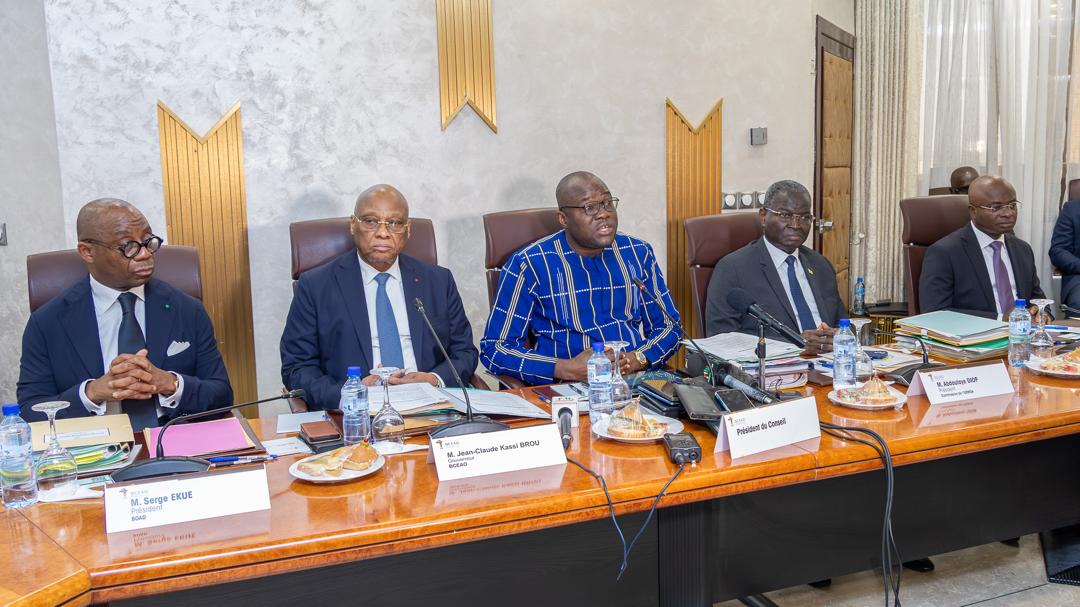
The second regular session of 2026 of the Council of Ministers of the West African Economic and Monetary Union (UEMOA) opened this Friday, July 3 in Ouagadougou, at the headquarters of the Central Bank of West African States (BCEAO). It focuses on the examination of several files related to the functioning and orientations of the Union, including economic policy orientations for 2027, the report on multilateral surveillance, and the framework for public debt policy.
The works are chaired by Aboubakar Nacanabo, Minister of Economy and Finance of Burkina Faso, who is also the current President of the Council of Ministers of the UEMOA.
Expected growth at 6.1% in 2026
At the opening of the session, Aboubakar Nacanabo presented an overview of the international and regional economic situation. He indicated that the global economy continued to grow in the first quarter of 2026, despite persistent disruptions in global supply chains, in a context marked notably by the crisis in the Middle East and tensions on certain international trade routes, particularly in the Strait of Hormuz area.
Regarding the UEMOA, the Burkinabe minister stated that economic activity remained dynamic. He added that growth is estimated at 6.1% on an annual basis in the first quarter of 2026, after 6.5% in the previous quarter. For the entire year 2026, it is also expected to be 6.1%.
However, the President of the Council of Ministers highlighted several risk factors that could affect these prospects, including geopolitical tensions, security and sociopolitical challenges, as well as the effects of climate change.
Several economic and financial issues on the agenda
During this session, the ministers are examining several texts and documents submitted by the Union’s institutions.
For the UEMOA Commission, the Council must in particular give its opinion on the draft report on multilateral surveillance of June 2026, on the recommendation regarding economic policy orientations of the member states for 2027, as well as on the draft regulation establishing the framework for public debt policy and debt management in the member states.
Ministers must also examine the draft decision on the adoption of the UEMOA social protection strategy.
As for the Financial Markets Authority of the UMOA (AMF-UMOA), discussions focus on the institution’s 2026 budget, as well as on the renewal of mandates and the appointment of members to its Board.
The council also examines the issue related to the operationalization of the Financial Stability Fund of the West African Monetary Union, presented by the BCEAO.
Finally, ministers are reviewing a note from the West African Development Bank (BOAD) requesting a derogation from the principle of territoriality of its interventions. This request concerns two financial support programs planned for the International Finance Corporation (IFC) and PROPARCO.

