



Who really controls Auplata Mining Group? Who ultimately decides in this fragmented architecture between French Guiana, Peru, Morocco, the DRC, Luxembourg, and offshore jurisdictions? Why did this mining group, long presented as a Francophone polymetallic champion, eventually disappear from the Euronext Growth Paris stock exchange? And what does the long-standing Moroccan dispute around the Compagnie Minière de Touissit reveal, ultimately settled by the entry of Ayrad Group into the equation? Investigation.
For over fifteen years, Auplata Mining Group, established in 2004 and listed in Paris since 2006, has built the narrative of an international mining group present on multiple fronts: gold in French Guiana, precious and base metals in Peru, lead and silver in Morocco, and ambitions in Central Africa. But behind this industrial trajectory, a difficult-to-read capital structure has gradually emerged, combining reference shareholders, current account advances, holdings, Luxembourg vehicles, offshore companies, trusts, and refinancing operations.
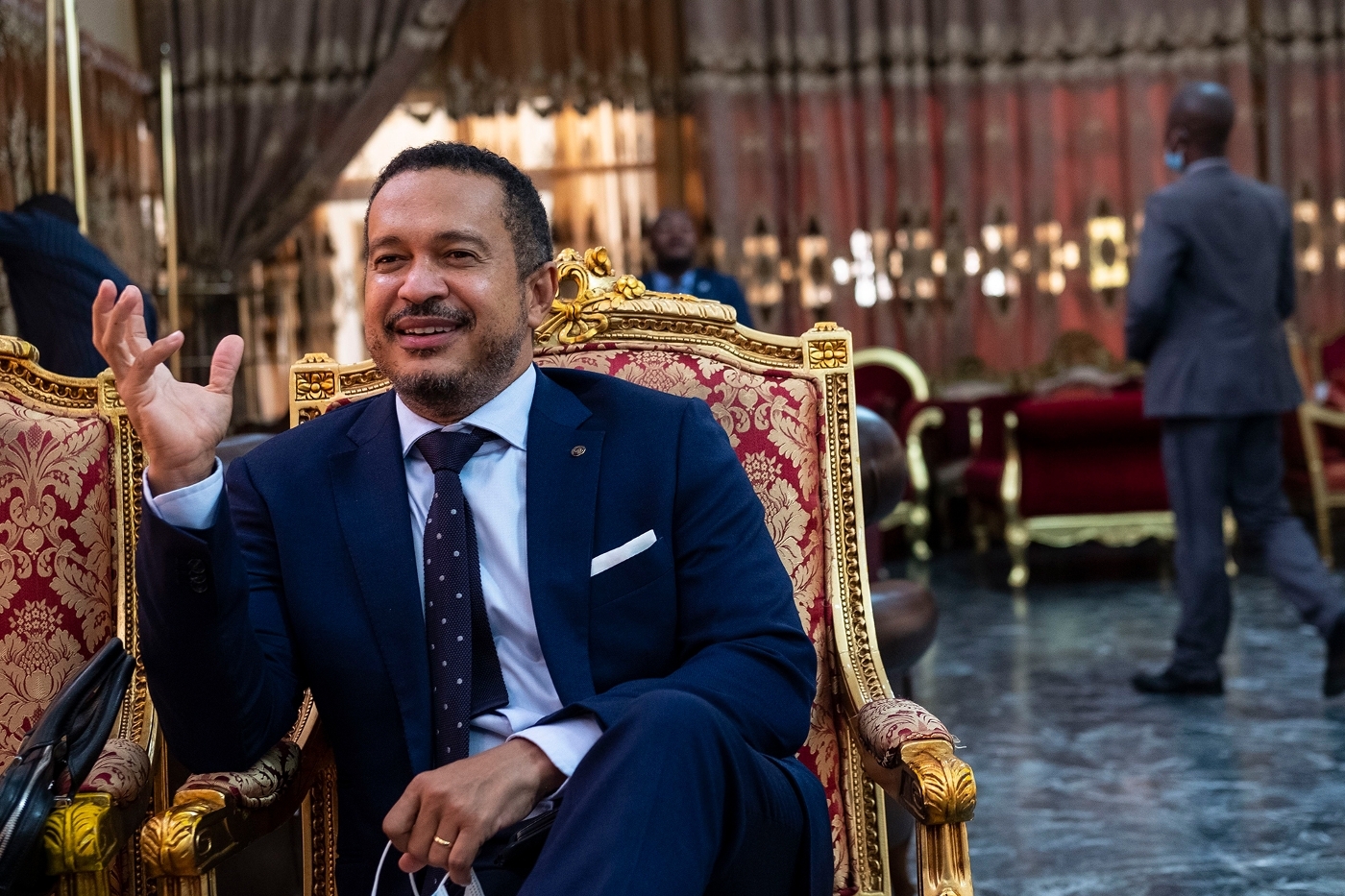
At the center of this galaxy is Luc Gérard Nyafé. Since November 19, 2018, he has been presented as the CEO of Auplata Mining Group. He also chaired the Compagnie Minière de Touissit in Morocco, a strategic asset of the group. Publicly, two vehicles stand out in the shareholding and financing of AMG: San Antonio Securities LLC, a shareholder at 19.61%, and Strategos Ventures Ltd, which in August 2022 granted a current account advance of €32.19 million to refinance the debt of San Antonio Securities. This operation allowed AMG to retain its indirect stake of 37.04% in CMT through the Luxembourg fund Osead and the company Osead Maroc Mining.
This is where one of the main grey areas of the file begins: effective control. AMG formally controlled certain assets through indirect ownership chains. But the combination of shareholders, creditors, refinancing vehicles, and holdings close to Luc Gérard Nyafé gives the image of control exercised in cascade. San Antonio Securities initially finances the indirect ownership in CMT. When this creditor requests repayment of its advance, Strategos Ventures Ltd takes over. The same strategic asset remains within the scope, but the creditor changes. Economic control shifts without significantly improving the overall clarity.
The Democratic Republic of the Congo adds an additional layer to this construction. In 2023, Oriental Jinzi, a vehicle associated with Luc Gérard Nyafé, acquired the assets of Banro, including the Namoya mine. The file is sensitive because the links between Strategos, AMG, CMT, and the Congolese assets are not always presented consistently in available sources. Some notes claim that Banro has no direct connection with AMG. Other public elements recall that Auplata had announced in 2021 the creation of an AMG Congo subsidiary and was negotiating the acquisition of Namoya. The convergence of clues does not allow us to conclude on a direct integration of all these assets into AMG, but it highlights a central question: where does AMG end and where does the Strategos galaxy begin?
The Moroccan aspect constitutes the judicial and financial heart of the file. Through Osead, AMG indirectly held 37.04% of the Compagnie Minière de Touissit, the leading Moroccan producer of lead and silver. This stake was one of the group’s most important assets. However, it became embroiled in a complex dispute involving CMT, Osead Maroc Mining, the Office of Changes, and Customs. The Office of Changes demanded a fine of 376.175 million dirhams (approximately $37 million) from CMT, while a conservatory seizure of around 2.25 billion dirhams was made.
In November 2025, the Casablanca criminal court fined CMT 2.324 billion dirhams ($232 million) for irregular financial transfers, a decision contested by the company. For the balance of the file, it must be recalled: several Moroccan sources attribute the origin of exchange offenses to a period prior to the takeover of CMT by AMG. In other words, the dispute cannot be mechanically attributed to the subsequent management of AMG without precise qualification. Another major development: in April 2026, the file was largely defused with the abandonment of proceedings by the Moroccan Customs acting for the Office of Changes, the lifting of the conviction, and the exit of the Osead fund in favor of Ayrad Group Limited.
The Ayrad operation marks a turning point. On April 21, 2026, Ayrad Group Limited, based in Abu Dhabi, finalized the acquisition of all shares of the Osead fund, which indirectly held over 37% of CMT. The total amount mentioned reached $130 million. Ayrad’s entry, associated with CIMR subject to the necessary authorizations, closes a major judicial and capital chapter. But it also confirms that some of the most strategic assets of the AMG empire were played through peripheral vehicles, especially Luxembourgish, rather than solely at the level of the listed Parisian company. The question of internal financial flows remains another blind spot. The only publicly documented flow concerns the current account advance that financed the indirect ownership of 37.04% of CMT, first through San Antonio Securities, then through Strategos Ventures Ltd.
An exit from Euronext that exacerbates opacity
For the rest, the flows between AMG, SMYD, CMD, Osead, and other entities within the scope remain largely inaccessible to the public domain. Their justification lies in the filed accounts, intragroup agreements, and explanations that the company may be required to provide. However, the last consolidated financial statements published report a turnover of €86.6 million in 2023, with a net loss of €22.6 million. AMG’s delisting has worsened this opacity. Trading was suspended on July 10, 2024. On October 30, 2025, Euronext notified the delisting of securities from the Euronext Growth Paris market, effective December 31, 2025. The main reason is procedural and financial: the lack of a firm date for the approval of the 2024 annual accounts and the 2025 semi-annual statements.
Subsequently, AMG contested the method, regretting in particular the lack of prior debate and the impact on a highly floating shareholding. But the result is relentless: shareholders retain their economic rights, without being able to trade their securities on the platform. It is a delisting due to a lack of financial publication, not a sanction establishing fraud. Governance remains. The clearest point in the public domain is the complaint filed by Michel Juilland, founder and former reference shareholder of AMG. On May 30, 2024, he referred the Paris prosecutor’s office for abuse of corporate powers, abuse of corporate assets, and money laundering. He claims to have gone from 15.02% of AMG’s capital in 2019 to 1.22%, targeting operations involving Touissit International Corporation, a company based in the British Virgin Islands.
Again, caution is required: these accusations are not judged. Luc Gérard Nyafé, for his part, indicated that he had filed a complaint for attempted extortion. A previous action by Michel Juilland had also been dismissed in June 2021 by the Cayenne Commercial Court, which had sentenced him to one euro in damages. Ultimately, the AMG file pits two readings against each other. The first is that of a mining group in permanent restructuring, facing the capital heaviness of the sector, inherited disputes, significant financing needs, and accounting delays leading to its delisting. The second is that of an opaque control galaxy, where assets pass through multiple vehicles, where creditors become capital pivots, where intragroup flows remain difficult to document, and where minority shareholders struggle to understand who actually controls what.
The assets exist. In French Guiana, AMG retains Dieu Merci, Dorlin, Yaou, and Bon Espoir, with declared but sometimes outdated significant resources. Gold production increased from 319 kg in 2024 to 412.12 kg in 2025. In Peru, the El Santo mine remains a polymetallic asset, although AMG Peru’s turnover has sharply declined. In Morocco, CMT has long been the flagship of the portfolio. In the DRC, the Banro and Namoya assets open another front, more difficult to legally link to the AMG scope.
In summary, the paradox of Auplata Mining Group lies in one formula: real assets, but difficult-to-read governance; tangible mining potential, but incomplete accounts; international ambition, but fragmented capital structure; legally present shareholders, but deprived of the market. The resolution of the Moroccan file with Ayrad Group does not close the AMG case. It rather reveals the mechanism. Behind the mines, concessions, and development announcements, the history of AMG is also one of cascading control, debt transformed into a lever of power, and a group whose richest areas may not only be in the subsoil but in the interstices of its organizational chart.

