



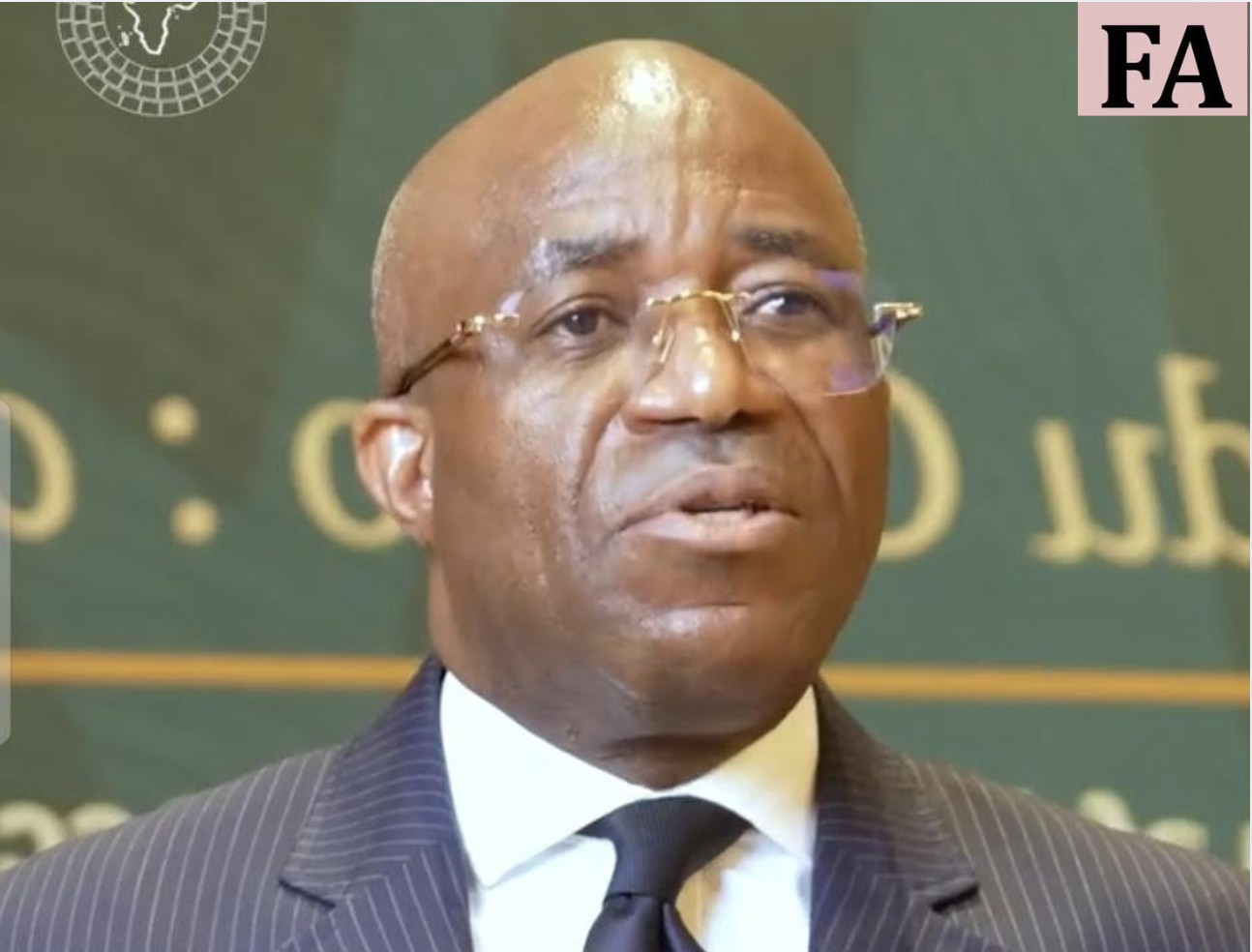
“The Blue Fund must transform announced commitments into concrete projects by 2026”
As the financial agent of the Blue Fund for the Congo Basin since 2021, the Central African Development Bank (BDEAC) played a central role in preparing the roundtable organized on the sidelines of the 2026 Annual Meetings of the African Development Bank in Brazzaville. In this interview with Financial Afrik, its Vice-President, Jean Paterne Megne Ekoga, discusses the progress made, details the priority portfolio of 63 projects representing $5.32 billion in investments, and outlines the next steps in implementing the Blue Fund.
The BDEAC is heavily involved in structuring the project portfolio of the Blue Fund for the Congo Basin. What initial assessment do you make of the mobilization around the Congo Basin following the roundtable in Brazzaville held on the sidelines of the latest Annual Meetings of the African Development Bank?
I would first like to recall that the BDEAC is the financial agent of the Blue Fund for the Congo Basin. We have held this responsibility since September 2021, when the heads of state of the member countries of the Congo Basin Climate Commission selected the BDEAC to host the Blue Fund following a highly competitive international tender process that lasted nearly two years. In December 2022, we signed a convention with the Congo Basin Climate Commission formalizing this hosting arrangement.
Following the roundtable held on the sidelines of the Annual Meetings of the African Development Bank Group, we can draw a historic assessment. I use this term intentionally. For the first time, the heads of state of the 17 member countries of the Congo Basin Climate Commission gathered around the same table with donors and investors, whether in person, via video conference, or through representation. This event is not just another diplomatic meeting. It represents the culmination of a decade of institutional building that began with the creation of the Congo Basin Climate Commission in 2016, on the sidelines of COP22 in Marrakech. Today, we presented partners with a first priority program consisting of 63 projects representing a total investment of approximately $5.32 billion.
This portfolio was extracted from a set of 254 projects identified during the prefiguration study conducted between 2018 and 2020. The selection process was carried out with great rigor. The projects were examined and validated by both the BDEAC and all governance bodies of the Blue Fund, including national focal points, relevant ministers, and heads of state. We can affirm that this first program is coherent, structured, and bankable. It serves as a lever for prosperity for the member countries of the Congo Basin Climate Commission. As the institution hosting the Blue Fund, the BDEAC guarantees the quality and credibility of this priority portfolio.
The BDEAC is leading the arrangement of several priority projects. What are the most strategic sectors for transforming the ecological potential of the Congo Basin into sustainable economic assets?
The Congo Basin is now one of the planet’s main ecological lungs. It represents an invaluable wealth that must be preserved alongside sustainable economic valorization. The projects we promote under the Blue Fund can be grouped into three main categories. The first involves sustainable ecosystem management, including the preservation of mangroves, peatlands, and community forests. These natural resources are no longer just biodiversity reservoirs; they have become carbon assets that can be valued on international markets. For example, the peatlands of the Democratic Republic of Congo and the Republic of Congo are strategic reserves for global climate balance. The goal is to preserve these assets while transforming them into economic development levers for the countries involved.
The second set of projects focuses on blue and green infrastructure, including investments in water, sanitation, and hydroelectricity. These infrastructures address the immediate needs of populations in terms of access to clean water, energy, and decent living conditions. These projects have a dual dimension: they directly improve the well-being of populations while contributing to sustainable development goals. They involve several countries in the sub-region, including Gabon, Burundi, the Central African Republic, and Congo. The third pillar concerns productive blue economy, a sector often underestimated. It includes sustainable fishing, aquaculture, and river transport. We are working on projects to rehabilitate waterways, manage fishery resources, and develop fish value chains. Several initiatives are already identified in Sudan, South Sudan, and Chad. These projects are intended to generate economic value and jobs quickly while ensuring the preservation of natural resources. This is why we refer to them as bankable sustainability projects.
Beyond environmental preservation, how can the Blue Fund become a true driver of development, job creation, and regional integration for CEMAC countries?
The Blue Fund does not replace existing financing mechanisms; it complements them. Africa already has major institutions like the African Development Bank that operate at the continental level. The different sub-regions also have their own banks and development institutions. The specificity of the Blue Fund is to target projects that are not always financeable in their current state by traditional mechanisms. But its true originality lies elsewhere: seventeen countries have chosen to come together to collectively promote the same financial instrument and collectively address international investors. This community approach is a considerable advantage. It allows for the pooling of efforts, strengthens project visibility, and increases their attractiveness to financial partners.
Furthermore, the Blue Fund can also support certain sub-regional institutions that do not always have direct access to financing from major development banks. I am thinking in particular of the International Commission of the Congo-Oubangui-Sangha (CICOS), the Central African Power Pool, the Lake Chad Basin Commission, the Lake Tanganyika Commission, and the Lake Victoria Commission. It is this ability to unite states and support regional institutions that makes the Blue Fund relevant for the 17 member countries.
What are the next concrete steps after this roundtable held on the sidelines of the Annual Meetings of the African Development Bank, and when can we expect to see the first structuring projects enter the operational phase?
The first step is to transform the commitments made by partners into actual financing. During the roundtable, partners expressed intentions and commitments totaling approximately $3 billion. We must now convert these announcements into mobilized resources. The second step will be to transform these resources into concrete projects on the ground. The 63 projects in the priority program will not all be executed simultaneously. We have planned for a gradual sequencing of their implementation with a phased ramp-up. A first group of projects will be validated and funded as early as 2026. A second group will follow in 2027, while the last projects will be initiated in 2028. The entire priority portfolio will therefore be implemented over the period 2026-2028.
At the end of this first cycle, we will return to donors with a new priority program incorporating new projects and operations. In concrete terms, we can affirm that by the end of 2026, the first projects will already have received funding. A new wave will occur in 2027, and a third in 2028.
What message do you have today for technical and financial partners as well as all stakeholders of the Blue Fund for the Congo Basin?
The 17 countries of the Congo Basin Climate Commission are firmly committed to preserving this global ecological heritage that is the Congo Basin. This wealth is a common good of humanity, but it primarily concerns the populations living in these territories who ensure its daily protection. Member states have decided to unite their efforts around a portfolio of concrete, structured, and development-oriented projects. We invite partners who have shown interest during the roundtable to translate their commitments into concrete actions. We also call on those who have not yet joined this momentum to participate. The Blue Fund is not just a tool for environmental preservation; it is also a tool for economic development, job creation, and regional integration. The stakes go far beyond our sub-region. They concern the future of the planet and future generations. We are at a crucial turning point today. The time has come to move from intentions to actions.

