



By Yves Daniel Adoum, Foundation for Innovation in Democracy
Since 1999, International Youth Day has been celebrated every August 12th. A day that highlights the challenges and role of young people in society. This year’s edition coincides with the holding a few days earlier of the inaugural session of the Pan-African Youth Parliament for Democracy with a stated goal: to no longer let democratic decisions be made without them.
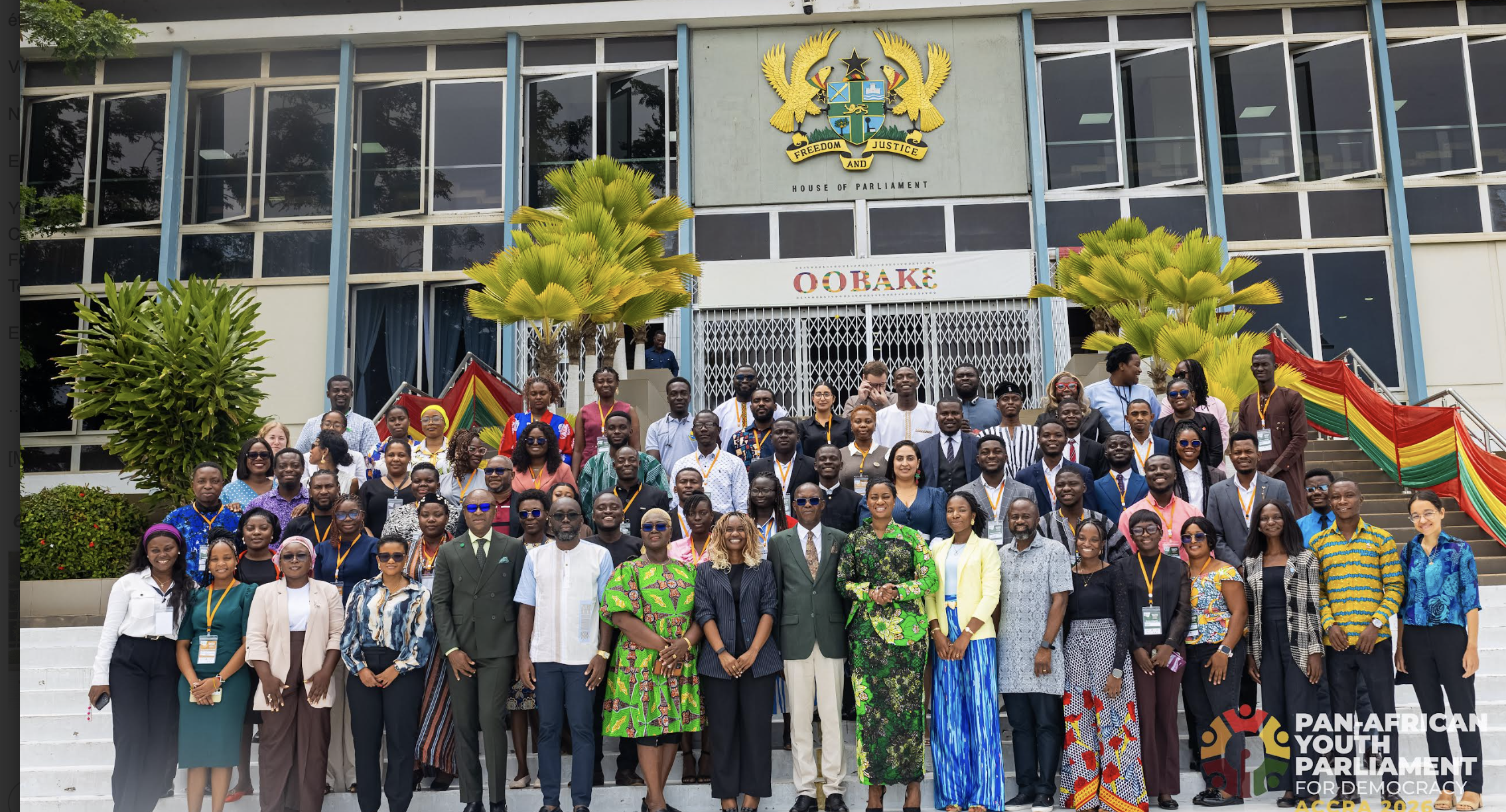
From August 3 to 5, the inaugural session of the Pan-African Youth Parliament for Democracy was held in Accra. The event was co-organized by the Foundation for Innovation in Democracy, at the initiative of the Pan-African Youth Parliament, Parliamentary Network Africa, and the National Youth Authority of Ghana, with the support of the Ghanaian Parliament and several institutional and diplomatic partners.
Coming from all over Africa and the European diaspora, 13 out of the 14 young parliamentarians elected following an online vote from July 3 to 9 took part in the proceedings, supported by a delegation of young Ghanaians.
Ngang God’swill, one of the 14 young parliamentarians elected for the Central Africa region, asserts after the exchanges that he has “trust in the youth to drive the development that this continent, and my country, Cameroon, urgently need.” The same tone is echoed by Julia Somé from Burkina Faso, a parliamentarian elected for the West Africa region, who believes “more and more that our generation has a special strength: we have the opportunity to meet beyond borders, to share our experiences, and to transform our differences into collective intelligence.” An optimism shared by Badal Fohmoh from Cameroon, a member of the Young Democracy Ambassadors program, also present in Accra. “I come back with the certainty that things are changing,” she says.
“I have gained new perspectives, shared my ideas, and met other young leaders. More importantly, I have understood that young people should not only be seen as the leaders of tomorrow, but that they must also have a significant voice in decision-making today,” emphasizes Thomas Obeng Danso, a member of the Ghanaian delegation, after three days of work.
An Embraced Symbol
The choice of location and date is not insignificant. August is Youth Month in Ghana, and August 12 marks the United Nations International Youth Day. Above all, Accra is associated with the history of African independence and the birth of Pan-Africanism. An inheritance that the organizers explicitly claim.
As the first sub-Saharan African country to gain independence in 1957, Ghana, under the leadership of Kwame Nkrumah, emerged as one of the main intellectual centers of modern Pan-Africanism. “The choice of Ghana as the host country for this inaugural edition has a particular historical, symbolic, and strategic significance,” summarizes Arlande Aroukoun, head of the North Europe Gates laboratory at the Foundation for Innovation in Democracy.
Three Work Axes and Proposals Supported by Personalities
Structured around the theme “A democracy that relies on the energy of the youth,” the discussions focused on three axes: relying on the energy of the youth, trusting young people to change the world, and providing them with the resources to do so.
Participants worked on the democratic challenges of the continent, the role of young people in decision-making processes, and the conditions for the emergence of more inclusive and resilient African societies. According to the organizers, this parliament constitutes a space dedicated to generating ideas, building networks, and developing democratic leadership. It aims to formulate proposals and affirm a renewed Pan-African citizenship, capable of bringing African responses to contemporary democratic challenges.
On a more concrete level, facing the conflicts and insecurity experienced by the African continent, young people decided to set up a group that will work exclusively on these issues. They also received support from Mpule Kgetsi from Botswana, former African Union Youth Ambassador for Peace for Southern Africa, who promised to lend her expertise to this group. Another significant support comes from Bonolo Makgale from South Africa, a specialist in democracy, governance, and citizen engagement, who offered to facilitate connections with other parliamentarians and initiatives of the Pan-African Parliament, for young people wishing to deepen their knowledge of the institution or join existing dynamics.”
Personalities Providing Support
Other personalities present also wanted to show their support for this initiative, such as the French Ambassador to Ghana, Diarra Dimé Labille, who committed to creating, with partners, a high-level dialogue space between young people, institutions, and the diplomatic world. She also emphasized the special place of Ghana in the democratic history of the continent.
On her part, Scyrielle Philomène Sende Etali, Managing Director of the Gabonese Agency for Green Economy Development, reflected on youth as a pivotal moment: keeping the ability to marvel, discover, question, but also using this time wisely to prepare for the future. She invited young people to ask themselves what they love, what they want for themselves, and how to pave the way towards what truly matters. Given her role at the head of this agency, one can also read a signal: the green economy is an important path for the training, employability, and access of young Africans to dignified jobs.
The proceedings were also marked by the presence of the Honorable Bernard Ahiafor, First Deputy Speaker of the Ghanaian Parliament, and Osman Abdulai Ayariga, Director-General of the National Youth Authority.
A Declaration as a Pact of Commitment in Preparation
At the end of the proceedings, the participants signed a final communiqué sealing their commitment to jointly draft the Accra Declaration, whose official presentation is scheduled for September 15, 2026, International Democracy Day. The text is expected to focus on youth participation in public decisions, access to dignified livelihoods and energy, combating misinformation, and climate challenges.
An Initiative in the Context of Democratic Recomposition
This initiative comes at a time when nearly 60% of the African population, according to United Nations estimates, is under 25 years old, making the continent the youngest in the world, even as institutional channels of political participation remain largely dominated by older generations. It echoes existing frameworks, such as the African Youth Charter adopted by the African Union in 2006, but distinguishes itself by its ambition to create a space of direct and elected representation, rather than advisory. In a context marked by a succession of coups d’état in West and Central Africa and by growing distrust towards traditional electoral processes, this bet on an organized youth legitimized by the vote can be seen as an attempt to renew the forms of democratic participation, without guaranteeing, at this stage, real influence on the formal decision-making processes of member states. The presence, among the supporters, of a Gabonese green economy official is not insignificant: this sector is now one of the most concrete paths for the training, employability, and access of young Africans to dignified jobs.
*Yves Adoum is a communication officer at the Foundation for Innovation in Democracy

