



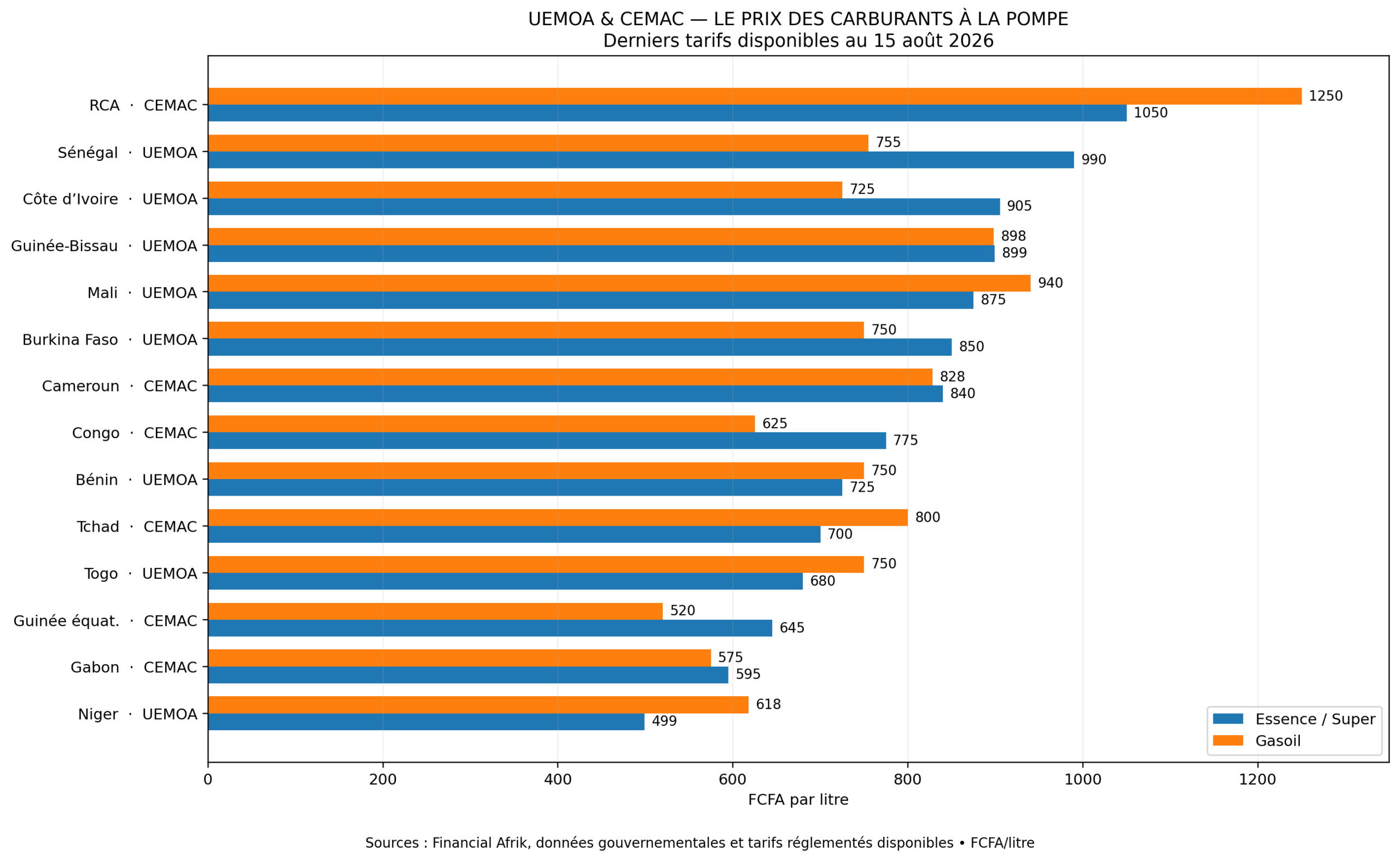
The new wave of fuel price increases in Francophone Africa does not affect UEMOA and CEMAC uniformly. Behind the same external shock – the rise in oil prices and supply costs following tensions around the Strait of Hormuz – are increasingly difficult budgetary trade-offs. Because between the international price of petroleum products and the price actually paid at the pump, someone has to settle the difference. When it’s not the motorist, it’s usually the state, through direct or implicit subsidies.
This bill is precisely what explains the increases observed in 2026. Fuel subsidies prevent, totally or partially, the increase in the actual supply cost from being passed on to the consumer. In the short term, the system protects purchasing power and limits inflation. But when oil prices increase sustainably, each liter sold at an administered price can become an additional burden on public finances.
UEMOA: the budgetary dam begins to give way
In UEMOA, the phenomenon has been particularly visible since spring 2026. Several states first absorbed part of the shock before making adjustments.
Senegal provides the most recent illustration. As of August 15, 2026, the price of super gasoline increased from 920 to 990 CFA francs per liter, an increase of 70 CFA francs or 7.6%, while diesel increased from 680 to 755 CFA francs, an additional 75 CFA francs or about 11%.
But the essential information lies behind these numbers: the Senegalese state indicates that it has already spent more than 245 billion CFA francs since the beginning of 2026 to support fuel prices. Maintaining the old tariffs meant continuing to burden the budget with an increasing share of the oil shock.
Burkina Faso faces the same equation. According to figures released by the authorities, the diesel subsidy alone would have amounted to about 60 billion CFA francs in the first six months of 2026. The increase in diesel prices therefore reduces a public expenditure that becomes particularly heavy when international prices rise.
Mali has chosen a much more brutal adjustment: gasoline has increased from 775 to 875 CFA francs, nearly 13%, while diesel has soared from 725 to 940 CFA francs, nearly 30%. Ivory Coast has followed a more gradual trajectory, raising the price of super to 905 CFA francs and diesel to 725 CFA francs on August 1.
Behind these different strategies is the same trade-off: subsidizing means transferring the increase from the pump to the state budget; raising the pump price means transferring part of this bill back to the consumer.
CEMAC: the Cameroonian precedent shows the scale of the bill
CEMAC probably provides the most spectacular example of the cost of a prolonged fuel support policy.
In Cameroon, the cost of fuel subsidies had reached exceptional levels during the previous energy shock. The IMF estimates the expenditure at about 900 billion CFA francs in 2022, or 3.2% of GDP, while some broader estimates of the subsidy cost exceeded 1,000 billion CFA francs.
In other words, stabilizing the pump price had become a real macroeconomic expense.
The successive increases decided in February 2023 and then in February 2024 helped reduce this burden. For the sole increase in 2024, the IMF estimated the budgetary savings at about 190 billion CFA francs, or 0.6% of GDP.
The reform has profoundly changed the equation. The cost of the Cameroonian subsidy dropped from about 4% of GDP in 2022 to less than 1% in 2024. Before the new oil shock of 2026, the system had practically stopped generating an effective subsidy when international prices were low enough.
But the rise in oil prices linked to the crisis in the Middle East changes the situation again. The IMF now estimates that the increase in Cameroon’s oil revenues will be partly absorbed by the return of subsidies resulting from administered price regimes. This is the paradox of a producing country: an increase in oil improves its export revenues but can simultaneously increase the budgetary cost of maintaining cheap fuel on the domestic market.
Even Equatorial Guinea is starting to reduce the bill
Equatorial Guinea also illustrates this evolution. Authorities have committed to a gradual reduction of subsidies. The IMF estimated that a first increase of 75 CFA francs per liter would reduce the gap between the pump price and the market cost by about a third. The associated budgetary challenge is estimated at around 20 billion CFA francs.
Thus, even in a historically oil-based economy, the question is no longer just about how much fuel costs the consumer, but how much it costs the state to maintain a price below its economic cost.
The true price of a liter therefore includes two bills
The comparison between UEMOA and CEMAC reveals an essential element: the price displayed at the gas station does not necessarily represent the real economic cost of fuel.
A liter sold for 700 or 800 CFA francs can actually cost more to import, refine, transport, and distribute. The difference can be covered by the state, directly or through various compensation mechanisms.
There are therefore two bills: the visible one, paid by the motorist at the pump, and the less visible one, settled by the taxpayer through the state budget.
This is precisely why comparing only pump prices can be misleading. A country with relatively cheap fuel is not necessarily more competitive: it may simply allocate more public resources to maintain this price.
The IMF also emphasizes that energy subsidies have an opportunity cost: the funds mobilized cannot simultaneously finance infrastructure, health, education, or better-targeted social programs. The institution also points out that generalized subsidies often benefit households that consume the most fuel more than the poorest populations.
Diesel, a political and inflationary tipping point
Governments are nevertheless faced with an additional difficulty: abruptly removing the diesel subsidy can generate an inflationary shock.
Diesel is directly involved in road transport, logistics, agriculture, construction, industry, and sometimes autonomous power generation. An increase is therefore gradually transmitted throughout the chain:
oil → diesel → transport → wholesale prices → food → inflation.
The recent experience of CEMAC shows this. The IMF already noted that the gradual withdrawal of subsidies in Cameroon and the fuel increases in Congo and Chad had contributed to keeping transport inflation high in the region.
This is why governments generally proceed in stages. The problem is not only economic. It is eminently social and political.
Ormuz ultimately transforms a subsidy into potential debt
The shock related to the Strait of Hormuz acts as a revealer. When oil prices rise sharply, a government that refuses to adjust the pump price must accept a parallel increase in its compensation expenditure.
The longer the shock lasts, the more difficult the equation becomes to maintain.
The 245 billion CFA francs already mobilized in Senegal in 2026, the approximately 60 billion spent on diesel in Burkina Faso in six months, or the Cameroonian precedent of nearly 900 billion CFA francs in one year, show the extent of the problem.
The two monetary unions thus face the same dilemma, even if they do not approach it at the same pace: either make the oil shock immediately paid by the consumer or defer it by making it borne by public finances.

