



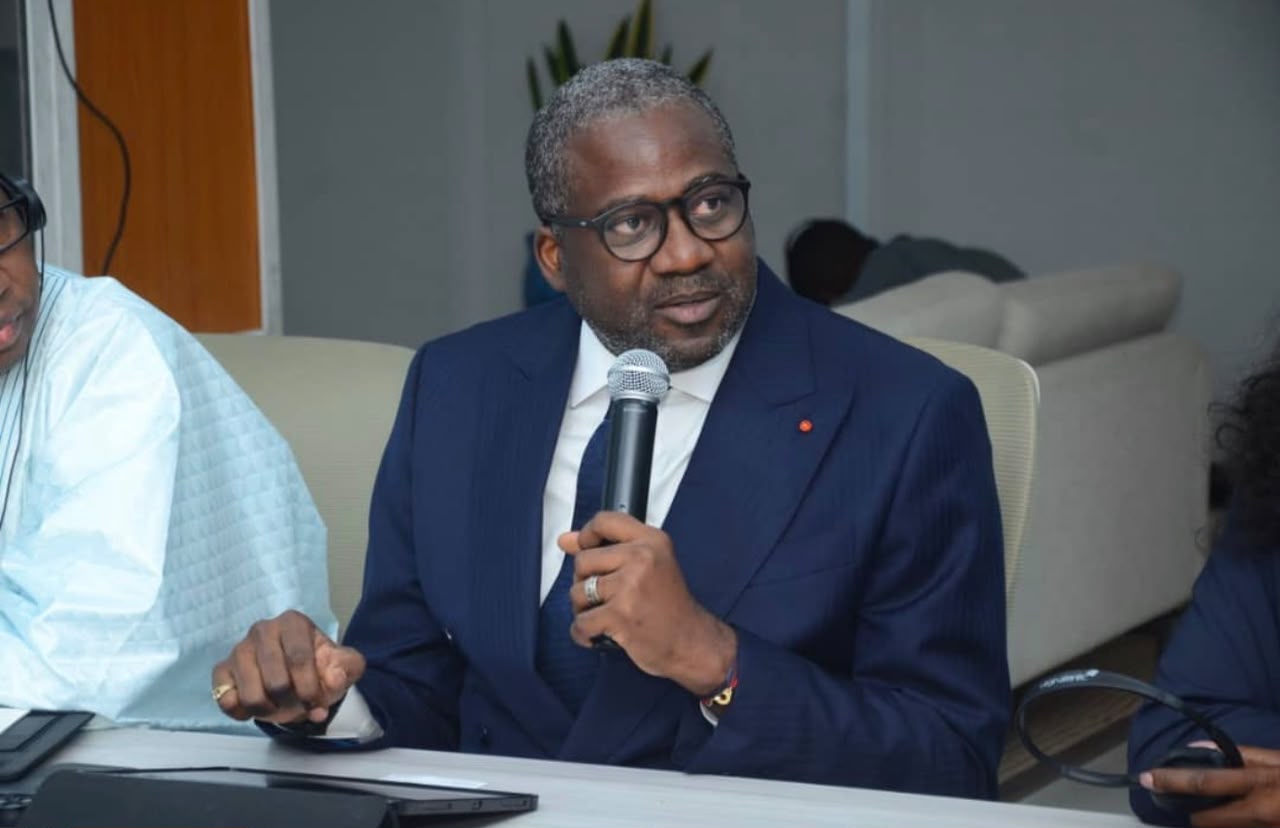
What twenty-eight years in telecoms, postal services, and payments have taught me about the Africa we are building
I remember the silence in the room.
I said this almost spontaneously, in front of an international audience that, once again, was measuring our African postal services against the giants of global logistics. “Don’t ask us to be Amazon here in Africa.” It was neither a confession of weakness nor a surrender. It was the opposite: the calm assertion of our own path. Since then, this phrase has stuck with me. It is quoted to me, challenged, demanded. Despite myself, it has become a signature. I would like to tell where it comes from. Because it does not come from intuition. It comes from a journey.
1. The first recruits
It all started in Abidjan, in the late 1990s. I had the rare opportunity to be among the very first recruits of a nascent mobile operator – Access Telecom, part of the Loteny group. We were not selling a product. We were selling an idea that no one had yet: that you could talk to someone wirelessly, without a line, without waiting three years for a connection.
We went to the markets. We explained prepaid recharging to traders who had never had a bank account. Unknowingly, we learned the fundamental lesson of my entire professional life: in Africa, a technology succeeds only if it aligns with an existing social usage. Not the other way around.
Then I moved to Aviso, an Internet service provider – the competitor across the street. The modem whistling, the first cybercafés, the first email addresses of a generation. I witnessed the birth of connectivity.
Then Orange Côte d’Ivoire, and the shift to another scale: millions of subscribers, extensive distribution networks, industrial rigor. You learn power there. You also learn its limits.
2. Bangui: learning the continent
Then came the expatriation to Central Africa, with Atlantique Telecom Group / Moov in the Central African Republic. I believe it was the most formative break in my career. When you leave Abidjan for Bangui, you discover that there is not one African market, but dozens of realities, commercial languages, relationships with money and trust. What works in Adjamé does not mechanically work in Bangui.
There, I unlearned the reflex of the imported model. Definitively.
3. Dubai, 2006: the lesson of push email
In 2006, I went to the United Arab Emirates as Africa Sales Director of i-mate PLC, a British firm based in Dubai, a supplier for operators, then at the forefront of instant messaging and push email – email that arrives in your pocket by itself, at a time when the term “smartphone” hardly existed.
I sold the future. For two years, I brought a technology several years ahead of its market to African operators. And there, I learned the most costly lesson of all: the most advanced technology in the world is worthless without the last mile of adoption. The best product always loses to the most adapted product. Always. It was in Dubai, between the glass towers and demonstration rooms, that my phrase began to take shape.
4. Money becomes data
Back in my country. I took over the Ivorian subsidiary of eTranzact, a specialist in banking solutions and electronic payment. New profession, same intuition. In our economies, payment is not primarily a financial flow: it is an act of trust. Ivorian and West African mobile money did not explode because it copied Visa. It exploded because it embraced the social fabric – the neighborhood kiosk, the known merchant, the word given. We had before our eyes the most striking African demonstration in the world: innovation through contextualization, not reproduction.
5. Public policy, then the Post
Then the State called me as Technical Advisor to the Minister in charge of ICT. We then moved to the other side of the mirror: where rules are written, where arbitration is made between private investment and the general interest, where we discover that digital is first and foremost a question of sovereignty.
Then came La Poste de Côte d’Ivoire. Deputy General Manager, then General Manager from 2016. Fifteen years in total, until 2026. Fifteen years at the bedside of an institution that many said was doomed. Mail was declining, parcels were increasing, e-commerce was arriving, Western models were presented to us as the only horizon.
We chose something else. We resumed our role as a local logistics provider. We transformed the counter into a point of access to public and financial services. We digitized without denying ourselves. We bet on what no global platform can ever buy: a physical network across the territory and a century-old trust capital.
This is the model that I went to defend at the presidency of the Universal Postal Union Board of Directors (2021-2025), on behalf of 192 countries. In front of Berne, in front of Dubai, in front of the postal world.
6. What it really means
“Don’t ask us to be Amazon” does not mean: we are less ambitious. It means: we do not have the same mission, so we cannot have the same model.
Amazon optimizes a transaction. We, we carry a universal service – to the last village, to the last citizen, even where it is not profitable. Amazon relies on standardized address, credit card, and continental scale. We operate in geographies without complete addressing, with largely unbanked populations, in economies where trust is built face to face. Asking us to be Amazon is asking us to lose a race we had no reason to run.
The alternative is not delay. The alternative is the African model: hyper-local, based on trust, frugal in capital, rich in human relationships. And, let’s say it, often more innovative in usage than what the Northern laboratories produce.
7. Today: regulating the future
Since 2026, I have been a member of the Regulatory Board of ARTCI, appointed by presidential decree for a term until 2032. I am the rapporteur for three priorities that almost too well summarize this journey: 5G and emerging technologies, digital platforms and OTTs, and postal modernization and universal service.
I also chair the Board of Directors of CPEAO/WAPCO, which brings together sixteen West African states. My obsession has not changed since the first day, in a market in Abidjan, with a recharge card in hand. How can we ensure that technology truly serves those for whom it is supposed to be made?
I remain passionately committed to innovation, artificial intelligence, and the infrastructure of tomorrow. But I deeply believe that technology is only valuable through the humanity it serves. This is what the Mandinka wisdom calls môgôya: accomplished humanity, this collective deposit that everyone receives and must transmit enhanced.
Twenty-six years in telecoms, Internet, payments, and postal services have led me to a simple conviction:
We don’t have to become someone else to succeed. We have to become fully ourselves.
And you, in your sector – what imported model have you stopped copying to finally build your own?
Isaac GNAMBA-YAO
Member of the ARTCI Regulatory Board
Chairman of the CPEAO/WAPCO Board of Directors (Cycle 2026-2028)
Former President of the Universal Postal Union Board of Directors (Cycle 2021-2025)

