



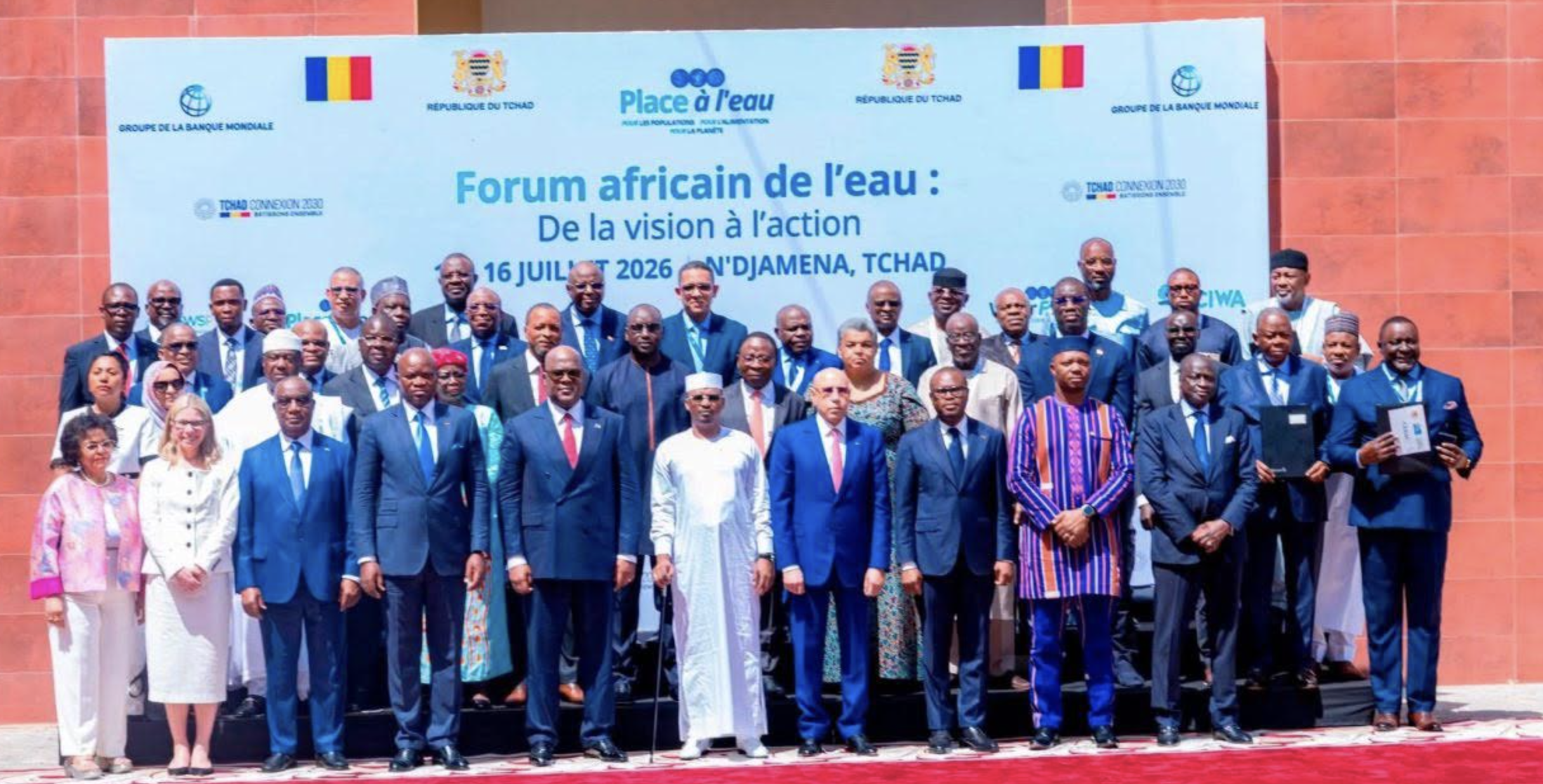
The African Water Forum, held in N’Djamena, brought to the forefront an instrument still relatively unknown to the general public: the “compact”. More than just a new financial facility, this mechanism aims to change the way African states plan, coordinate, and finance their water policies. Chad is leading the way with a roadmap estimated at $3.8 billion over five years.
On July 16, 2026, the African Water Forum in N’Djamena concluded with the highlighting of a mechanism that has been relatively invisible in African public debate: the “water compact”. Co-organized by the Chadian government and the World Bank Group, the event brought together representatives from 45 countries around a persistent paradox: Africa has significant water resources, but hundreds of millions of Africans still do not have safe and sustainable access to water. On this occasion, Chad unveiled its own compact, valued at $3.8 billion, with an initial financing of $160 million signed in N’Djamena.
From isolated projects to a national roadmap
The change lies less in the emergence of a new source of financing than in the way existing resources are mobilized and organized. In concrete terms, a compact is a roadmap developed by a country with its financial and technical partners. It establishes a diagnosis of the water sector, identifies the reforms to be carried out, and defines a precise, quantified, and time-programmed financing trajectory. It does not constitute a financing agreement in itself. Instead, it serves as a common reference framework, integrated into national plans and budgets, around which government financing, multilateral development banks, and other partners can then be coordinated.
The logic breaks with an approach long dominated by a succession of projects negotiated separately with different donors: water supply here, drilling there, sanitation or irrigation elsewhere. With the compact, the ambition is to start from a consolidated national strategy and then align the financing with it.
The principle was not born in N’Djamena. Around fifteen African countries had already embarked on a similar process. But Water Forward, a global initiative launched by the World Bank in April 2026, aims to give it a new dimension by bringing together the resources of ten multilateral development banks around a goal: to help secure access to water for one billion people by 2030.
National compacts thus become one of the main instruments allowing states to organize their needs, commitments, and sought-after financing.
Chad’s $3.8 billion gamble
For Chad, the stakes are considerable. Until now, a large part of the sector’s financing relied on projects negotiated on a case-by-case basis with development partners, without necessarily fitting into a consolidated and multi-year national financial trajectory. The compact seeks to reverse this logic. The country now estimates its needs at $3.8 billion over five years. Above all, the Chadian government commits to financing 20% of the effort itself, approximately 115 billion CFA francs per year. This domestic component is probably one of the most structuring dimensions of the mechanism. It means that the mobilization of international donors must be accompanied by an identifiable and measurable national budgetary effort.
In return, financial partners are invited to align their interventions more closely with this common trajectory rather than multiplying scattered initiatives. The initial commitments already provide an indication of this new financial architecture.
A financing of $160 million is intended for the Water Security and Resilience Support Project in Chad. The stated ambition is notably to bring the country closer to universal access to safe drinking water by 2030, compared to an access rate estimated at around 65% today.
In addition to this financing, $50 million is allocated to a regional program for pastoral communities in the Sahel. But funding new infrastructure will not be enough.
Chadian Minister of Finance, Tahir Hamid Nguilin, particularly drew attention to a recurring weakness in African water policies: the maintenance of existing equipment. A borehole built and then abandoned due to lack of maintenance represents not only a lost public asset but also an unfulfilled promise to the populations that depend on it.
This issue could become one of the true tests of the compact: succeeding in financing not only new, politically more visible infrastructures but also their operation, maintenance, and renewal.
The N’Djamena Declaration as a political framework
The Chadian compact is part of a broader continental ambition, materialized by the N’Djamena Declaration, presented as one of the main political achievements of the Forum. Signed by more than 15 countries and five regional organizations, the text organizes commitments around four priorities: ensuring access to water for populations, strengthening food system security, protecting water resources and ecosystems, and making water a driver of job creation and urban resilience.
The challenge is to move water policy from a succession of announcements and projects to quantified, monitored, and measurable commitments. Chadian President Mahamat Idriss Déby Itno placed this ambition in a geography that transcends national borders: that of the Lake Chad basin, on which around 30 million people in five countries depend.
In a space facing the scarcity of certain resources, droughts, floods, and high demographic pressure simultaneously, N’Djamena advocates for the creation of regional platforms for sharing hydrological data to better anticipate crises.
Is water financing really changing its model?
This is probably the central question left by the N’Djamena Forum. The compact alone does not create the billions of dollars needed to fill the continent’s hydraulic infrastructure gap. Nor does it guarantee that the announced commitments will be fully disbursed.
Its interest lies elsewhere: transforming an accumulation of projects into an investment strategy, imposing a multi-year visibility of national needs and commitments, and asking donors to align with this programming.
For finance ministries, this approach also more clearly integrates water into the budgetary and macroeconomic equation. Access to water is no longer presented solely as a social or humanitarian issue but as an essential economic infrastructure for agriculture, urbanization, public health, industry, and climate resilience.
The real test will begin after N’Djamena: how much of the $3.8 billion planned by the Chadian compact will actually be mobilized? At what pace? And what proportion of national commitments will be effectively included and executed in public budgets?
A first meeting is already scheduled: the United Nations Water Conference in December 2026. The commitments made in N’Djamena will then need to move from the realm of declarations to the much more demanding realm of disbursements, completed infrastructure, and measurable results for the populations.

