



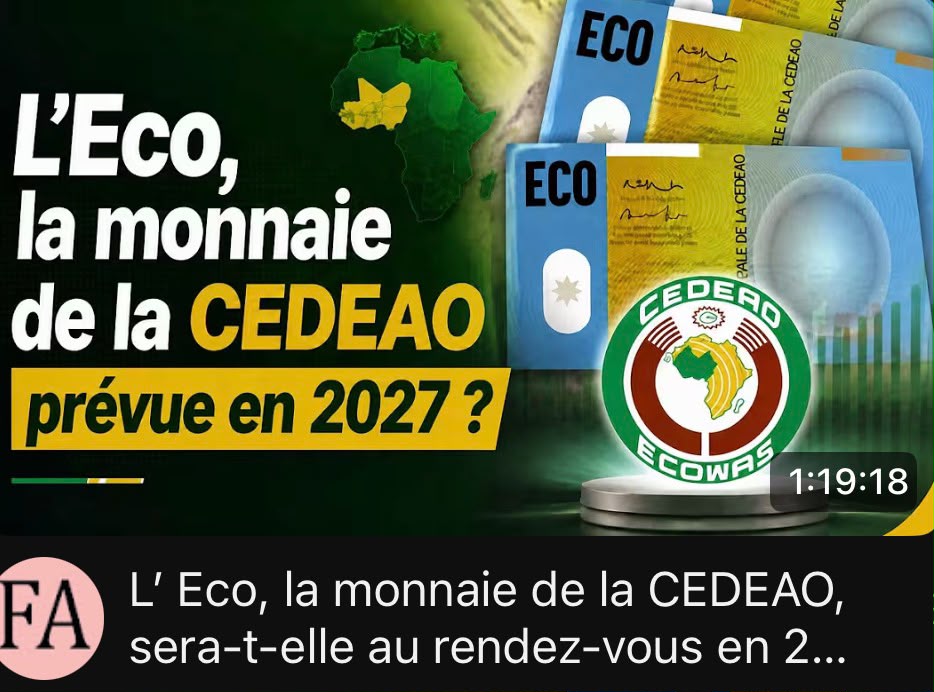
After several delays, the Economic Community of West African States (ECOWAS) intends to relaunch its ambitious project of a single currency. Gathered on July 19 in Freetown, Sierra Leone, during the 69th ordinary session of the Conference of Heads of State and Government, West African leaders reaffirmed their willingness to launch the ECO starting from 2027. This time, the approach is intended to be gradual.
Countries that meet the macroeconomic convergence criteria would be prioritized for joining the monetary union, while others would be supported to gradually join the process. However, is this new schedule truly credible? Are the economic, political, and institutional conditions currently in place? Are the member states ready to abandon their national currencies in favor of a common currency?
To try to provide some answers, we have three guests with complementary perspectives.
First, Demba Moussa Dembélé, economist, researcher, director of the African Forum of Alternatives, and specialist in economic sovereignty, regional integration, and monetary policies. Co-author of the reference book “Getting Africa out of monetary servitude: Who benefits from the CFA franc?”, he believes that the technical, economic, and political conditions are not met for the launch of the ECO in 2027. According to him, this deadline still appears very challenging to meet, and several areas of uncertainty remain.
Alongside him, Rivolala Ratsimandresy, CEO and founder of RDE – The Entrepreneurs’ Meeting, shares the private sector’s point of view. He explains to what extent a single currency could facilitate trade, strengthen companies’ competitiveness, or, conversely, raise new concerns.
Finally, Adama Wade, publisher of Financial Afrik, provides a more balanced analysis of the stakes. While acknowledging the numerous challenges that remain, he will review the progress made by ECOWAS and the prospects offered by a progressive implementation of the ECO.
It should be noted that ECOWAS currently consists of twelve states since the withdrawal of the three states of the Sahel Alliance. Five of them – Benin, Côte d’Ivoire, Guinea-Bissau, Senegal, and Togo – already share a common currency, the CFA franc, within the UEMOA, of which Mali, Burkina Faso, and Niger are also members. The other seven have their own currency, namely the escudo in Cape Verde, the dalasi in The Gambia, the cedi in Ghana, the Guinean franc in Guinea, the Liberian dollar in Liberia, the naira in Nigeria, and the leone in Sierra Leone. One of the main challenges of the ECO will be precisely to bring together these economies with sometimes very different structures and monetary policies within the same monetary union.

