



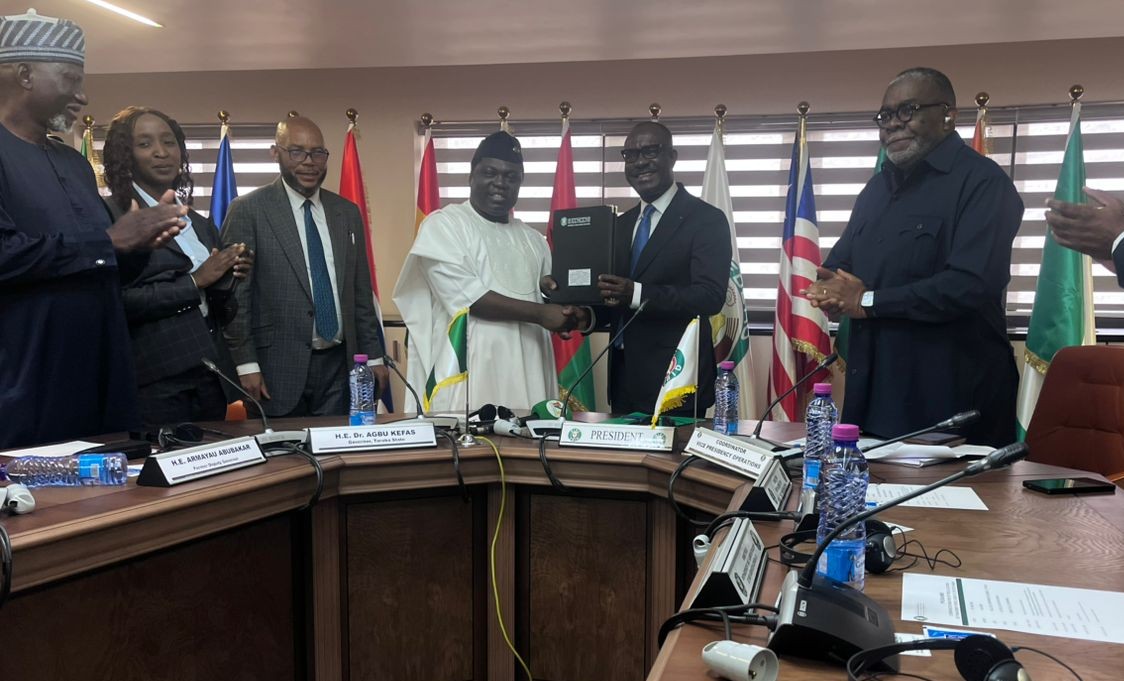
The ECOWAS Investment and Development Bank (BIDC) and the government of the Nigerian state of Taraba signed three loan agreements totaling $268 million on June 26, 2026. The goal is to support industrialization, strengthen rice production, and develop the energy supply through a 50 MW solar power plant.
Signed at the regional institution’s headquarters in Lomé, Togo, the agreements commit the BIDC and the Taraba State authorities to an investment program focusing on three strategic areas: industry, agriculture, and energy. The ceremony was attended by the President of BIDC, Dr. George Agyekum Donkor, and the Executive Governor of Taraba State, Dr. Agbu Kefas, along with a high-level delegation.
The first part of the financing, amounting to $91.23 million, is allocated to the first phase of an integrated industrial park. This project, presented as a multi-cluster logistics and manufacturing hub, aims to attract private investments, stimulate local value creation, and promote employment in this northeastern state of Nigeria.
The second agreement involves $79.21 million for the development of 10,000 hectares of irrigated rice fields. The program also includes the establishment of modern processing and milling units, with the stated ambition of enhancing food security and reducing dependence on rice imports.
The third and largest financing, totaling $98.19 million, will be used to build a 50 MW photovoltaic solar power plant in Jalingo. This infrastructure, according to BIDC, aims to improve the reliability of the electrical grid, expand access to clean energy, and support the industrial growth of the state.
The regional bank emphasizes that these projects are part of its GRO strategy, focused on growth, resilience, and optimization, aimed at promoting high-impact economic, social, and environmental investments in West Africa.
In addition, the BIDC President highlighted that this intervention aligns with the bank’s mission as the financial development arm of ECOWAS. In a context where states and communities are seeking to mobilize more resources to accelerate their modernization, the institution aims to position itself as a key partner for high-impact projects capable of stimulating growth, employment, and structural transformation of the sub-region’s economies.
For the Taraba authorities, this partnership marks a major step in the state’s economic transformation. The local government believes that this funding should lay the foundation for a new development model, based on the growth of industry, improved food security, and better access to reliable and sustainable energy. Governor of the state, Dr. Agbu Kefas, also hailed it as a “great moment” for his administration and the population.
Ultimately, the program’s promoters aim to make Taraba a leading industrial and agricultural hub in Nigeria, while supporting the transition to a lower-carbon economy.

